
This article was published in Scientific American’s former blog network and reflects the views of the author, not necessarily those of Scientific American
In September, a computer found the two largest known twin primes, weighing in at 388,342 digits apiece. Prime numbers are whole numbers that are only divisible by 1 and themselves (e.g. 2, 3, 11, and 19), and two prime numbers are called twins if they differ by only 2, like 3 and 5 or 11 and 13. I wrote about the discovery for Science News for Students.
The computer that found the numbers and Tom Greer, the person who owns the computer that found the numbers, were part of PrimeGrid, a massive distributed computing project that searches for new prime numbers. Earlier this year, I wrote about another prime unearthed by a massive computing project, the largest known prime number, weighing in at a beefy 22,338,618 digits. It was found by the Great Internet Mersenne Prime Search, or GIMPS.
Greer, an IT professional from San Marcos, Texas, first got interested in distributed computing projects as a way to test and compare different computer processors. The first project he contributed to was SETI@home, which searches for possible extraterrestrial signals in radio telescope data. He has been running PrimeGrid since 2010. “Over time, PrimeGrid has become my favorite of all of the volunteer computing projects that I have run,” he wrote in an email. “This is because PrimeGrid is well-run and reliable, and regularly reports concrete, understandable results.”
On supporting science journalism
If you're enjoying this article, consider supporting our award-winning journalism by subscribing. By purchasing a subscription you are helping to ensure the future of impactful stories about the discoveries and ideas shaping our world today.
PrimeGrid has one teensy advantage over SETI@home that automatically makes it more discovery-friendly: we know there are prime numbers to find. SETI@home, on the other hand, “has never found a signal from an extraterrestrial intelligence, and may never do so," says Greer. We don't even know if it's out there to find.
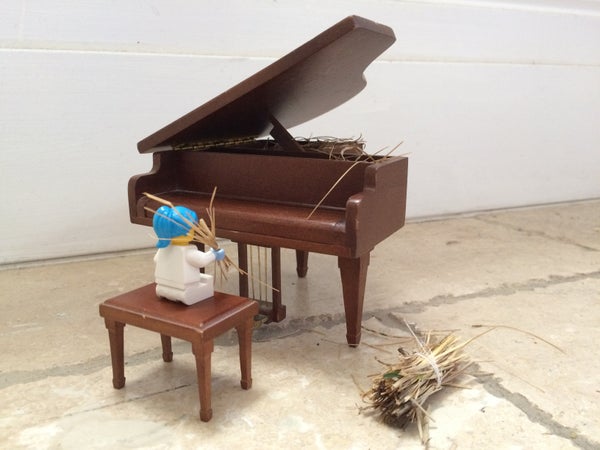
When I thought about PrimeGrid and SETI@Home, I was naturally reminded of mid-twentieth century avant-garde music, specifically La Monte Young’s 1960 Piano Piece for David Tudor #1:
Bring a bale of hay and a bucket of water onto the stage for the piano to eat and drink. The performer may then feed the piano or leave it to eat by itself. If the former, the piece is over after the piano has been fed. If the latter, it is over after the piano eats or decides not to.
You can watch performances of the piece, either performed on piano as originally composed or arranged for guitar, on YouTube.
Perhaps I am overly pessimistic (or optimistic, depending on how afraid we should be of extraterrestrials), but I think SETI@home is just like that piece. We don’t know whether, when, or how extraterrestrial life will make its presence known. It's very likely that even if it is out there, it is too far away from us for us ever to encounter or detect it. If it's not out there, then we're doing the equivalent of waiting for the piano to make a decision about its dinner. (My analogy is not meant to trivialize either SETI@home or La Monte Young's music. The search for meaning, either scientific or artistic, is important. Analyzing data and creating art are worthwhile, whether the piano eats or not.)
Logically my next thought is that if that La Monte Young piano piece is the SETI@home of 20th century music, what’s the PrimeGrid? I nominate one of the Knee Plays from Einstein on the Beach by Philip Glass. PrimeGrid searches for many different types of primes, so its discoveries trickle out at a fairly steady pace.
GIMPS, the program responsible for finding the very largest known primes to date, should probably be As Slow As Possible, a John Cage composition currently in year 16 of a 639-year performance in Halberstadt, Germany. Every few years, GIMPS announces a new prime and Organ2/ASLSP has a chord change.
Do you have a favorite distributed computing project? What twentieth-century avant-garde music does it most resemble?

Performer Minnie Phyg recommends protective goggles for any musical endeavors (or distributed computing projects) that involve farm equipment. Credit: Evelyn Lamb