
This article was published in Scientific American’s former blog network and reflects the views of the author, not necessarily those of Scientific American
Mathematics is the realm of perfection. (Or so we mathematicians like to tell ourselves.) Proofs are monuments to pure logic, and because the objects we prove things about are abstractions that exist only in our minds, they obey the rules of logic perfectly.
Perfection can be intoxicating. We calculate π to trillions of digits, never mind the fact that a few dozen suffice to compute any length in the known universe to within the width of an atom. “Good enough” is never good enough.
A funny thing happens when mathematics moves to the real world: it works. Granted, it’s not quite as perfect — the real world isn’t as well-behaved as those purely mathematical objects in our minds, but it’s pretty good. Newton's law of gravitation is mathematically very simple but matches the real world incredibly accurately, at least at human scales. Einstein's theory of general relativity was built on a scaffold of mathematics that existed to analyze abstract spaces but turned out to be useful for describing large-scale space and time. The real world seems to approximate abstract mathematics remarkably well. Physicist and mathematician Eugene Wigner described this phenomenon in a famous lecture, subsequently published as a paper, as “the unreasonable effectiveness of mathematics in the natural sciences.”
On supporting science journalism
If you're enjoying this article, consider supporting our award-winning journalism by subscribing. By purchasing a subscription you are helping to ensure the future of impactful stories about the discoveries and ideas shaping our world today.
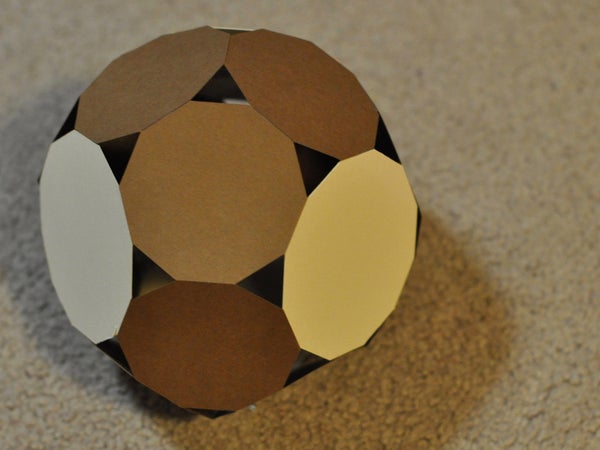
In an article in Nautilus, I wrote about the funhouse mirror image of this phenomenon: the mathematical near-miss. I was inspired to write about near-misses by University of Waterloo computer scientist Craig Kaplan and the near-miss Johnson solid he wrote about in February 2016. The figure he made from cardboard and tape looks perfect, but there are no equilateral triangles or regular decagons or dodecagons to be found. His article inspired me (and others) to find more examples of near-misses in mathematics: from Renaissance-era near-miss polygons to equal temperament in music to the colorfully named mathematical theory called "monstrous moonshine." Writing the article was challenging because there's no objective criterion that qualifies something to be a near-miss. Sometimes I felt like I was trying to hold onto a fist full of sand. In the end, I came to this understanding of mathematical near-misses.
Near misses live in the murky boundary between idealistic, unyielding mathematics and our indulgent, practical senses. They invert the logic of approximation. Normally the real world is an imperfect shadow of the Platonic realm. The perfection of the underlying mathematics is lost under realizable conditions. But with near misses, the real world is the perfect shadow of an imperfect realm. An approximation is “a not-right estimate of a right answer,” Kaplan says, whereas “a near-miss is an exact representation of an almost-right answer.”
Read the full article at Nautilus.