
This article was published in Scientific American’s former blog network and reflects the views of the author, not necessarily those of Scientific American
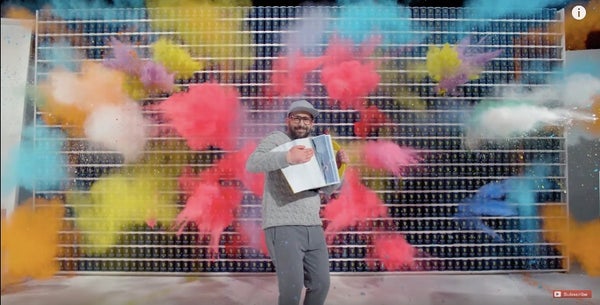
If you teach math to middle- or high-schoolers, I hope you’ll share this video with your class.
Now ask them how When I saw the video, my first thought was how much number-crunching must have gone into the production, and indeed OK Go and the engineers they worked with corroborate that. In a page about the making of the video (warning: the page contains language some people find objectionable), lead singer Damian Kulash Jr writes, “The whole point of the video is to explore a time scale that we can’t normally experience, but because it’s so inaccessible to us, our tools for dealing with it are indirect. The only way we can really communicate with that realm is through math.”
On supporting science journalism
If you're enjoying this article, consider supporting our award-winning journalism by subscribing. By purchasing a subscription you are helping to ensure the future of impactful stories about the discoveries and ideas shaping our world today.
They also made a short behind-the-scenes video talking about the difficulty of getting the math just right.
I love the fact that the combination of math and precise engineering allows us to access a timescale that we can’t perceive on our own. That idea reminds me of a sentence in Jordan Ellenberg’s book How Not to Be Wrong, where he describes math as “the extension of common sense by other means.” Here, math (along with its pals physics and engineering) is the extension of our normal perception by other means.
I haven’t spent much time working with middle- and high-schoolers, so you should take my pedagogical advice with a grain of salt, but I can imagine videos like these leading to a lot of fun discussions about math and motivating students to crunch the numbers to create their own smaller-scale projects, perhaps with slightly less paint flying around. (Or slightly more, depending on whether you have good access to sprinklers.)
This is not the first time OK Go’s videos have explored or exploited mathematics, science, and engineering. In fact, I’d go so far as to say they are the leading pop group for incorporating STEM topics in their music videos, thought it is admittedly a niche market. Here are some of the other ones they have that might be good starting points for class discussions or activities.
Upside Down and Inside Out: angular momentum, elastic collisions
Needing/Getting: acoustics, engineering
I Won’t Let You Down: symmetry, patterns
This Too Shall Pass: Rube Goldberg machines
The Writing’s On the Wall: reflections, optical illusions
Last Leaf: the Maillard reaction. (OK, that one might be a bit of a stretch.)
If you’re a teacher, let me know what you think about including these videos in your classroom. If you’ve used videos like this as the basis for a lesson, what did you do, and how did it go?