
This article was published in Scientific American’s former blog network and reflects the views of the author, not necessarily those of Scientific American
On our latest episode of our podcast My Favorite Theorem, my cohost Kevin Knudson and I talked with University of Arkansas mathematician and artist Edmund Harriss. I was lucky enough to be in the studio with him because we were both part of the Illustrating Mathematics semester program at the Institute for Computational and Experimental Research in Mathematics (ICERM) last fall.
You can listen to the episode here or at kpknudson.com, where there is also a transcript.
On supporting science journalism
If you're enjoying this article, consider supporting our award-winning journalism by subscribing. By purchasing a subscription you are helping to ensure the future of impactful stories about the discoveries and ideas shaping our world today.
Harriss chose to talk about the Gauss-Bonnet theorem, which relates the topology of a two-dimensional surface to its geometry. The total curvature of a surface—how much it bends and in what directions—is related to a few large-scale properties (topology): whether it is orientable and how many holes it has.
With this episode, the Gauss-Bonnet theorem makes its second appearance on My Favorite Theorem. Our guest Jeanne Clelland picked for her episode almost two years ago. This is the third time we’ve had a repeated theorem, and something I love about our guests and the show is that even when the underlying mathematics is the same, different people talk about their theorems completely differently, and the episodes usually end up having very different flavors.
To overgeneralize a bit, our former guest Clelland took a bird’s-eye view of the theorem and the surfaces to which it applies, and Harriss talked about the theorem in terms of the “turning” (also known as holonomy if you want to be fancy) around loops on the surface and about what it means for real, physical objects in the world. Both are great ways to view and appreciate a wonderful theorem!
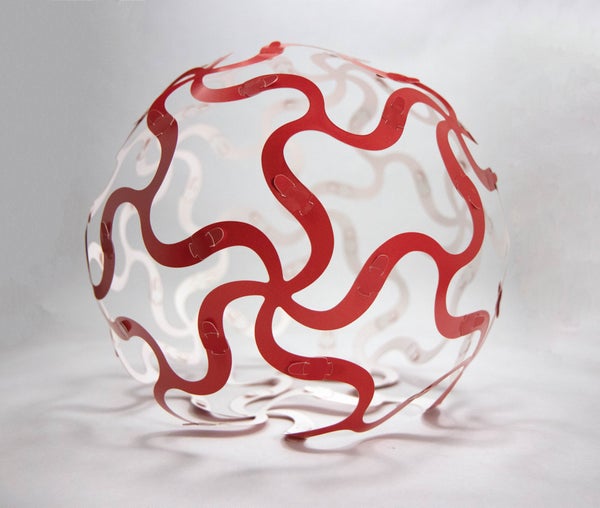
Harriss’s point of view fits perfectly into one of his recent artistic/making endeavors, Curvahedra. These are construction toys that you can use to make different surfaces. Harriss has used them to help kids explore the mathematics of surfaces and discover versions of the Gauss-Bonnet theorem for themselves. You can connect the pieces in different ways that give different geometries and topologies to the resulting surfaces.
In each episode of the podcast, we invite our guest to pair their theorem with something. While donuts are a classic pairing for anything topology-related, Harris went a little more sophisticated with a pear-walnut salad. Get all the details on the episode, ideally while eating a fancy salad.
You can find Harriss on Twitter and his blog. With Alex Bellos, he has put together two mathematics-themed coloring books. Learn more about Curvahedra here.