

This article was published in Scientific American’s former blog network and reflects the views of the author, not necessarily those of Scientific American
This morning, Émilie Du Châtelet stopped me in my tracks. I’ve been reading Inventing the Mathematician by Sara N. Hottinger. The book, which I’m sure I’ll write more about after reading and inwardly digesting it, is about race, gender, and mathematics. Today, I was reading a chapter about how portraiture influences our conception of mathematics and mathematicians.
I’m sure I’ve seen pictures of Du Châtelet before. She did research in physics and translated Newton’s Principia into French, which helped his ideas gain acceptance in France. She is one of the first women whose contributions to math are recorded, but like Sophie Germain, Emmy Noether, Sofya Kovalevskaya, and our other foremothers, she was not one of the first women with significant mathematical talent. I know I’ve read about her in the past. But this time, I really looked at her.
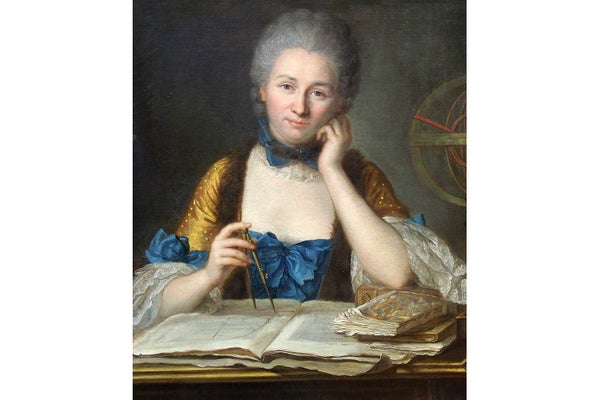
She is wearing a flouncy dress and a shiny gold jacket, or perhaps shawl or cape, trimmed with fur. Lace and bows abound, and, after the fashion of the time, her dress is low-cut in the front. Her desk is covered with books and she is using a compass. She is looking right at the viewer. Hottinger writes, “it is clear that her work has just been interrupted by the viewer. The soft smile, however, indicates that she is pleased to see the viewer, and the position of the head, learning on the left hand, communicates both a sense of youth and that she is working on something that gives her pleasure…”
On supporting science journalism
If you're enjoying this article, consider supporting our award-winning journalism by subscribing. By purchasing a subscription you are helping to ensure the future of impactful stories about the discoveries and ideas shaping our world today.
No mathematicians I know—not even Cedric Villani, with his flamboyant cravats and brooches—dress quite as extravagantly, but the picture is familiar. She looks intelligent, kind, and lost in thought, just like many women I know who do math today. It’s the face of a mathematician when a student knocks on her door with a question about homework or when a colleague asks if she wants to go get a coffee.
I was startled to see this portrait of a woman doing math hundreds of years ago, but I shouldn’t have had to feel that way. Our culture still treats women in math as exotic, even though we’ve been around for a long time. In her book, Hottinger argues that it’s no coincidence that Newton’s portrait is seared into my brain but Du Châtelet’s isn’t. Du Châtelet’s soft, smiling face isn’t in most math history books, even when her story is. It’s not the face our culture expects a mathematician to have.
I needed to see that face today. Thanks, Émilie, for taking a moment out of your day to help me feel that human connection. I can see you’re busy right now. Maybe we can get that coffee next week.
For more information on Émilie Du Châtelet, check out her biography on the Agnes Scott College women in math site or these articles: This Month in Physics History, APS News Émilie Du Châtelet, the Woman Science Forgot by Robyn Arianhrod (subscription required) A feminist Newtonian by Thony Christie