
This article was published in Scientific American’s former blog network and reflects the views of the author, not necessarily those of Scientific American
In July, Rio de Janeiro hosted the first World Meeting for Women in Mathematics, or (WM)2, as a satellite conference to the International Congress of Mathematicians. As part of the event, they screened the first part of a short documentary called Journeys of Women in Mathematics. The full version is embedded below.
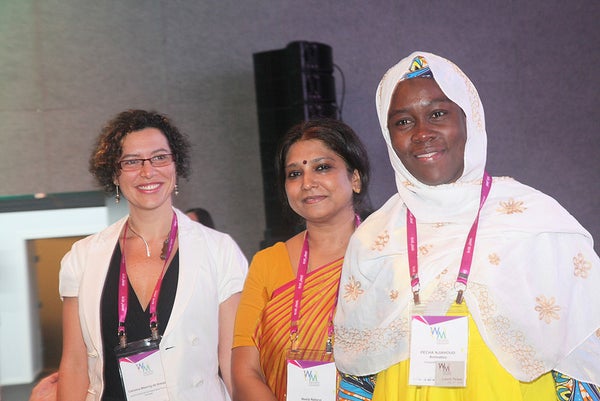
The film, about 20 minutes in its finished length, starts with profiles of three women in mathematics. Neela Nataraj is the chair of the mathematics department at the Indian Institute of Technology Bombay. Aminatou Pecha Nijahouo is a researcher in pairing-based cryptography at Maroua University in Yaounde, Cameroon. Carolina Araujo is a mathematician at the Institute of Pure and Applied Mathematics (IMPA) in Rio de Janeiro, Brazil. All three talk about their paths in mathematics and the challenges they faced as women in their fields. After profiling Nataraj, Nijahouo, and Araujo, the film goes to (WM)2 to talk to women mathematicians from Latin America about their work and their hopes for the future of women in the discipline.
On supporting science journalism
If you're enjoying this article, consider supporting our award-winning journalism by subscribing. By purchasing a subscription you are helping to ensure the future of impactful stories about the discoveries and ideas shaping our world today.
I have a complicated relationship with stories of women in math. I’ve seen enough “rah-rah women in math” media to last a lifetime. And many stories of historical women mathematicians are more sad and frustrating to me than they are inspirational. But this film was refreshing because it pointed out how limited my mental catalog of stories of women in math is. The women mathematicians whose stories I know were or are usually affluent, often white, and almost always educated and working in the U.S. or Europe. I was grateful to be reminded that those are not the only stories worth telling. All three women tell their stories as well-rounded people, not just mathematicians. They have families to care for, and they facilitate community-building for women in mathematics in their countries. I loved listening to their stories.
But stories are not enough. I am reminded of physicist Chanda Prescod-Weinstein’s essay “Diversity is a dangerous set-up:” awareness and diversity are not enough. The goal is equity, a world in which women and minoritized people do not have to fight to get seats at the table and where they are treated as well as their white men colleagues when they get there. Beyond the stories of women in math, Initiatives like the organization of Cameroonian women in mathematics that Pecha Nijahouo helped start and projects supported by the Committee for Women in Mathematics can help ensure that the work does not end with awareness.
Watch and listen to the stories of these remarkable women in mathematics. And then think about how to move beyond stories.