
This article was published in Scientific American’s former blog network and reflects the views of the author, not necessarily those of Scientific American
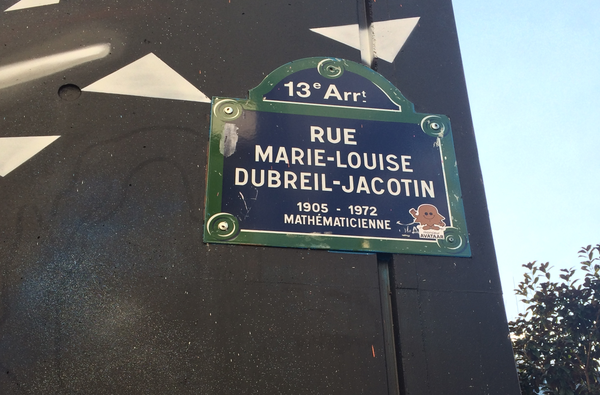
Earlier this month I mentioned that I had visited Rue Sophie Germain, the only street in Paris named after a woman mathematician. I was wrong! Just a few days after writing that post, I was taking a walk and stopped to photograph some street art when I noticed the word mathématicienne on a street sign. Surprised, I saw that I was at Rue Marie-Louise Dubreil-Jacotin, another Paris street named for a woman mathematician. Sophie is not alone!
I have been basing my Paris mathematician street tourism on this helpful page from the MacTutor website. (Incidentally, MacTutor is one of my favorite math history resources. Check it out!) Rue Marie-Louise Dubreil-Jacotin was not on their Paris streets list yet, and that’s why I didn’t know about it. In their defense, the street was only named in 2008, so it may not even have existed when they first put it together. (I sent the MacTutor site authors a note about it, and they've since updated the list.)
I was excited to see another street named for a mathématicienne, but I must confess I had never heard of Marie-Louise Dubreil-Jacotin until I stumbled on her street. Dubreil-Jacotin (1905-1972) was the first woman mathematician to be appointed to a full professorship in France and the second woman to earn a doctorate in pure mathematics in France. She placed second in the exam to get into the École Normale Supérieure, but when the official rankings came out, she was listed behind 20 men. Through a connection with a friend, she was able to attend anyway, a few months late.
On supporting science journalism
If you're enjoying this article, consider supporting our award-winning journalism by subscribing. By purchasing a subscription you are helping to ensure the future of impactful stories about the discoveries and ideas shaping our world today.
She graduated from the ENS in 1929 and married her classmate Paul Dubreil in 1930. She traveled with him to Göttingen, where she met Emmy Noether and got interested in algebra. She focused on fluid mechanics in her thesis research, though, and earned her doctorate in 1934. Her husband had an appointment at Nancy, to the east of Paris, for the first few years after their marriage, and she, not being allowed to get a position at the same university, worked in Rennes, Poitiers, and Lyon to the west and south. (How they made it work in the days before the fast TGV trains and Skype, especially considering they had a child, is hard for me to understand.) She was made a full professor at Poitiers in 1943, and eventually she and Paul were both able to get jobs in Paris. In addition to her research on fluid mechanics and algebra, she wrote a textbook and wrote about women in mathematics.
To learn more about Marie-Louise Dubreil-Jacotin, check out her MacTutor biography or the article “Women mathematicians in France in the mid-twentieth century” by Yvette Kosmann-Schwarzbach. The MacTutor article also has a translation of a remembrance written for the École Normale Supérieure by her classmate and colleague Jean Leray in 1974, not long after Dubreil-Jacotin’s death in 1972.
So not one but two streets in Paris are named for women mathematicians. If you’re willing to expand your range ever so slightly beyond the Boulevard Périphérique, you can even increase that number by 50 percent: Rue Emmy Noether is only a few meters from Paris in Saint-Ouen. I have not made my pilgrimage out there yet, but I plan to soon.
Wrong in Public is a (thankfully very occasional) series in which I correct errors from previous posts. Read the previous post in this series: Wrong in Public: The Four-Color Theorem Edition