

This article was published in Scientific American’s former blog network and reflects the views of the author, not necessarily those of Scientific American
After spending the last few months watching bright red-orange lava fountain out of Kilauea's Lower East Rift zone and promptly turn into dark black basalt rock, you may be somewhat astonished to learn how recently it was that scientists were bitterly divided over the origin of basalt. But there was quite a bit of debate over hundreds of years. Plenty of reputable men of science even believed, passionately, that basalt is deposited by water. And we're not talking hot water, either!
This is the very odd history explored in Haraldur Sigurdsson's fascinating Melting the Earth: The History of Ideas on Volcanic Eruptions.
Unfortunately, the book heavily focuses on European male naturalists and scientists. I'm sure there were plenty of women who had opinions on the subject, and indigenous people on volcanic islands and such who could have advised the Europeans on the precise origin of this common black rock. It would have been nice to hear from scientists in other civilizations on the matter. And I could have done with a lot more focus on Iceland. But these drawbacks don't detract too much from the book. So don't let them stop you from picking it up and thoroughly enjoying it.
On supporting science journalism
If you're enjoying this article, consider supporting our award-winning journalism by subscribing. By purchasing a subscription you are helping to ensure the future of impactful stories about the discoveries and ideas shaping our world today.
After a brief survey of volcano myths from around the world, Sigurdsson settles into ancient Greece and environs. He describes the tectonic setting for a fascinating chapter before getting down to what ancients believed caused all this burning and exploding: wind. Well, that and underground fires. Many ancient thinkers, it turns out, figured that a combo of winds and combustible materials in passages underground led to volcanic eruptions. They definitely noticed the correlation between increasing earthquakes followed by mountains going boom. And their ideas on how and why these happened persisted for well over a thousand years in some scholarly circles.
Then we come to the Christian era, when volcanoes could be easily explained away as "chimneys of Hell," with a brief stop by alchemy, in which the ancient Greek ideas of underground winds and fires are reprised. These ideas persist into the Renaissance, when folks in Italy get to watch a volcano being born (Monte Nuovo). Now we see people beginning to perform practical experiments, like melting volcanic rocks to see what would happen, and poking active lava flows with sticks to test viscosity. In addition to learned folks trying to figure out what makes volcanoes tick, we get to see some of the impacts of Etna and Vesuvius on Renaissance citizens, with plenty of very excellent contemporary illustrations of eruptions.
By the Enlightenment, people were starting to figure that ordinary combustibles like bitumen, coal, and sulfur weren't powerful enough to fuel volcanoes, so we get a very neat chapter on pre-radioactive theories such as Earth maybe being a cooling star.
Afterwards, we get to the real silliness: Neptunists. Yes, my friends, despite thousands of years of people witnessing molten rock emerge from volcanoes and cool into basalt, there was still a respectable group of scientists in the Age of Reason who decided basalt is sedimentary. Sigurdsson explores their arguments in enough depth to help us befuddled modern folk understand how this notion was ever taken seriously. But, of course, the Plutonists win, everybody learns where basalt actually comes from, and then it's a matter of the first field volcanologists figuring out how basalt works and how on earth rock melts in the first place.
Chemists get in on the mystery, petrology is born, and the true secret behind melted earth is discovered. By the end, we've discovered radioactivity, learned it's not just heat but pressure that's important when it comes to melting magma, determined the structure of the interior of the earth, and solved many volcanic mysteries. It's an incredible earth science ride.
There's probably no better book that combines the history of volcanology with a solid description of how volcanoes work. Melting the Earth is well worth any volcano-lover's time.
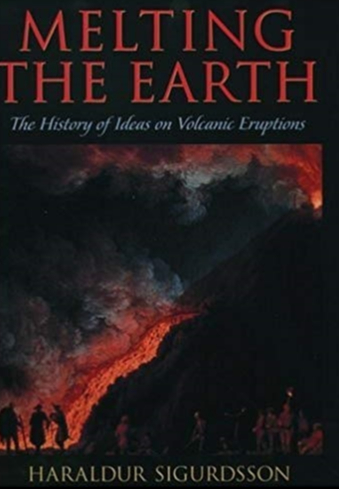
Melting the Earth cover. Credit: Oxford University Press