
This article was published in Scientific American’s former blog network and reflects the views of the author, not necessarily those of Scientific American
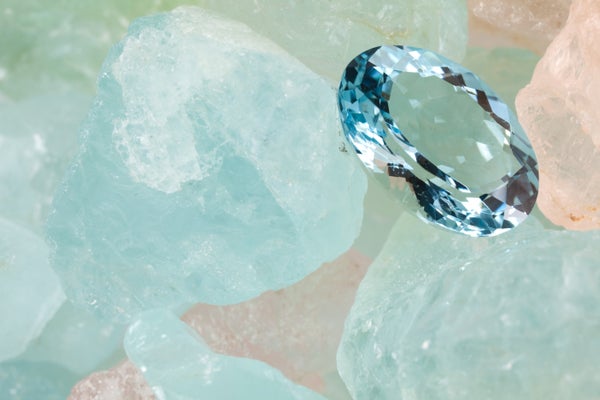
If you were an ancient Roman, about to embark on a sea voyage, you might have sought out a lovely pale blue stone from India to protect yourself. These "oriental emeralds" were even more treasured than gold. They came in shades of the sea, from a translucent blue almost to faint to see to a radiant blue-green that was highly sought after. Their hexagonal shape needed just a bit of polish to provide women with gorgeous cylindri to dangle from their ears. They even adorned fancy bowls.
It wasn't hard to imagine the serene "sea-water" stones to have a close association with and power over the ocean. They look like Neptune plucked them from the waves and froze them into crystals. So I'd imagine the ancient Romans who adored aquamarine so would be mightily surprised to discover their intensely hot, subterranean origin. And I'd imagine that learning their color comes from iron would be more astonishing still.
Aquamarine is a form of beryl, a hard (7.5-8 on the Mohs scale), clear mineral formed from beryllium, aluminum, silica, and oxygen. Its cousin is the more rare and expensive emerald. It can form in metamorphic rocks sometimes, but it's far more commonly associated with granite. As massive bodies of granitic magma slowly cool, aquamarine and other forms of beryl grow in vugs or pegmatite veins, nurtured by hot water saturated with metals and minerals.
On supporting science journalism
If you're enjoying this article, consider supporting our award-winning journalism by subscribing. By purchasing a subscription you are helping to ensure the future of impactful stories about the discoveries and ideas shaping our world today.
Pure beryl is so clear it was once used for the lenses in spectacles, before the glassmaker's art was able to produce a suitably transparent material. It's impurities that create the various colorful varieties of beryl we prize so highly. In aquamarine's case, a bit of iron in the form of Fe²+, gets in and makes itself at home in the crystal lattice, imparting that enchanting translucent aqua color. If a bit of Fe³+, our friend from amethyst, makes it into the channels instead of slotting in where Fe²+ or AL usually goes, it provides a hint of yellow; so if you have one of those prized blue-green aquamarines, you know what sort of iron you've got and where it's lurking. And, as with amethyst, you can use heat and other radiation to tweak the colors, although you won't manage to make yourself a purple aquamarine.
But it doesn't take radiation to make a striking and unique gem. Most of us know aquamarine as a translucent, almost transparent stone, usually cut into glittering facets. A different kind of aquamarine caught the eyes of gemstone miners and gem cutters in India over a thousand years ago. Buddhabhatta noted it in his early 6th century Ratnapariska, a book on gems, remarking that a variety of beryl known as sphuling āni bahā gleamed like a cat's eye. If you held the opaque blue stone at an angle and tipped it to catch the light, a band of light would dance across it.
This effect, known as chatoyancy, is one we've explored here before. But chatoyant aquamarine gets its effect from a different cause than tigers eye. Instead of asbestos fibers, cat's-eye aquamarine is filled with microscopic rods all laid in the same direction. They give these aquamarines a satiny appearance in addition to the cat's-eye band of light, and they're subtly stunning.
Chatoyant aquamarine has now been found worldwide, although it's still rare. If you want to find any in North America, so far your best bet is the granite pegmatites of old New England, where ancient mountain building episodes have left us a legacy of gem-filled granite. The chatoyant aquamarine found in the spoil heaps of old mica mines have reached sizes of nearly 20 carats, and if imperfection doesn't bother you, you can score even larger specimens. The chatoyancy of aquamarine is usually subtle, but some of the gems here are nearly as intense as the finest cat's-eye chrysoberyl.
Even rarer aquamarines exhibit asterism, which you'll be familiar with if you've ever seen a star sapphire. Pretty nifty for a stone most of us have never thought of as anything but a sparkly clear crystal!
In all of its variety, there's still something intensely satisfying about the classic seawater variety of aquamarine. The next time you see one, you can marvel at how such a cool, serene stone emerged from heat and darkness deep under the earth.
References:
Badar, M.A. et al (2017): X-ray Diffraction Study of Aquamarine from Shigar Deposits, Skardu Valley, Northwest Pakistan. International Journal of Economic and Environmental Geology. 8. 33-40.
Biswas, Arun Kumar (1994): Vaidurya, Marakata and other beryl family gem minerals: etymology and traditions in ancient India. Indian Journal of History of Science, 29, 2, 139-152
Gosse, R. (1968): Notes on Rare and Unusual New England Gemstones.Rocks & Minerals, 43:10, 753-756