
This article was published in Scientific American’s former blog network and reflects the views of the author, not necessarily those of Scientific American
So, you know those disaster movies where volcanoes explode like Mount St. Helens, but also spew fountains of really runny lava like Kilauea on laxatives?
I have really bad news for them, courtesy of Edward Wolfe and Thomas Pierson in Volcanic-Hazard Zonation for Mount St. Helens, Washington, 1995.
On supporting science journalism
If you're enjoying this article, consider supporting our award-winning journalism by subscribing. By purchasing a subscription you are helping to ensure the future of impactful stories about the discoveries and ideas shaping our world today.
Lava flows are destructive but generally not life-threatening because they normally advance so slowly that people can walk or run away from them.
Drat.
Of course, it's never about realism anyway, which is why I avoid any disaster movie with a volcano in it - I know I'd end up ruining everyone's movie experience by howling, "That doesn't happen!" every ten seconds or so. (And no, I sure as heck am not going to see San Andreas - that looks even worse than the volcano flicks, and I'm not interested in dying from apoplexy at my tender young(ish) age. I will probably eventually watch Pompeii because some of you asked me to years ago, and I can now watch it here at home, where I can scream into a pillow so as not to disturb the neighbors.) I'm not a fan, is what I'm trying to say. Some people enjoy disaster films despite (or because of) the absurdity. I have a lot more fun with reality. I mean, this is the greatest stuff ever!
Did you hear that crackling?! Did you see the little pieces of volcanic glass popping up like popcorn kernels in a hot pan? Did you seem them cook burritos and marshmallows on a bloody pahoehoe flow? And hear the squeals of pure science-geek joy? Oh, yes. That's my kinda flick! You can see the whole video here.
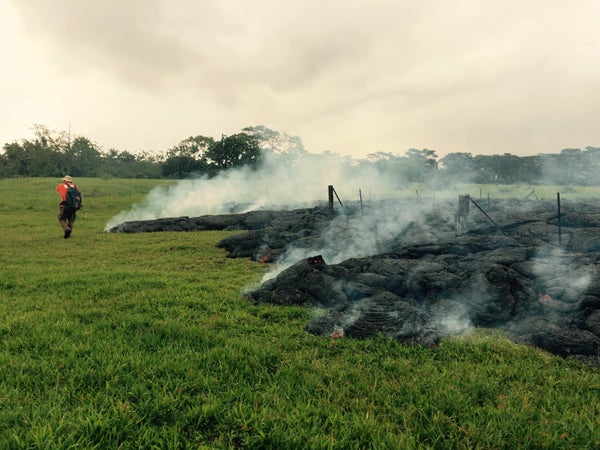
So yeah, those of you who like your volcano disaster flicks can enjoy the ridiculously-funny lava and the volcanic bombs that set off huge gasoline explosions wherever they land and stuff. I'm just gonna enjoy watching geologists amble around the edges of active lava fields.


I mean, that is so ridiculously epically awesome - except for the people of Pāhoa: I'm so sorry Kilauea tried to eat your town.
And now Ima go watch my favorite lava lake video of all time. Join me!
A version of this post originally appeared at En Tequila Es Verdad. I'm in the middle of a hectic move, hence cross-posts, but I'll be returning with more super-awesome, totally fresh geology soon!