Cascades, Volcanoes and Fantastic Fossils! Seattle's Burke Museum, Part 2

Welcome to the second leg of our Burke Museum visit! In this one we get to meet a very awesome sabre kitty, enjoy some of the prettiest rocks and fossils ever, and lie in the center of a volcano

Dana Hunter

Join Our Community of Science Lovers!

This article was published in Scientific American’s former blog network and reflects the views of the author, not necessarily those of Scientific American


In our last visit to the Burke Museum, we found some pretty gemstones and explored life on Earth up until the dinosaurs perished. Now we step forward in time to 40 million years ago, before the Cascades, but after much of Washington State had emerged from the ocean. We see fossils of the critters that inhabited the coast back then (which was roughly where I-5 is now), and the various lovely land plants and critters. One of my favorites is this delicate pair of flowers, preserved in stone.
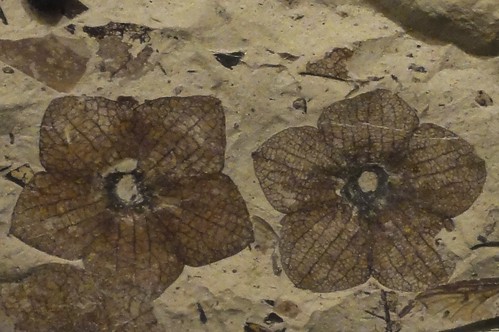
Image shows two small, five-petaled flowers pressed into a fine-grained sedimentary stone. They are dark brown against the tan stone. Each flower has five diamond-shaped petals around small round centers.
Forissantia quilchenensis fossils. They're around fifty million years old! They're Washington natives, found in the rich fossil beds near Republic, WA. Credit: Dana Hunter

There's a huge, upright slab full of fossil footprints of various birds, mammals, and reptiles. It was, of course, flat when those critters walked on it: tectonic forces tilted it into a near-vertical position. It's so very cool to see it displayed that way: it gives you a sense of the forces involved as the Juan de Fuca plate subducts beneath the North American plate.


On supporting science journalism

If you're enjoying this article, consider supporting our award-winning journalism by subscribing. By purchasing a subscription you are helping to ensure the future of impactful stories about the discoveries and ideas shaping our world today.


Image shows a huge slab of tan rock standing almost straight up from the floor. It has a lot of divets in it; if the photo is enlarged, footprints and other traces can be discerned.
Slab with fossil footprints of various animals, found on the slopes of Mount Baker. Credit: Dana Hunter

Kids will probably adore the skeletons of sabre-toothed cats, too! They're about the size of bobcats, which reminds us that some sabres were itty-bitty kitties compared to the gigantic beasts we're usually drawn to from that age.
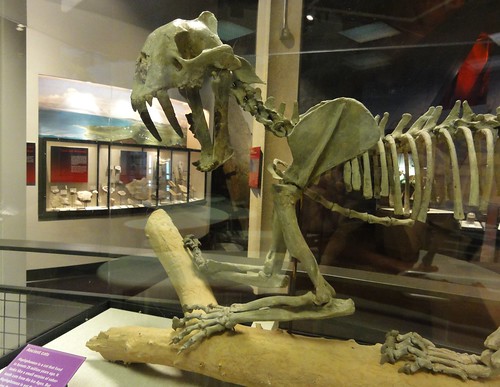
Image shows the front half of  a sabre cat skeleton, perched on a branch in a glass case. Its teeth are quite prominent. It is in profile with its head slightly turned toward the viewer, as if noticing something small and tasty is standing below it.
"Why, hello, lunch!" Credit: Dana Hunter

Now comes one of the best parts! They've created a stylized volcano to house the Cascades volcanoes displays. Outside it, you'll find Mount St. Helens ash and pumice from various eruptions in her history. There's also a model of Mount Rainier. Then you go inside the volcano, and get treated to beautiful back-lit signs explaining volcanoes, showing scientists working on them, and detailing the Cascades' history. On the opposite wall, an enormous glass case displays the glittering volcanic rocks and minerals that eruptions and hydrothermal processes produce. And if you look up, it seems very much like you're in an erupting volcano. So awesome!
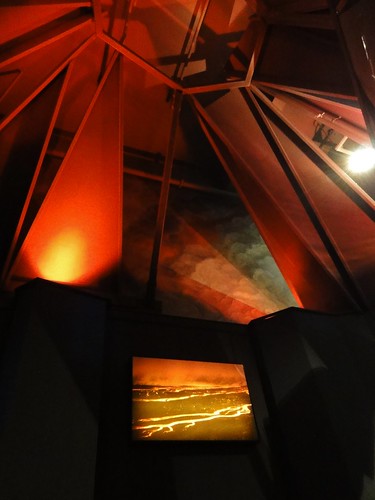
Image shows the inside of the Cascades volcano display. It's a dark, conical room whose ceiling is made up of wide slabs of metal tipped toward each other, with open spaces between them. They're lit by a few red-orange lights. On the wall is an illuminated photo of a lava flow at night.
Artist's impression of being inside a metal volcano. Credit: Dana Hunter

I laid down on the floor to get that one for you. That's how much I love you all.

When you come out the other side, you'll have enormous fun exploring one of my favorite features of the Burke: the replica of the Blue Lake Rhino cast. Can you imagine? This baby rhino's body was engulfed by basalt flows that were well over 1000 degrees F, and yet, it was able to cool the surrounding lava enough to leave a cast of itself. You can even find where the horn was if you look! This is a great little feature for the kids to climb into and explore. It also shows the marvelous columnar jointing of the Columbia River Basalt flows.
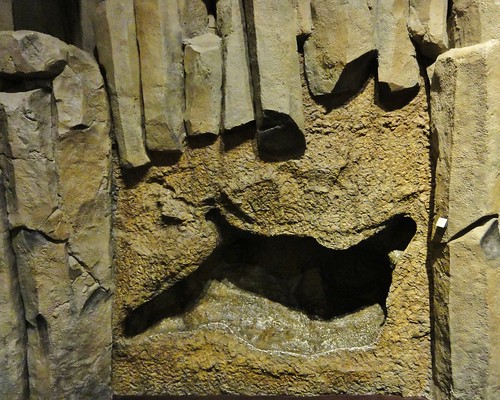
Image shows a replica of the Columbia River Basalts, complete with columnar jointing. In the center is a hole that's roughly shaped like an animal on its back with its feet in the air.
The Blue Lake Rhino cast replica is one of the best things ever. Credit: Dana Hunter

On the wall nearby, you'll find an absolutely gorgeous display of zeolites. I've found many of these in the wild, but none of this size or quality. They're utterly marvelous.
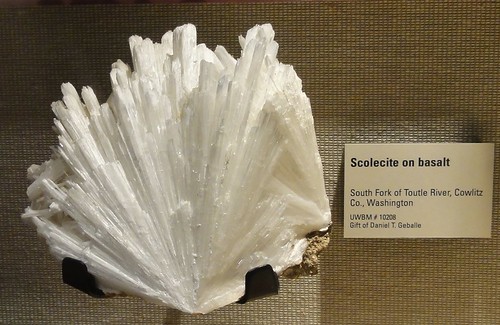
Image shows a white mineral that looks like a palm frond made of thin fibers.
A HUGE sample of scolecite on basalt. This was collected from the South Fork Toutle River. Gorgeous! Credit: Dana Hunter

There are also slices of petrified wood in the case with them. Almost everything in the case comes from Washington State, excepting the palm from California. You probably don't generally connect lava flows with petrified wood, but most of the wood in this case formed when the Columbia River flood basalts buried an ancient lake. Logs within the lake petrified, and were protected for millions of years by thick layers of lava. We'll be visiting there someday soon!
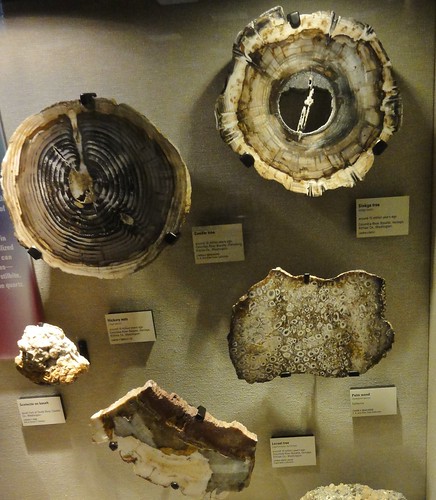
Image shows several round slices of petrified wood pinned to a wall.
Lovely petrified wood! Credit: Dana Hunter

Next up: we'll be getting our hands on some geology.

It’s Time to Stand Up for Science

If you enjoyed this article, I’d like to ask for your support. Scientific American has served as an advocate for science and industry for 180 years, and right now may be the most critical moment in that two-century history.

I’ve been a Scientific American subscriber since I was 12 years old, and it helped shape the way I look at the world. SciAm always educates and delights me, and inspires a sense of awe for our vast, beautiful universe. I hope it does that for you, too.

If you subscribe to Scientific American, you help ensure that our coverage is centered on meaningful research and discovery; that we have the resources to report on the decisions that threaten labs across the U.S.; and that we support both budding and working scientists at a time when the value of science itself too often goes unrecognized.

In return, you get essential news, captivating podcasts, brilliant infographics, can't-miss newsletters, must-watch videos, challenging games, and the science world's best writing and reporting. You can even gift someone a subscription.

There has never been a more important time for us to stand up and show why science matters. I hope you’ll support us in that mission.

Thank you,

David M. Ewalt, Editor in Chief, Scientific American

Subscribe