
This article was published in Scientific American’s former blog network and reflects the views of the author, not necessarily those of Scientific American
Worldwide, it's been a terrible month for natural disasters. The mind boggles at the scale of them.
Bangladesh, India, and Nepal, pummeled by intense monsoon rains, have experienced landslides and massive flooding that has left at least 1,200 people dead and tens of millions left homeless. Bangladesh has seen a staggering one-third of the country submerged. India's financial heart, Mumbai, has seen floodwaters claim its low-lying districts. Both India and Nepal have been hit with catastrophic landslides that killed dozens and left many more homeless.
Sierra Leone's bustling capital, suffering from unusually heavy seasonal rains, was hit hard by an enormous mudslide that ravaged several neighborhoods, leaving at least 500 dead and almost a thousand more missing.
On supporting science journalism
If you're enjoying this article, consider supporting our award-winning journalism by subscribing. By purchasing a subscription you are helping to ensure the future of impactful stories about the discoveries and ideas shaping our world today.
And if you're American, you haven't been able to miss the news from south Texas, where ferocious Hurricane Harvey has stalled, dumping trillions of gallons of water on Houston and other cities. Thirty people are dead, hundreds of thousands displaced, and the rains continue. Louisiana is now in the hurricane's path.
This is our new reality in an age of anthropogenic global warming.
You may be feeling helpless in the face of relentless nature. But we humans are good at surviving. We take care of each other. We lift each other out of harm's way. We help each other rebuild. It's what we do, and I have a list of organizations here that are ready to put your donations to work helping victims of meteorological and geological catastrophe survive and reclaim their lives.
For Sierra Leone and South Asia:
Médecins Sans Frontières (Doctors Without Borders): MSF is providing aid to mudslide victims in Sierra Leone. They're giving medical aid, supplying communities with clean water, and watching for disease outbreaks (always a concern after disasters like this).
Save the Children is accepting donations to provide relief and rebuilding assistance to victims of the floods in India, Bangladesh, and Nepal.
Oxfam's emergency fund is accepting donations that will help them provide emergency supplies to all of the affected South Asian countries.
For Hurricane Harvey relief:
Portlight provides emergency assistance to people with disabilities, who are among the most vulnerable in a disaster. Click here to support their Harvey relief efforts.
Here's a long list of local orgs devoted to filling disaster relief gaps, rescuing animals, and protecting the vulnerable. Any of them are worthy of your donation dollars.
Remember: every dollar makes a difference. You may only have a few dollars to spare, but those tiny donations add up. Thousands of us acting together add up to significant help.
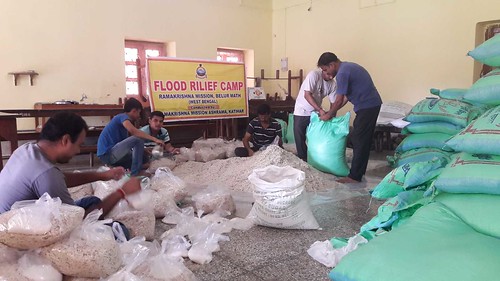
People at Ramakrishna Mission fill sandbags for flood relief. Credit: Katihar Ashrama Flickr
If you have special skills or training, and you are able to take time off work, you can search for organizations that need physical assistance as well as monetary aid. But please don't just jump in a car or on a plane and head into the disaster zone: without a sponsoring org that can provide you the equipment and housing you need and put you to work in specific positions and locations, you become just another potential victim relief agencies and first responders need to divert their limited resources to protect and feed.
Do not donate physical items unless an established relief organization asks for specific things! It may feel good to clean out your closets and send clothing and other goods you no longer use, but most of those items end up being thrown out. Cash is almost always better, and established charities and relief orgs know how to put it to the best use.
A portion of the proceeds of this post will be donated to some of the relief organizations listed above.