
This article was published in Scientific American’s former blog network and reflects the views of the author, not necessarily those of Scientific American
One of the things I like best about volcanoes is the fact that they generally let you know when they're about to erupt. They may not be very specific about the time and nature of the event, but they do tell those of us who are listening when they're about to wake up on the cranky side of the bed. Proper monitoring ensures we know when magma's on the move. Sometimes, we even learn how to read a particular volcano's signals so well that we can predict particular eruptions to within hours of when they'll start.
But as a BBC crew recently learned, even volcanoes as thoroughly studied as Mount Etna can take us completely by surprise.
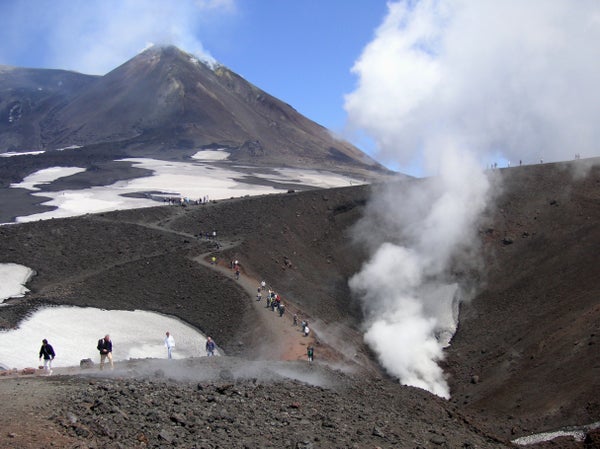
We had come to see a lava flow that had appeared overnight. A giant stream of rock, glowing red, was oozing down the slopes - and we had been taken there by a scientist from Italy’s National Institute of Geophysics and Volcanology, who was monitoring its progress.
Dozens of tourists had also been brought by Etna’s guides to see the spectacle.
The lava was so slow moving it’s not usually considered dangerous, and the fierce heat as the rocks fizzled and crackled preventing anyone from getting too close.
But about 20 minutes after arriving, a burst of white steam emerged from the lava – it didn’t make much of a noise or look especially threatening – but the guides started asking people to move.
Then, moments later, there was an explosion. The lava had mixed with snow and ice, and boiling rocks and boulders were flung up high into the air. They started to rain down in every direction.
On supporting science journalism
If you're enjoying this article, consider supporting our award-winning journalism by subscribing. By purchasing a subscription you are helping to ensure the future of impactful stories about the discoveries and ideas shaping our world today.
The video at the link is pretty spectacular. If you watch it, please be advised there's some blood involved. But everyone made it out alive. This isn't always the case—a very similar type of phreatic eruption killed five climbers and seriously injured several others on Mount Mayon in 2013. The volcano had been quiet since 2010, but when water found its way to the super-hot magma within, chaos ensued. The force of the steam blast hurled room-sized rocks down on the unfortunate hikers. Phreatic explosions have also killed on Etna before: 2 people died in a suspected phreatic blast in 1929, 9 people were killed by a phreatic explosion near Bocca Nuova in 1979, and 2 died at the southeast crater in 1987.
The dramatic but non-lethal blast last Thursday occurred when a lava flow encountered a snow field. Lava doesn't always cause snow to flash to steam, but when it does, the results can be spectacular:
Researchers at Tolbachik volcano have been studying what sorts of lava react violently as opposed to which roll along quietly. At Tolbachik, it seems to be pahoehoe that that makes a scene. At Etna, it looks like an a'a flow. It will be fascinating to discover why those differences exist, and what factors actually cause lava to explosively interact with snow. With that knowledge, we may be able to predict which lava flows will become deadly, and which are safe for people to enjoy.
Volcano monitoring is critically important and saves countless lives, but it can't predict every dangerous event. So if you plan to explore an active volcano up close, don't try to go it alone. Make sure to heed all warnings and exclusions. Only go with experienced guides and/or volcanologists. Stay watchful and ready to duck for cover at an instant's notice.
And make sure your affairs are in order, just in case.