
This article was published in Scientific American’s former blog network and reflects the views of the author, not necessarily those of Scientific American
Is California going to experience a massive earthquake this week?
Probably not.
But judging from my Facebook feed over the last couple of days, plenty of people are worried. Warnings have gone out that there's a heightened risk of a major quake on the San Andreas fault due to an earthquake swarm near the Salton Sea. And yes, that swarm has changed forecasts a bit. Let me have John Vidale of the Pacific Northwest Seismic Network explain it:
On supporting science journalism
If you're enjoying this article, consider supporting our award-winning journalism by subscribing. By purchasing a subscription you are helping to ensure the future of impactful stories about the discoveries and ideas shaping our world today.
In the Salton Sea, the earthquake swarm last week changed the odds of an earthquake of at least M7 on the San Andreas fault to between 1 in 3000 and 1 in a 100 for the following week.
That's all the spate of news stories means. No new discoveries, but there is a new willingness to tell the public of small changes in the odds of earthquakes, and new methodologies to be somewhat specific in the size of the probabilities.
In the terminology that seismologists use, this is forecasting - estimating the rate of earthquakes, not predicting - which is guessing when, where, and how big will be an upcoming quake. Also, forecasts tend to be longer odds, while if one says an earthquake is definitely going to happen, we consider it more of a prediction, even if the location is vague.
As my friend Garry Hayes, who teaches geology at Modesto Junior College, puts it:
Swarms happen all the time, and many don't lead to more activity. But on rare occasions they do lead to larger quakes. How to respond? Panic? Of course not. But it's like checking your fire alarms on daylight savings: check and see if you are ready for a large earthquake. Do you have water, food, first aid kit? Do you have a family plan for if you are separated? Review the risks and expectations of a large earthquake, and educate yourself. And most important of all: don't believe inflammatory internet headlines.
So. Here's what you need to do to prepare if you're in earthquake country. And if you're in California, head on over to the Great California ShakeOut's website to learn more about California's specific risks, and steps to take that are specific to California.
It's okay. You've got this. Even if the big one does come, you can be prepared to survive it.
-
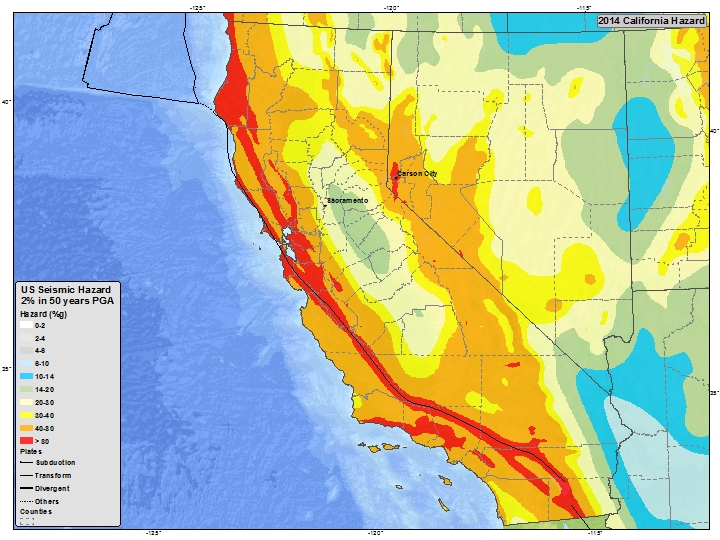
2014 Seismic Hazard Map for California. Credit: USGS