Rumors of Mount St. Helens Being Extra Explodey Have Been Greatly Exaggerated

I'm so sorry if any bubbles get burst by this news, but Mount St. Helens isn't really more explosive than we thought. She's still pretty much the same. I mean, yeah, she'll erupt again. She's a young and active volcano. She has some growing to do. We might even get to see some hawt dome-building activity in our lifetimes, if we're really lucky. But she's most probably not going to suddenly become a supervolcano and wipe out Washington State.

Join Our Community of Science Lovers!

This article was published in Scientific American’s former blog network and reflects the views of the author, not necessarily those of Scientific American


Did you hear about "new" magma chambers under Mount St. Helens? Did a bunch of people start talking like "ZOMG she's gonna blow!!!"? Did you get really super-excited thinking, "Wow, she'll erupt again soon and Dana will be there to blog it for us!"?

I'm so sorry if any bubbles get burst by this news, but Mount St. Helens isn't really more explosive than we thought. She's still pretty much the same. I mean, yeah, she'll erupt again. She's a young and active volcano. She has some growing to do. We might even get to see some hawt dome-building activity in our lifetimes, if we're really lucky. But she's most probably not going to suddenly become a supervolcano and wipe out Washington State.


On supporting science journalism

If you're enjoying this article, consider supporting our award-winning journalism by subscribing. By purchasing a subscription you are helping to ensure the future of impactful stories about the discoveries and ideas shaping our world today.


Let volcano expert Erik Klemetti explain, or at least sum up. There's lots at the link, but here's a little bit to take away right now:

We haven’t added new bodies of magma, we haven’t increased the likelihood of another eruption, we just understand the architecture of the crust better now.

There isn’t even full agreement on what the data might mean—some of what is being interpreted as “partially melted” crust may actually be metamorphosed sediment. Seismic data is highly interpretative, so trying to deduce exactly what it is might be akin to trying to groping into a bag and trying to figure out everything in it without seeing anything.

I'm sure Mount St. Helens has plenty of surprises in store for us. We're still only beginning to understand the volcanoes around us. But rest assured, this new information is in the realm of, "Oooo, neat, now we know a bit more!" and not "OH NOES WE'RE ALL GONNA DIIIIEEEE!!!"

You can bet, though, that I'll be all over her if she starts steaming again. I promise!
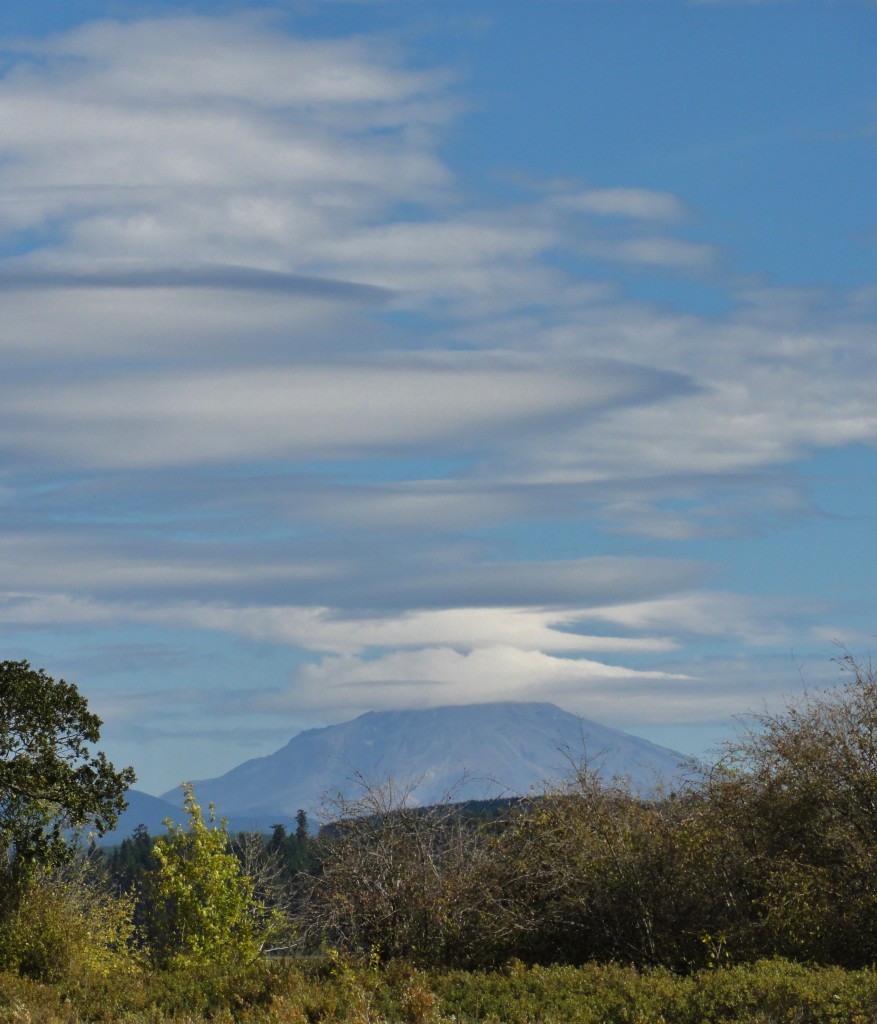
Image shows Mount St. Helens looking over Silver Lake. Clouds are rising from its summit. One set looks like it's emerging from inside her in a lazy, soft-white eruption cloud. A few more oblong clouds further up make it look like she's been trying to blow smoke rings all morning!

Mount St. Helens with super-awesome clouds. No, she's not erupting! Photo by Dana Hunter.

It’s Time to Stand Up for Science

If you enjoyed this article, I’d like to ask for your support. Scientific American has served as an advocate for science and industry for 180 years, and right now may be the most critical moment in that two-century history.

I’ve been a Scientific American subscriber since I was 12 years old, and it helped shape the way I look at the world. SciAm always educates and delights me, and inspires a sense of awe for our vast, beautiful universe. I hope it does that for you, too.

If you subscribe to Scientific American, you help ensure that our coverage is centered on meaningful research and discovery; that we have the resources to report on the decisions that threaten labs across the U.S.; and that we support both budding and working scientists at a time when the value of science itself too often goes unrecognized.

In return, you get essential news, captivating podcasts, brilliant infographics, can't-miss newsletters, must-watch videos, challenging games, and the science world's best writing and reporting. You can even gift someone a subscription.

There has never been a more important time for us to stand up and show why science matters. I hope you’ll support us in that mission.

Thank you,

David M. Ewalt, Editor in Chief, Scientific American

Subscribe