The Mind-Boggling Scale of Mount Saint Helens's Crater

If you haven't stood in front of Mount Saint Helens, it's hard to get a feel for how truly enormous the crater left by the May 1980 eruption is. But thanks to a handy sightseeing helicopter, perhaps I can give you a taste

Join Our Community of Science Lovers!

This article was published in Scientific American’s former blog network and reflects the views of the author, not necessarily those of Scientific American


On this day in 1980, an earthquake beneath Mount St. Helens got everyone's attention. Within two months, much of her summit would be lying on the North Fork Toutle River valley floor, the lush forests stripped away, and our views of her changed forever.

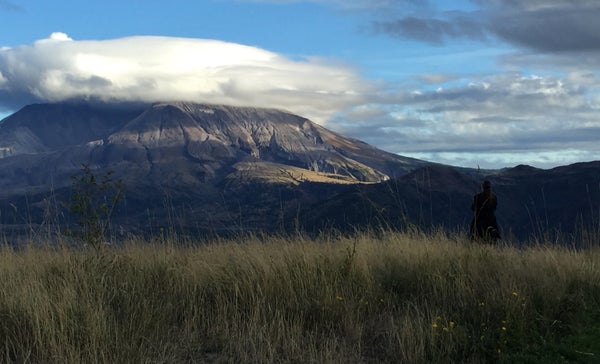
Image shows Mount St. Helens, rays of sunshine striking it from low in the west and a thick white cloud over its summit. I'm standing on a grassy ridge to the right, almost invisible due to shadows and my black trench coat. I look very small in comparison to the enormous mountain many miles away.
Mount St. Helens et moi. Image courtesy Suzanne.

My dear friend Suzanne took the above photograph during one of our visits. Perspective makes the grass look almost as tall as me -but it's waist-high at best, possibly shorter. I was completely entranced by the mountain, so I didn't notice the exact height. But I'd probably remember slogging through something trying to poke me in the eyeballs. And, of course, the volcano towers over us all, even though it's off in the distance up and across the broad valley.


On supporting science journalism

If you're enjoying this article, consider supporting our award-winning journalism by subscribing. By purchasing a subscription you are helping to ensure the future of impactful stories about the discoveries and ideas shaping our world today.


It's not just perspective that makes Mount St. Helens look so huge. It is so huge! To give you an idea of how huge, even with nearly two thousand feet of its summit missing, check this out:
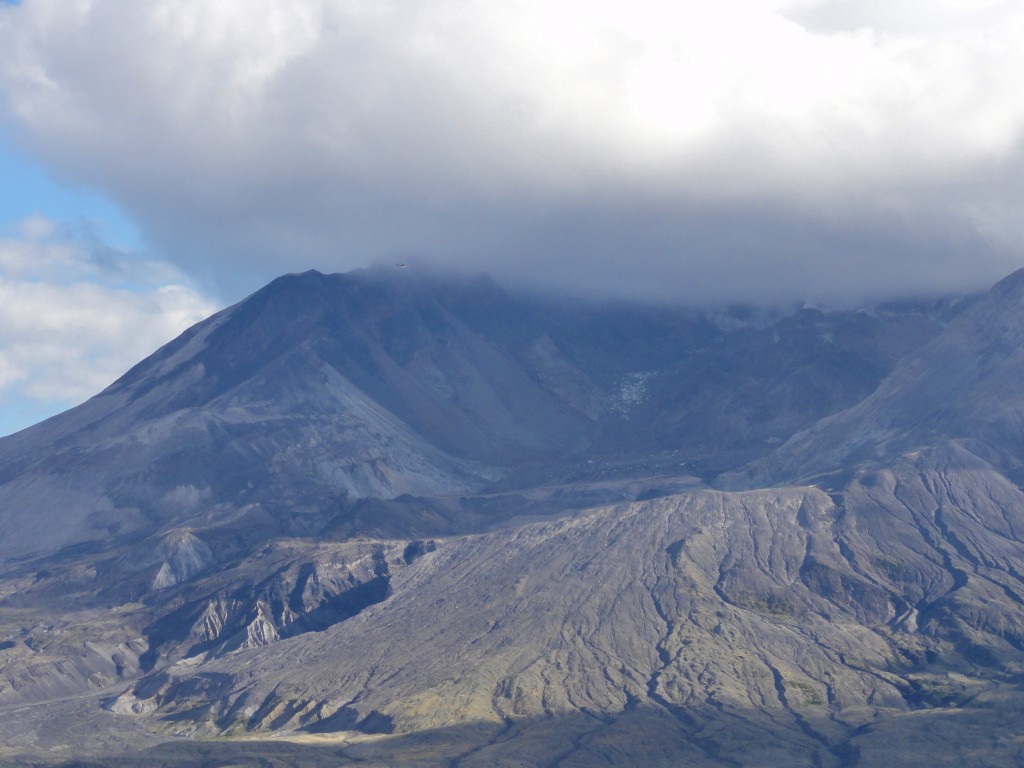
Image shows a portion of Mount St. Helens. The upper rim of the crater is obscured by cloud, but the interior of the crater, exterior wall, and ramp of pyroclastic deposits spilling from the gap in the rim are all visible. The dome is a low, wide mound within. The helicopter is flying past the rim. It's only a few pixels wide and virtually invisible.
Mount St. Helens and the helicopter. No, seriously, there's a helicopter in this photo!

Can you see the helicopter in that photo I took? No? Let me crop that for you:
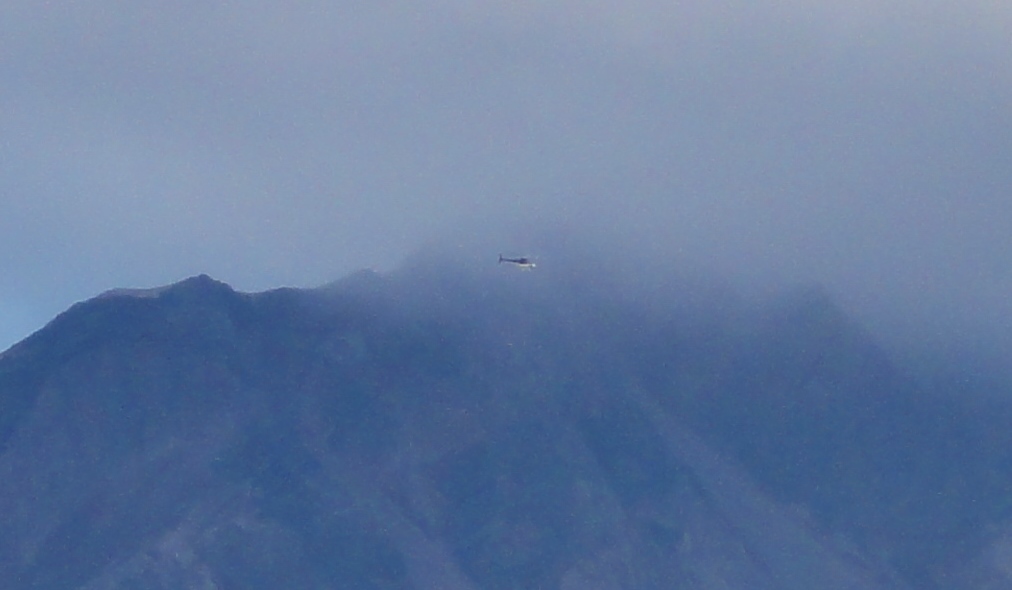
Image is a crop of the previous, showing a piece of the crater rim and the overlying cloud. The helicopter is just visible as a tiny streak between the cloud and the crater.
Can you see me now?

Yep, that wee spec is a Bell JetRanger, which is about 40 feet long. Here's one parked at Hoffstadt Bluffs:

Image shows a blue helicopter with a white underbelly parked on a helipad. The Toutle River valley is visible behind it.
A tour helicopter parked at Hoffstadt Bluffs. Image by Dana Hunter.

And to give you some additional perspective, here are some people standing beside one.

Alas, I have no photos of a helicopter right in the middle of the crater, but here's a lovely shot from one of the trails at Johnston Ridge, showing you what's inside.

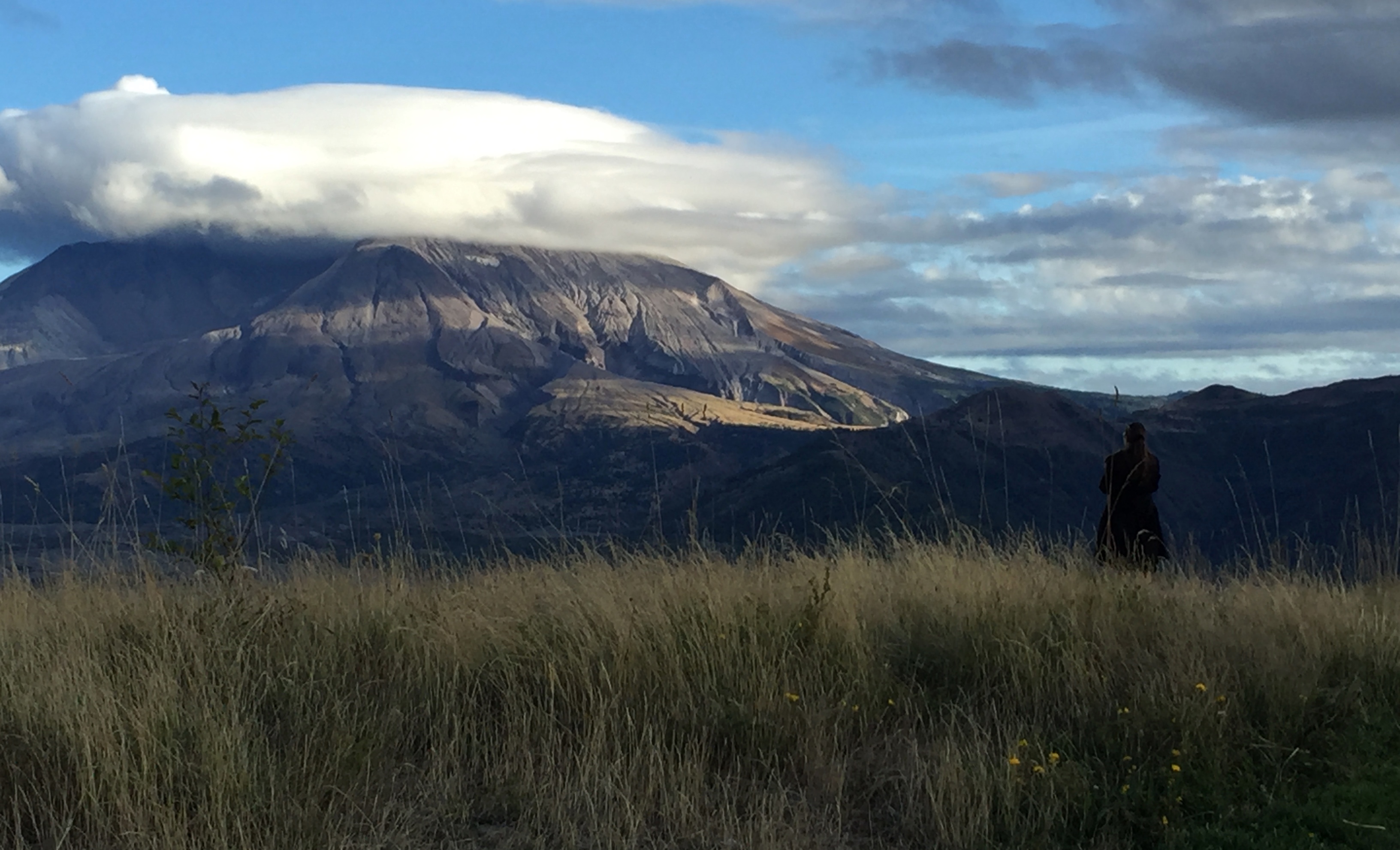
Image shows a bit of dirt trail winding along the side of a bare ridge. It seems to vanish into the snow-capped crater of Mount St. Helens in the distance. The view shows the dome rising from the center.
Looking into the heart of destruction. Photo by Dana Hunter.

That mound of lava in the crater that looks like a blister? That's around 1,000 feet tall. This pdf has a lot of stats on how big the dome is, all concluding: it's huge. Yet it doesn't even fill the crater left by the May 1980 eruption.

Amazing, isn't it?

It’s Time to Stand Up for Science

If you enjoyed this article, I’d like to ask for your support. Scientific American has served as an advocate for science and industry for 180 years, and right now may be the most critical moment in that two-century history.

I’ve been a Scientific American subscriber since I was 12 years old, and it helped shape the way I look at the world. SciAm always educates and delights me, and inspires a sense of awe for our vast, beautiful universe. I hope it does that for you, too.

If you subscribe to Scientific American, you help ensure that our coverage is centered on meaningful research and discovery; that we have the resources to report on the decisions that threaten labs across the U.S.; and that we support both budding and working scientists at a time when the value of science itself too often goes unrecognized.

In return, you get essential news, captivating podcasts, brilliant infographics, can't-miss newsletters, must-watch videos, challenging games, and the science world's best writing and reporting. You can even gift someone a subscription.

There has never been a more important time for us to stand up and show why science matters. I hope you’ll support us in that mission.

Thank you,

David M. Ewalt, Editor in Chief, Scientific American

Subscribe