
This article was published in Scientific American’s former blog network and reflects the views of the author, not necessarily those of Scientific American
Shurgoshan asks me, "What kind of rock would you be?"
I'd be the schist, of course!
I mean, sure, I could've chosen something more serenely sedimentary, with delicate colors and textures. I could've been igneous, firey and explosive. I could've even chosen to be a valuable ore, or a gorgeous semi-precious gemstone. All of those are fabulous choices.
On supporting science journalism
If you're enjoying this article, consider supporting our award-winning journalism by subscribing. By purchasing a subscription you are helping to ensure the future of impactful stories about the discoveries and ideas shaping our world today.
But I'm completely schist.
I mean, honestly, I'd love being able to introduce myself with comic grandiosity: "I'm the schist!" or mock self-deprecation: "I'm just a little schist." People would ask me how I'm doing, and I could be all, "I feel like schist!" I'm sort of punny that way.
If I were schist, I'd have such a history.
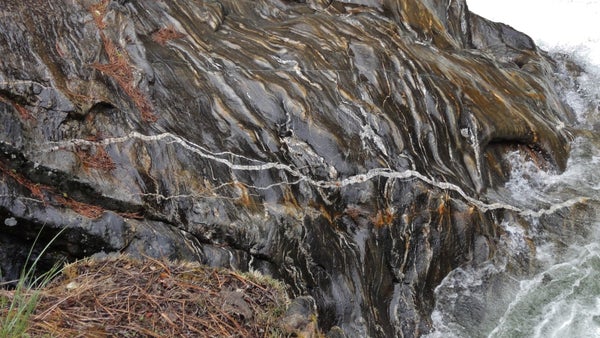
I'd be very, very old: at least millions and possibly billions of years old. You don't become schist overnight, you know. It's not as easy as getting erupted one day and freezing on the surface, or slowly cooling within the heart of a volcano. It's not as gentle as settling out of water, or being laid down by the wind or waves. I would have started in one of those ways, probably. But then I'd have found myself getting pushed down and down by the pressure of moving plates. I'd have been buried down in the deep earth, until I became the roots of great mountains, the foundations of immense ranges. I would have been subjected to intense heat without melting, and withstood enormous pressure without breaking (well, not too much). And that would have transformed me: made me harder, stronger, glittering and garnet-studded. You could trace the tensions I endured in my swirls and waves and folds. You could see the beauty that emerges from darkness.
But my story isn't over.
I've been the foundation of mountains: now I've become the basement of continents, unseen except where a raging river has carved down to my level.
-
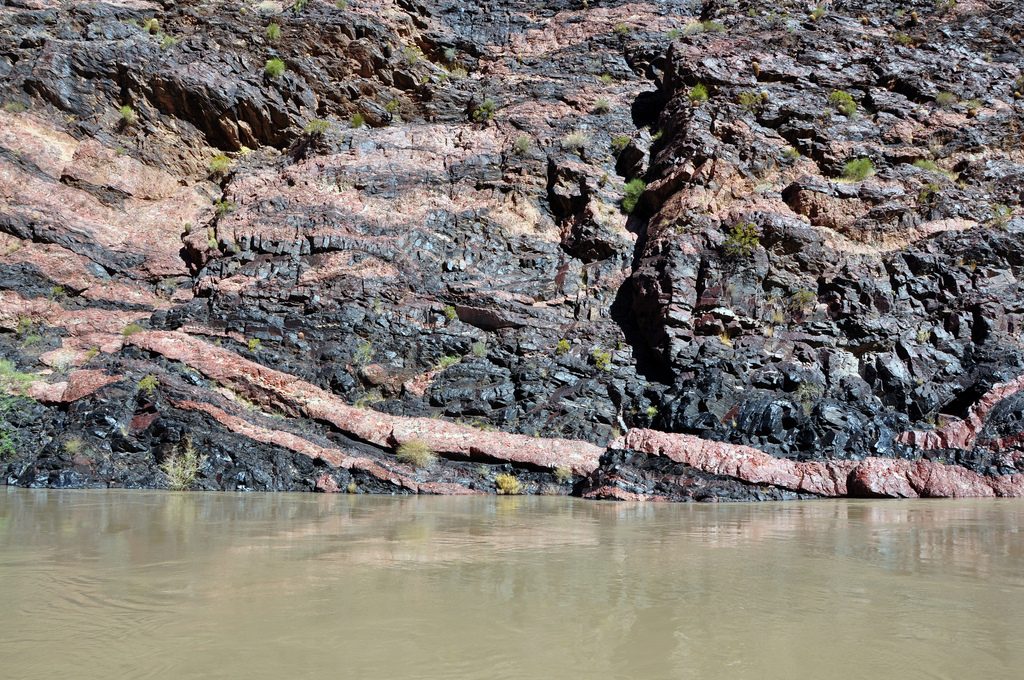
Vishnu Schist, visible at the bottom of the Grand Canyon. Credit: Erin Whittaker NPS
Or, perhaps, I've become the strength you build on as you raise towers into the sky. I will hold you safe as you strive.
Or I've been lifted up, and become mountains in place of those I once lay beneath. I show you all of my majestic self as I create a new version of myself, rooted deep beneath me.
You can use me for art. You can build with me, or adorn your buildings with me. I am tough, and I am beautiful. I can be almost anything you need. I will even sit in a box and tell you a story while making you laugh.


I can play my name for a joke. I'm pretty down-to-earth that way.
I'd definitely want to be the schist. But there's so many good choices. What rock would you be?