This article was published in Scientific American’s former blog network and reflects the views of the author, not necessarily those of Scientific American
I've got a list of potential geological disasters for you today, my darlings! And I may be bursting a few bubbles with one bit of news, but you'll probably manage to survive the experience.
Garry Hayes posted a news item to Facebook recently that reminded me how much work being a dictator is. You rule the country with an iron fist, you pretty much have to make all the decisions, and so what do you do? If you're Sadaam Hussein, you have a dam built without remembering why it's critically important to get a geologist involved from the beginning. Otherwise... you end up doing something unwise, like having your huge dam built on rock salt.
On supporting science journalism
If you're enjoying this article, consider supporting our award-winning journalism by subscribing. By purchasing a subscription you are helping to ensure the future of impactful stories about the discoveries and ideas shaping our world today.
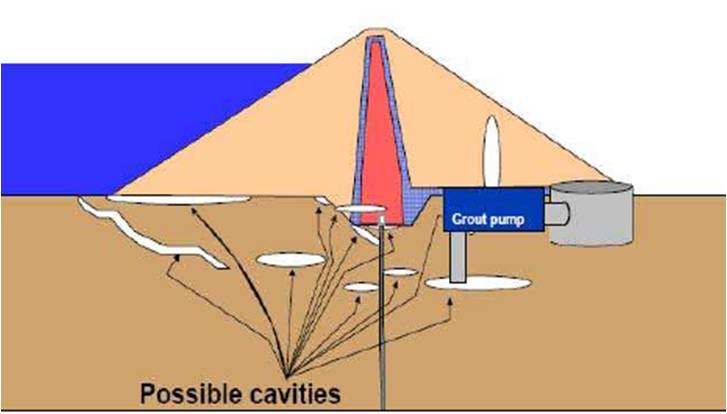
The rock salt would be gypsum, a salt of calcium and sulfate which is less soluble than sodium chloride (table salt) but dangerously soluble for the foundation of a dam. Mosul, a city of 2 million people below the dam could be hit by a 66 foot (20 meters) wall of water. The state department warns that half a million people could die and a million left homeless when the dam fails.
Engineers have been trying to save it by pumping grout into the cavities and sinkholes that develop. But this is not how you want the foundation of your dam to look:

And that's bad enough. It really is. But when you have done something really foolish like that, and then you get deposed, and a group of religious fanatics come to power and chase off all the people who were keeping your very dangerous dam from failing... yeah. It gets really terrifying. That dam is holding back a huge amount of water. You do not want a gigantic lake suddenly thundering downstream. It's all bad. Just look into the St. Francis Dam disaster, or the Johnstown Flood, or any of dozens of similar disasters worldwide, and you'll see what the people of Iraq are in for when their dam fails. As if they're not already suffering enough.
So. If you take over a region or country or anything, and you want to have something huge built, especially if that something huge is holding back a lot of water: consult geologists before you have people build it.
Now, I'm going to turn from horrible dam disasters in the making to another disaster scenario people in America are more familiar with: Yellowstone! Everybody's seen the disaster shows talking about how we're all gonna die with the supervolcano goes ba-boom, right? Everybody sees at least two breathless news articles a year saying how America as we know it will end any minute, yeah? I am so very, very sorry if the following comes as a disappointment after all that buildup, but...
In all, Yellowstone is a pretty quiet place. It definitely wouldn’t appear in my list of the top 10 volcanoes likely to erupt in the next century. Heck, it likely wouldn’t even be in my top 100. That 5 to 10 percent chance of a major eruption somewhere in the world is based on looking at how often we’ve had Tambora-scale or larger eruptions. This means that it could happen next week or not for 300 years. The probability is low: 90 percent of the time, no eruption Tambora-scale or bigger occurs.
The most recent rumors of our impending demise are thoroughly dispatched by Erik at that link. But do not despair, disaster aficionados! There are still plenty of dangerous volcanoes out there, and Erik's pointed us toward a handy list of ten of the worst of 'em. Is your country on it?