
This article was published in Scientific American’s former blog network and reflects the views of the author, not necessarily those of Scientific American
Yes, we usually talk about rocks in these parts, not astronomy. But as you might have noticed if you were anywhere near the US on August 21st, a rather large rocky body got between our planet and our sun, and some pretty neat things happened as a result.
There is some geology involved in an eclipse. We'll talk about it soon! But today, I wanted to show you some fun eclipse photos and explore a few of the unusual happenings when the moon comes between us and our star.
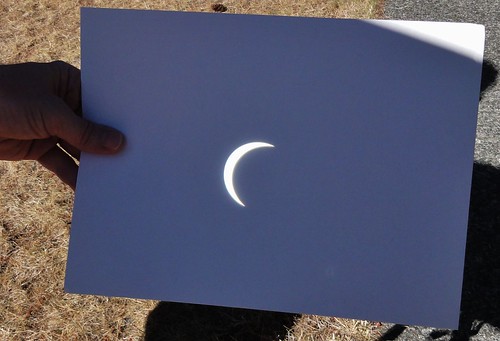
Crescent Sun. Credit: Dana Hunter
On supporting science journalism
If you're enjoying this article, consider supporting our award-winning journalism by subscribing. By purchasing a subscription you are helping to ensure the future of impactful stories about the discoveries and ideas shaping our world today.
One of our neighbors used a set of binoculars to project the eclipse onto a sheet of paper. We'd been walking through the neighborhood without seeing much of anything except a faint dimming of the light - you'd barely know anything was happening if it wasn't for this! You can see how much of the sun has been obscured by the moon - when this photo was taken, we were only fourteen minutes from maximum coverage, which in the Seattle area ended up being around 92%. I'd never seen the crescent sun before and it was awesome.
We also got to see the eclipse directly through eclipse glasses kindly lent by folks down the street, and that was fantastic. But there's something special about this simple rig and stark image.
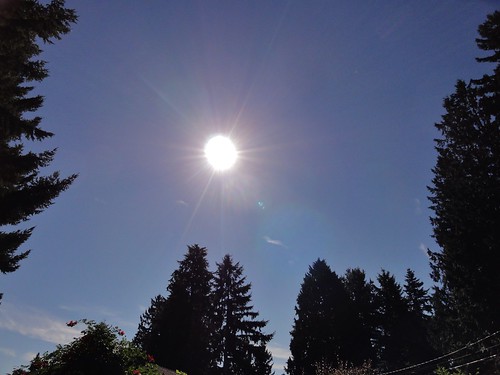
Still Shining. Credit: Dana Hunter
The sun a mere 8 minutes before maximum coverage. If you don't have a filter, you can't really tell the moon's covering almost 90% of the sun. But I've shot the sun with this camera before, and I can tell you it's usually a much more massive blob of light, without all the picturesque rays of light and artful lens flare and such. Also, if you look closely, you'll note the sky and clouds and trees have a slight sepia tinge - the effect of weakened light.
Still, it gives you an idea of how powerful our star is. Even with the moon blocking most of its light, it's still bright and warm.
(Don't worry. I shot this photo without looking. And my old camera has been quite good about photographing the sun without dying over the years - and is old enough I was willing to potentially sacrifice it to this anyway. You should absolutely never point a camera at the sun and look through the viewfinder to focus! And don't do this with any camera you wouldn't be okay living without, because even if you protect your eyes, the light sensor can be damaged.)
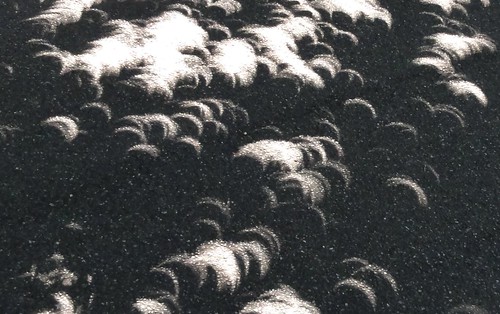
Eclipse Leaf Shadows. Credit: Dana Hunter
One of the most enchanting effects of the eclipse was what it did to leaf shadows. I noticed it as soon as we began walking up a shaded part of the road. The shadows looked lacy, so much fancier than normal! Different trees made different effects. The leaves of the tree I took this photo under showed crescents. It turns out that leaves act as pinhole cameras, projecting images of the crescent sun onto the surface their shadows are landing on. Normally, the sun shows up as circles of light, and it's so ordinary to us that we don't really pay attention.
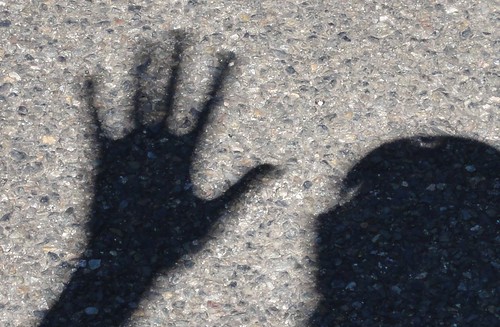
Strange Shadows at Maximum. Credit: Dana Hunter
Maximum! Our shadows, normally robust and dark with a powerful sun behind us, were strangely dim and fuzzy. It felt like we were turning into ghosts! Really, really marvelous effect, and so we stopped to play with it.
None of this was as exciting as totality, I expect, and yet experiencing just a part of the eclipse was actually really neat. It's astonishing how much power the sun has - it's incredible how much light is still shining when the moon's obscuring all but 8% of it.
Make your plans for the next solar eclipse! We've got another chance at totality in 2024. See you there?