
This article was published in Scientific American’s former blog network and reflects the views of the author, not necessarily those of Scientific American

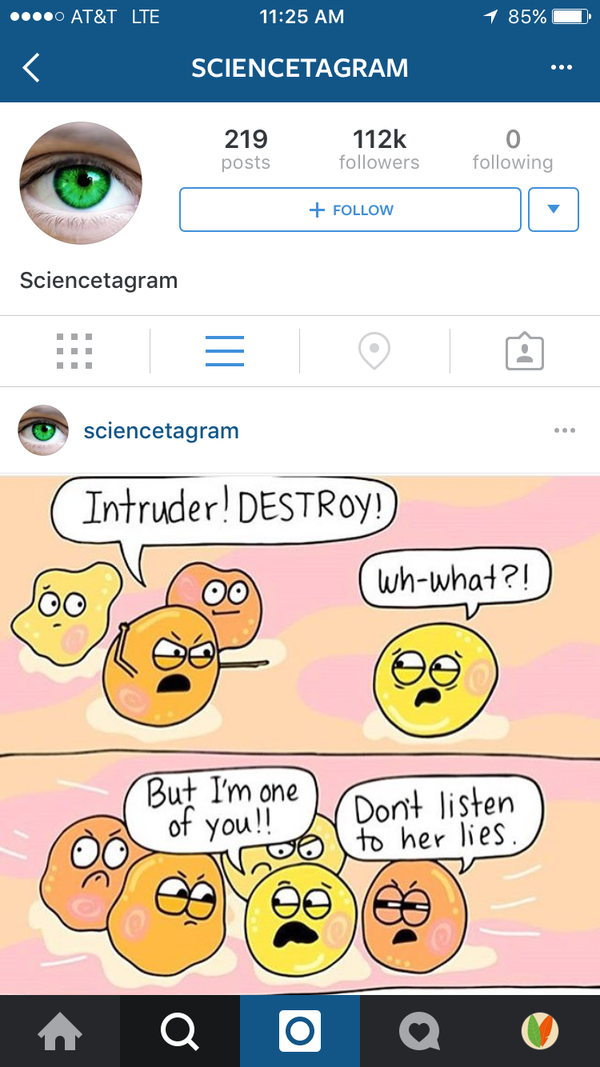
It all started with this.
My sister sent me a text when she saw that my comic had been shared on this, evidently, very popular instagram account called sciencetagram that has 112,000 followers. Not too shabby.
On supporting science journalism
If you're enjoying this article, consider supporting our award-winning journalism by subscribing. By purchasing a subscription you are helping to ensure the future of impactful stories about the discoveries and ideas shaping our world today.
But then I saw that not only had I not been tagged, but my signature was mysteriously missing. This is what we in the biz call "stolen artwork." It never ceases to annoy, but when a big account with, say, 112,000 followers does it, it stings all the more. Not tagging me means that I don't get any new readers from this sharing of my work. When other popular instagram accounts share a comic and tag me, such as AsapSCIENCE, everyone wins. But when someone shares my work without any mention of who I am--surprise!--I lose.
And then there is the missing signature. Salt in the wounds, I tell you. Even if someone doesn't have the decency to tag my username so readers can oh-so-easily follow me, then at least the really smitten ones could find me if they knew what my web comic was called from the signature.
Not here. To find me now, you'd either have to be 1) my sister, or 2) so familiar with my work you recognize it even if it's caught naked without a signature. Someone would have to take a screenshot, crop down to just the comic, and look it up on a reverse image search engine to find me. I wonder how many people do that. Let's assume zero.
So I did what any normal social media user would do. I complained on twitter.
Oh hey look an instagram account that shared my comic and clipped my signature off and didn't tag me. https://t.co/P7Pllvd63D
— Beatrice Biologist (@beatricebiology) March 29, 2016
I get that I can't expect to always be tagged, but why crop out the signature? Just... don't do that. https://t.co/P7Pllvd63D
— Beatrice Biologist (@beatricebiology) March 29, 2016
I would have loved some new readers from this 112K-following. Just such a bummer.
— Beatrice Biologist (@beatricebiology) March 29, 2016
These sad, wallowing tweets called in the science art (#sciart) cavalry, and friends, fans, and colleagues rushed to defend me on the offending instagram, commenting on the stolen comic:

And do you know what happened? Well, sciencetagram took down the de-signatured comic and added it anew, signature intact. The caption of the re-shared comic reads, "There you go. I found the last picture like that already."

Let's address this, "I found it that way," piece of the puzzle. Ahem:
That doesn't matter.
I don't care.
Tell it to the judge.
I know you are, but what am I?
I don't care if someone serves you a .png file on a digital silver platter. If you are going to share something, it is your duty (duty, I say!) to credit the person who made it. You know why? Because if you contribute to a culture that keeps sharing stolen work for your selfish, lazy reasons, someday there isn't going to be enough artwork to go around.
And you know why that is? Because those artists whose work you stole will be too busy working day jobs to pay their rent, leaving less time to create more stuff for you to steal. See, they can't exactly support themselves by being creators because so many people stole readership and money from them.
Please think before you share. Think for one moment about the person who made the content you admire so much you want to show it to more people. I know it takes a second. I know you probably have other things to do. I'm asking you to be a good person on the internet and care about other people. I'm asking you to be courteous to the creators that make the internet such a great place to be.
And yes, everything I'm saying can be summed up in two lines from The NeverEnding Story:
Always begging the internet to credit artists has me feeling like Atreyu yelling at Artax in the swamps of sadness. pic.twitter.com/GnBEUGiKM7
— Beatrice Biologist (@beatricebiology) March 29, 2016