
This article was published in Scientific American’s former blog network and reflects the views of the author, not necessarily those of Scientific American
Compare works of art across time, space, and civilizations - the earliest cave paintings and DaVinci’s Mona Lisa, or lavishly painted temples and aboriginal body art. Do these vastly different expressions share anything in common? If they are at least partially painted, they are all composed, loosely speaking, with various shades of dirt.
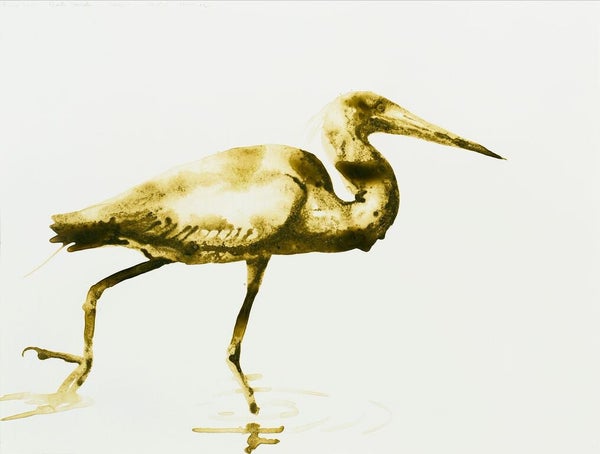
The relationship between dirt and paint may not be obvious to non-artists, but since humans were first moved to decorate themselves and their world, ground earth pigments have been a central ingredient in artistic expression. Artist Alexis Rockman draws attention to this often overlooked relationship in his latest body of work, a collection of 93 images of plants and animals painted in mud, sand, and clay from various sites in Eastern Long Island, NY.
On supporting science journalism
If you're enjoying this article, consider supporting our award-winning journalism by subscribing. By purchasing a subscription you are helping to ensure the future of impactful stories about the discoveries and ideas shaping our world today.

Eastern Wild Turkey (Meleagris gallopavo silvestris) by Alexis Rockman, 2014;
Soil from Georgica Pond and acrylic polymer on paper, 12" x 16"
Courtesy of The Drawing Room, East Hampton
Long Island may be best known for its residents’ funny accents and proximity to New York City, but according to the Long Island Nature Organization, it occupies an interesting ecological niche. For many northern species, Long Island is the furthest south they can be found; likewise, for many southern species, it represents the northern extent of their range. This makes the island a unique melting pot, contributing to a vibrant and diverse ecosystem. Sadly, this and countless other locales across the globe tell a story by now as familiar as our own names. Human encroachment on native habitats is decimating species that have nowhere else to turn.

Broadleaf Cattail (Typha latifolia) by Alexis Rockman, 2014;
Soil from Big Reed Pond and acrylic polymer on paper,
20” x 14”
Courtesy of the artist
In formulating this project, Rockman met with local experts and chose to highlight locations and species that are threatened by human activity to draw attention to their plight. To underscore the species' vital connection to place, he used mud and dirt collected from their habitats to draw them. His resulting works on paper, East End Field Drawings, are being exhibited through January 18th, 2016 at the Parrish Art Museum on Long Island. All 93 images are also available in a full-color exhibit catalog which can be purchased for $20 from the museum’s gift shop.

Virginia Opossum (Didelphis virginiana) by Alexis Rockman, 2014;
Soil from Georgica Pond and acrylic polymer on paper, 16" x 12"
Courtesy of The Drawing Room, East Hampton
Alexis Rockman: East End Field Drawings
October 25, 2015 to January 18, 2016
Parrish Art Museum
279 Montauk Highway
Water Mill, NY
Fun fact: not all of Rockman’s work is loose or gestural, although he has revisited this style of drawing consistently throughout his career. Many of his paintings are hyperreal in style and/or surreal in subject - an interesting tidbit when you learn that he provided concept sketches and a storyboard for the Academy Award winning film, Life of Pi.