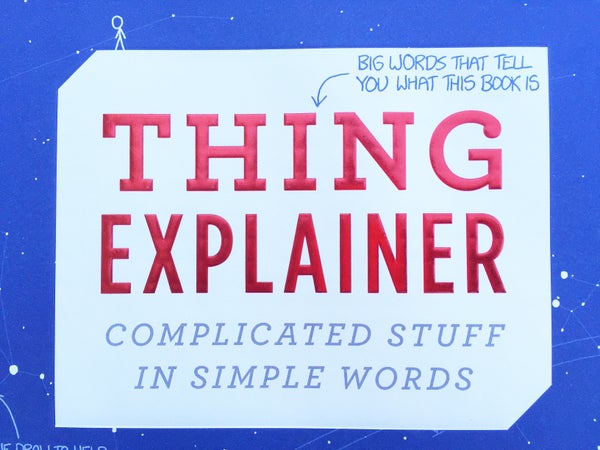
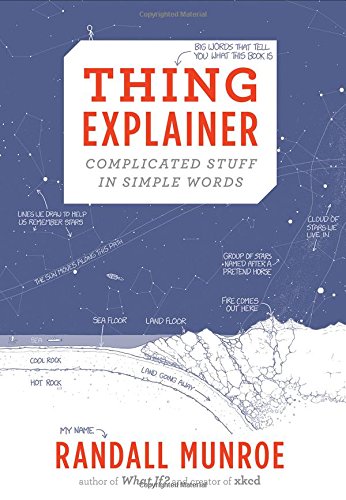
"Thing Explainer" Explains All the Things!

Randall Munroe, author of "What If?" and the creator of XKCD, has a new book explaining complex processes and machines with the thousand words people use most often.

Join Our Community of Science Lovers!

This article was published in Scientific American’s former blog network and reflects the views of the author, not necessarily those of Scientific American


Do you know the 10 hundred words people use most often? Well, thousand isn’t one of them. Neither is organ, helicopter, or battery, but that doesn’t stop Randall Munroe from explaining them all using only this basic vocabulary—er, letter groups—in his new book, "Thing Explainer."

In the “page before the book starts,” Munroe explains his (and our collective) complicated relationship with industry jargon. Of course it’s useful in a setting where specificity is paramount, such as if you’re working for NASA and building a spacecraft (uh, space machine). For the rest of us, how important is it to know what something is called as long as you understand what it does? As Munroe explains, there are lots of resources about what all these specific parts, process, and concepts are named; “Thing Explainer” is about what they do and how they work.

This book is a feast for the eyes and a party for your brain. I cannot more highly recommend that you get this for yourself, your favorite nerd, or someone who just loves beautiful drawings.


On supporting science journalism

If you're enjoying this article, consider supporting our award-winning journalism by subscribing. By purchasing a subscription you are helping to ensure the future of impactful stories about the discoveries and ideas shaping our world today.


It’s Time to Stand Up for Science

If you enjoyed this article, I’d like to ask for your support. Scientific American has served as an advocate for science and industry for 180 years, and right now may be the most critical moment in that two-century history.

I’ve been a Scientific American subscriber since I was 12 years old, and it helped shape the way I look at the world. SciAm always educates and delights me, and inspires a sense of awe for our vast, beautiful universe. I hope it does that for you, too.

If you subscribe to Scientific American, you help ensure that our coverage is centered on meaningful research and discovery; that we have the resources to report on the decisions that threaten labs across the U.S.; and that we support both budding and working scientists at a time when the value of science itself too often goes unrecognized.

In return, you get essential news, captivating podcasts, brilliant infographics, can't-miss newsletters, must-watch videos, challenging games, and the science world's best writing and reporting. You can even gift someone a subscription.

There has never been a more important time for us to stand up and show why science matters. I hope you’ll support us in that mission.

Thank you,

David M. Ewalt, Editor in Chief, Scientific American

Subscribe