
This article was published in Scientific American’s former blog network and reflects the views of the author, not necessarily those of Scientific American
Bullies often like being bullies—and an entire line of research links aggressive behaviors to brain areas tied to sensations of reward—sites deep below the organ’s surface with names like the ventromedial hypothalamus and the extended amygdala.
One lingering puzzle is what precedes the aggressive act. What makes a person—or, in this case, a mouse—lash out? A new study, published June 29 in Nature, shows that the thought of being the aggressor simply feels good to certain animals. I had a fascinating talk this week with Scott Russo from the Icahn School of Medicine at Mount Sinai, the paper’s senior author, who described the significance of these findings.
On supporting science journalism
If you're enjoying this article, consider supporting our award-winning journalism by subscribing. By purchasing a subscription you are helping to ensure the future of impactful stories about the discoveries and ideas shaping our world today.
[An edited transcript of the interview follows.]
What did your study find?
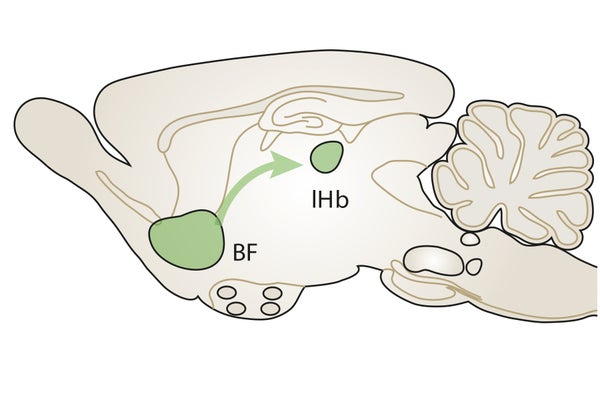
We discovered a brain circuit—connecting the basal forebrain and lateral habenula—that appears to control the motivation of a male mouse to be aggressive and subordinate another male mouse. The significance of these findings is that the circuit seems to be telling an animal that subordinating, or “bullying,” another animal is a rewarding behavior.
To test this, we adapted a conditioned place preference protocol—often used to measure the rewarding properties of addictive drugs, whereby mice were allowed to attack an intruder mouse within one of two environmental contexts: When asked which of the two environmental contexts they preferred, aggressive mice chose the environment in which they were allowed to attack the intruder mouse over the environment in which they had no access to the intruder mouse. Interestingly, the basal forebrain and lateral habenula have been previously shown to support conditioned place preference to drugs of abuse, such as nicotine and cocaine, suggesting that similar neural processes mediate rewarding aspects of aggression and addictive substances.
Does this perhaps provide some indication about the biological underpinnings of bullying behavior in animals in general, including humans?
There is some reason to believe that this is a conserved behavior across multiple species, including humans. For example, previous work in rats shows that when an aggressive male is allowed to attack and subordinate an intruder male, there is greater release of dopamine—a neurotransmitter in the brain that signals pleasure—within a structure called the nucleus accumbens. Although we have to be cautious when interpreting our studies within the context of human behavior, there are some interesting parallels with human antisocial personality disorder or psychopathy. Functional brain-imaging studies suggest that certain basal forebrain areas—notably the nucleus accumbens—are activated when subjects with antisocial personality disorder or psychopathy view images of other individuals hurt or in pain. The results have been interpreted to suggest that they find pleasure in viewing other’s in pain.
Is it conceivable that your findings would have some clinical significance in treating bullies through behavioral therapies or with drugs or medical devices?
We know so little about the fundamental mechanisms driving aggression or bullying behavior that we are probably a long ways away from developing new therapies or treatments for such behavior. However, I truly believe that by gaining a basic understanding of the brain circuits and neurotransmitters controlling complex aggressive behaviors, we will pave the way for future development of new strategies to reduce violence and aggression.
How does this fit within the broader sweep of research that you are pursuing?
The primary focus of my research group had been to identify novel biomarkers [measurable activity] that correlates with depression in humans and then reverse-translate these findings to relevant mouse stress models to determine whether any of these biomarkers actually play a role in causing depression- or anxiety-related behaviors. Over the past decade we have utilized a social-defeat stress model in which a larger aggressive mouse “bullies” a subordinate intruder mouse, inducing a wide spectrum of depression- and anxiety-like behaviors in the intruder. Our studies have provided important preclinical data informing clinical studies of new antidepressant treatment strategies. Despite having some success with such studies, we couldn’t help but ask ourselves whether a better depression prevention strategy might be to mitigate aggression and violence towards others in the first place. Thus, we flipped the question and began studying the bully mouse rather than the socially defeated subordinate mouse.