

This article was published in Scientific American’s former blog network and reflects the views of the author, not necessarily those of Scientific American
Third Eye Blind singer Stephan Jenkins mocked Republicans last summer who thronged to a concert in Cleveland that coincided with the convention by asking who in the crowd was a devotee of the sciences. Jenkins’s ironic comment was not quite fair because it appeared to roundly tar Republicans as an organized opposition to the ultimate fact-based endeavor.
It is not an alternative fact that the Trump administration has proposed massive cuts in federal science spending. Yet, surveys in recent years have shown that science still ranks among the most-respected professions in the public eye, far above the esteem held for, say, the clergy. And even people who question evolution somehow have no difficulty in voicing support for science as a contributor to societal well-being.
What exactly does it mean, though, to back science—and does that relate somehow to the polarized U.S. political landscape? Or are these nothing more than empty endorsements tinged with nostalgia for chemistry kits, moon shots and photos of Einstein’s bad hair, bygone fantasies about what scientists really do for a living?
A team of researchers from the University of Chicago and colleagues came up with a novel means of tackling these questions. They decided to forego yet another poll asking people what they think and instead consider what they really do. In other words, the investigators decided to follow the money.
On supporting science journalism
If you're enjoying this article, consider supporting our award-winning journalism by subscribing. By purchasing a subscription you are helping to ensure the future of impactful stories about the discoveries and ideas shaping our world today.
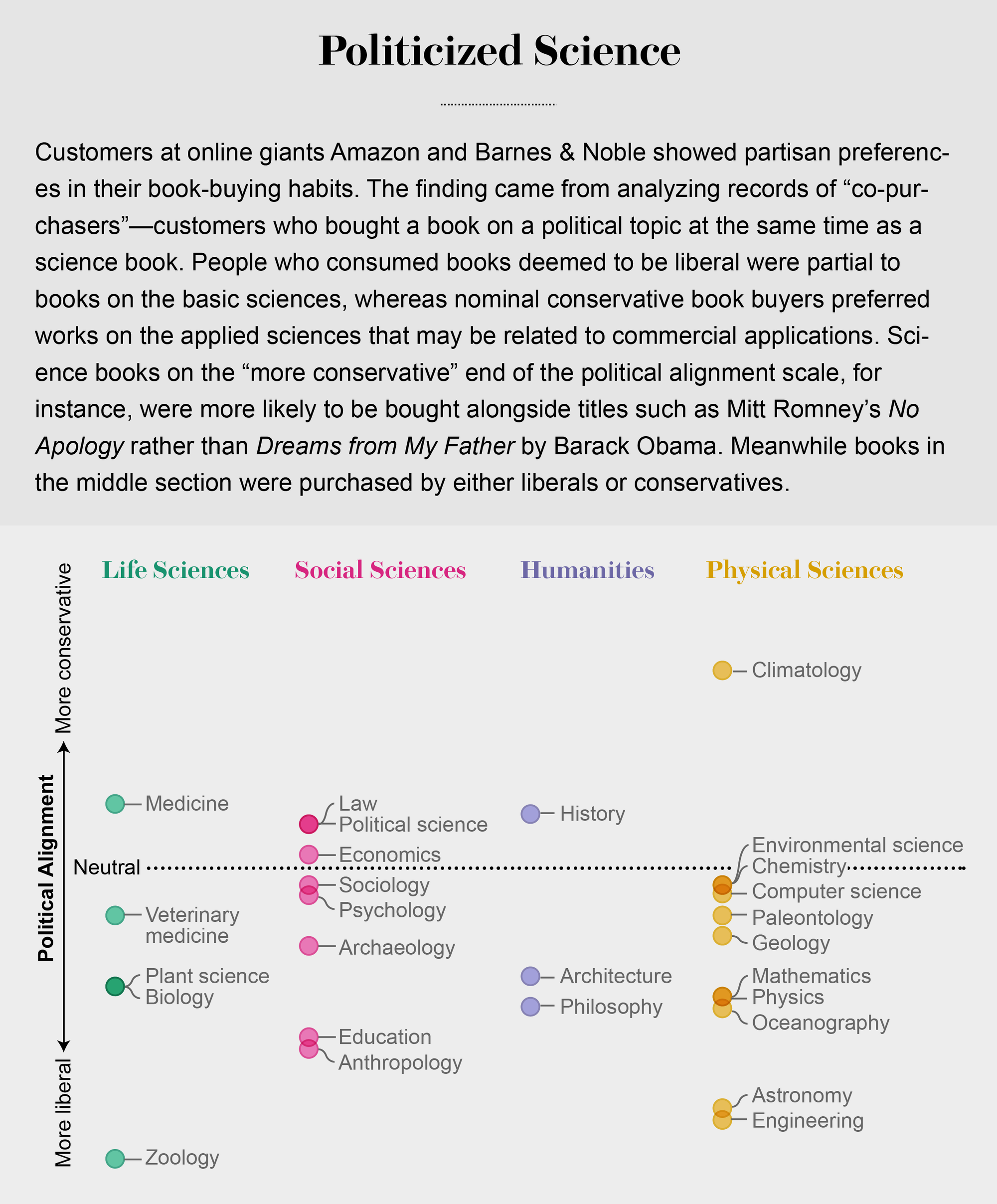
They examined millions of book purchases at Amazon and Barnes and Noble in which buyers bought a political book at the same time as a science tome. The research kept the team busy. They had to classify 428,433 books from the Library of Congress as science-related (further subcategorized mainly by discipline) and 3,350 books from the booksellers deemed to deal with politics, more than 1,200 of them designated as either liberal or conservative in persuasion.
Credit: Amanda Montañez; Source: “Millions of Online Book Co-Purchases Reveal Partisan Differences in the Consumption of Science,” by Feng Shi et al., in Nature Human Behavior, Vol. 1, No. 0079; April 3, 2017
It turned out that both red and blue book buyers show a liking for the sciences, but the partisan divisions still held. Presumed liberals and conservatives bought books on different science topics. A “blue” political book often went with the purchase of a basic science book—physics, astronomy or zoology, to name a few. A “red” tome more likely accompanied the buying of applied science titles—say, organic chemistry, law or medicine. Overlap occurred in a purple zone that contains books on topics such as paleontology, surprisingly. Yet the research did find red customers’ appreciation for “a narrow cluster of relatively peripheral books in the more polarized disciplines is consistent with recent research documenting growing skepticism among conservatives of the cultural authority held by professional scientists.”
The study, which appears in Nature Human Behavior today, was by no means the last word on who believes in science because it did not involve a random sample of readers. Half the population buys books through online vendors, but other studies are needed of the other 50 percent before generalizations can be made about the red-blue science reading split.
The more-research-is-needed mantra still holds, but there was enough evidence collected that a commentary in the journal accompanying the study warned of the danger of an echo-chamber effect in which like-minded individuals expose themselves to the same sources of scientific and political information—a circumstance that might ultimately undermine the ability of science to inform political debate.