
This article was published in Scientific American’s former blog network and reflects the views of the author, not necessarily those of Scientific American
Every so often I’m briefly and viscerally aware of environmental "triggers," cues to use a substance, and how difficult evading them must be for addicts. Alcohol, on billboards and shopping bags, commercials and taxi cabs, is everywhere, and avoiding it teems with impossibility. For the rest of us, it may be moderately comparable to running into a friend you’ve fought with – you may avoid your usual grocery store, certain gym hours, common social functions and neighborhoods altogether. In fact, you may rearrange your life to avoid a close encounter. You may try to avoid even speaking about this former friend. For addicts, that reality is daily, even lifelong, and their spurned ‘friend’ is a bottle.
Avoiding a trigger like the beer aisle in the grocery store may seem like an easy feat, but many more reminders lie in the form of social gatherings and conversations. And the truth is, addicts likely begin thinking about alcohol long before they actually see it at a dinner party. In PET image scans, addicts' brains show a circuitry frenzy and a chemical compulsion to use after being shown a 'trigger' image, such as a beer bottle, for even a third of a second. This timetable isn't even long enough for the conscious brain to realize what it's seen. In day-to-day life, even a flicker of a thought can cue a brain-mandated relapse, though a person may not realize what set their neural wirings off.
Addicts have a very sensitive 'Go' portion of the brain; the older primitive system responsible for survival instincts like getting food and finding a mate also pushes them to use their substance. This is part of the reason why relapse can occur after years of avoiding a drug: should an unconscious brain reflex be cued, addicts' brains go into a primal "use to survive" mode. And actually, relapse rates for addiction are similar to those of other chronic diseases, like Type 1 Diabetes, hypertension and asthma.
On supporting science journalism
If you're enjoying this article, consider supporting our award-winning journalism by subscribing. By purchasing a subscription you are helping to ensure the future of impactful stories about the discoveries and ideas shaping our world today.
Though it's important to understand the quick and insidious effect of triggers, over time the brain can return to "normal" -- regain healthy levels of neurotransmitters and their transporter bindings -- which makes addicts less likely to relapse. However, even with renewed neurotransmitter function, addicts have to constantly manage their disease.
To this I wonder if we minimize relapse and alcohol abuse potential as a society. Of course, the liquor industry will always promote its products and Hollywood will continue to make them look glamorous, but what lifestyles and choices do we inadvertently choose to promote? Do we unknowingly make life difficult for recovering addicts, many of whom -- neighbors, friends and colleagues -- we may not know have a substance problem? Or perhaps worse, do we encourage an abuse problem?
As a writer, indulging in alcohol (and overindulging) seems a nearly mandatory hobby, a coping exercise and creativity jump-start, accordingly to jokes and industry stereotypes. Verbal and non-verbal lifestyle cues across business sects rarely come with alternatives; there's no adopted group exercise or meditation, nor other healthy mood-influencing activities, acceptable or cool in office culture to ease the frazzled mind. Substances are the chosen cure-all for tonight, until tomorrow, next Friday or the next time creative process needs to hit again.
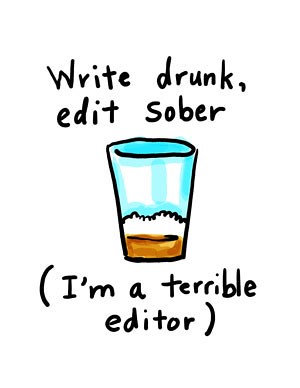
Here I look to a few fields I've been immersed in -- journalism for one, business for another, science for a third. I've seen an editor too hungover to move in her office (and her accepting, disconnected colleagues), business executives ritually "pounding shots" after 5 p.m. COB on Fridays, vodka-soaked watermelon in a -30 degree science lab freezer. It's not the fault of the business but the culture surrounding it. This type of wide-spread "relaxation" is somehow justified, perfectly permissible and a representation of camaraderie, however much it slyly encourages reliance on substance use.
This isn't sustained relaxation, but it's the socially understood and dominant unwinding medium. As a fellow writer once said to me, "drinking's just what we do." That sort of frightening logic suggests why substance abuse problems are almost too easy to slip into. Is complying to society’s norm worth the long-term consequences of triggering potential substance use, abuse or relapse in those around us, and in ourselves?