
Space & PhysicsFebruary 22, 2012
Dual Interpretations: Milky Way's Outer Fringe of Stars Sparks Disagreement
Resolving how the galaxy's halo of stars was assembled would provide important clues about galactic formation
Dual Interpretations: Milky Way's Outer Fringe of Stars Sparks Disagreement
Resolving how the galaxy's halo of stars was assembled would provide important clues about galactic formation
A Universe from Nothing: Einstein, the Belgian Priest and the Puzzle of the Big Bang
An excerpt from physicist Lawrence M. Krauss's new book explains why we are not the center of the universe

The Quantum Physics of Free Will
Do we have autonomy, or are our choices preordained? Is that a false choice? And what, if anything, does physics have to say about that?
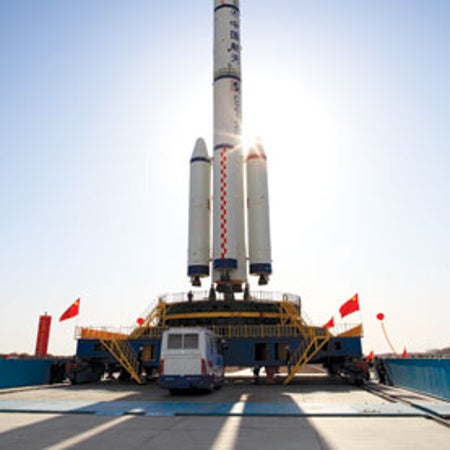
Should the U.S. Collaborate with China in Space?
During the cold war the U.S. found ways to work with the Soviet Union on space missions

A Sea of Spacetime Foam?

Is Space Digital?
An experiment going up outside of Chicago will attempt to measure the intimate connections among information, matter and spacetime. If it works, it could rewrite the rules for 21st-century physics
Gigantic Radio Telescope to Search for First Stars and Galaxies
The array could be the most complex and versatile radio telescope ever attempted, with the capacity to sweep the entire northern sky in 45 days for low-frequency radio waves
Catching a Gravity Wave: Canceled Laser Space Antenna May Still Fly
The ambitious Laser Interferometer Space Antenna, a casualty of tightening budgets, could rise again
Future Studies Will Extend Census of Middleweight Black Holes
The current census of middleweight black holes is incomplete in many ways. Additional studies will push astrophysicists' understanding of and search for middleweights in new directions
Radio Array Starts Work to Detect Whispers from Universe
Giant low-frequency sensor system on track to probe the birth of the first stars.
Biggest Map Yet of Universe's Invisible Dark Matter Unveiled
Scientists hope that by plotting out the distribution of dark matter throughout space, they will come closer to understanding what it is
Race between Two Photons Ends in a Tie
Result puts limit on how 'lumpy' space-time can be.