


On a July afternoon in 1992, a young postdoc came to Richard Blumberg’s office at Harvard Medical School, worried about a lab study. Analyzing cells from an adult human intestine produced an unexpected discovery: the cells contained what Blumberg, a physician-scientist specializing in immunology, soon determined was the neonatal Fc receptor (FcRn), a protein previously found only in newborn rodents. No one had encountered FcRn in an adult animal, much less in a human being. The postdoc thought he had performed “a failed experiment,” Blumberg says.
Instead, the seemingly botched experiment helped launch a new generation of therapies for autoimmune diseases afflicting hundreds of millions of people.
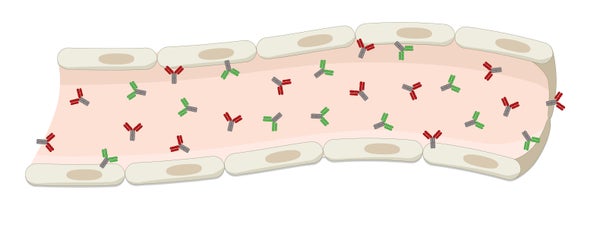
Scientists now know that FcRn plays a crucial role in maintaining a healthy immune system by keeping immunoglobulin G (IgG), the most abundant type of human antibody, in circulation throughout life. Many variants of IgG exist, each of which flags different viruses, bacteria and other pathogens for destruction, making them essential for immune defenses. IgG and other antibodies are made by B cells in the immune system. In some cases, however, B cells mistakenly produce autoantibodies that attack the body’s own cells and tissues.
The resulting autoimmune diseases have traditionally been treated with broad-acting immunosuppressants like corticosteroids. Although long-term use of corticosteroids can cause negative side effects, including bone loss and higher risk of infection, these treatments remain widely used because they rapidly suppress autoantibodies and reduce inflammation, which is common in autoimmunity.
“Our focus is on identifying the actual causes of autoimmune diseases and finding specific interventions with favorable safety and efficacy profiles,” says Peter Ulrichts, chief scientific officer at argenx, an immunology innovation company that develops antibody-based therapies.
FcRn-directed drugs are one of those interventions. They reduce IgG levels selectively while largely sparing the rest of the immune system. By reducing—and in some cases replacing—the need for corticosteroids, such treatments can lower infection risk while keeping autoimmune symptoms under control. “That’s good for patients,” Blumberg says.
Dedicated Recycling
Before Blumberg’s team detected FcRn in human tissues, the protein was known for supplying nursing rodent pups with IgG from their mothers. The research began in the 1960s at what is now Bangor University in Wales, when Irish zoologist F.W. Rogers Brambell proposed that a single protein works via two mechanisms to protect pups from infection.
The two mechanisms were confirmed by separate teams. First, scientists at the Whitehead Institute for Biomedical Research revealed in the late 1980s that FcRn carries IgGs from the mother’s milk across a rat pup’s gut wall and into its bloodstream, which builds a pup’s immune response. (Later experiments showed that in humans, FcRn transports IgG into a fetus through the placenta.)
In the mid-1990s Sally Ward—then a molecular immunologist at UT Southwestern Medical Center in Dallas and now at the University of Southampton in England—proved that FcRn rescues IgG from destruction. It does this by serving as part of a specialized recycling system that keeps IgGs circulating at high levels and for longer durations than other types of antibodies.
At first, it was not clear how this recycling operation worked. Like all antibodies, IgG is a Y-shaped molecule. Each arm of the antibody ends in a binding site that recognizes and latches on to a specific molecular marker, called an antigen, on the surface of a microbe. These markers vary, allowing antibodies to distinguish one target from another. In contrast, the stem of the antibody—its Fc region—has a relatively constant structure.
Ward found that IgGs are routinely engulfed by cells as part of a regular housekeeping process that breaks a variety of proteins down into their constituent amino acids. FcRn intervenes in that housekeeping process—grabbing IgG by its stem and whisking it away from the cell’s garbage disposal and releasing it back into circulation. (See “Subduing dangerous antibodies.”)
In this way, FcRn recycles IgGs that fight pathogens, returning them to the bloodstream so they can keep doing their job. But in the process, FcRn also recycles IgG autoantibodies that attack the body’s own tissues and make people sick.
A Novel Target
Ward first began to consider FcRn as an autoimmune disease drug target in the early 2000s. By then she had shown that FcRn could be harnessed to keep therapeutic antibodies in circulation longer by boosting IgG recycling. The strategy has since been used to create experimental therapeutic antibodies for several infectious diseases, including an approved drug to prevent RSV infection in infants.
Ward also envisioned targeting FcRn with a drug that would inhibit IgG recycling, thereby blocking recirculation of harmful autoantibodies. She engineered an IgG with five mutations in its Fc fragment so it binds to FcRn more tightly than the body's own IgG. With an FcRn-blocking IgG, other IgGs are unable to be recycled, and are sent to the cell’s garbage disposal for destruction. The result: both fewer healthy IgG antibodies and rogue IgG autoantibodies leave the cell. Although researchers considered the possibility that so many healthy antibodies would be removed that infection risk would rise, the method does not impact IgG production and leaves some IgGs in circulation to decrease infection risk.
Ward’s strategy had a further benefit: FcRn also recycles albumin, an essential protein that keeps fluid from leaking out of blood vessels. But since FcRn has separate binding sites for IgG and albumin, the uniquely engineered molecule was able to block FcRn from recycling IgGs, while maintaining its grip on the albumin and recycling it back to the bloodstream. Ward tested the engineered Fc fragment in mice, and it “cleared autoantibodies at remarkable speed,” she says.
An Expanding Horizon
In partnership with argenx this concept was optimized and was the first FcRn-directed therapy brought to market. Called efgartigimod, this Fc fragment was the first such therapy approved for treating generalized myasthenia gravis (MG), an autoimmune disease impacting the connections between nerves and muscles. Additional approvals for efgartigimod have followed, including one for chronic inflammatory demyelinating polyneuropathy (CIDP), which affects the fatty covering that insulates peripheral nerves. Moreover, efgartigimod was the first therapy with a new mechanism of action approved for CIDP since the 1990s.
Ward and argenx continue to partner and work together through the company’s Immunology Innovation Program (IIP), which promotes collaborations with academic and clinical researchers around the globe, combining their deep disease and target biology expertise with argenx’s antibody-engineering and development capabilities.
Meanwhile, Blumberg sees a bright future ahead. In addition to argenx, other companies are pushing towards new formulations of FcRn inhibitors that require fewer return visits to the clinic and that might be given as pills rather than infusions or injections.
Even now, argenx is testing efgartigimod against various IgG-mediated autoimmune diseases and neuromuscular conditions with some already in mid- to late-stage clinical trials. “We are optimistic the same approach could be used in more than 100 diseases in which IgG autoantibodies have been identified,” Ulrichts says. “The question is whether the autoantibodies are as central in these diseases as they are in MG and CIDP.”

Alisdair Macdonald
Explore argenx’s Immunology Innovation Program and learn more about antibody engineering.