
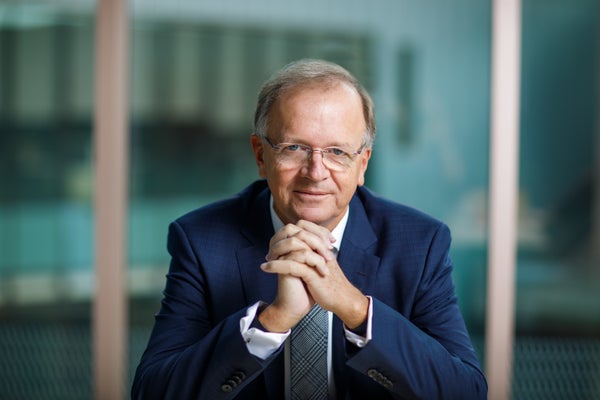


Peter Schlosser has spent his career studying the natural world and humanity’s place within it. Few people are better placed to understand how this relationship is breaking down and the scale of action required to reshape it. To contribute to this global effort, Schlosser founded and leads the Julie Ann Wrigley Global Futures Laboratory (GFL) at Arizona State University. The laboratory, founded in 2019, serves as a prototype of a university for the future of the planet, bringing speed, scale and a transdisciplinary focus to Earth’s connected systems.
What is the Global Futures Laboratory’s vision and mission?
Our vision is a world in which all life can thrive on a healthy planet. The mission, then, is to find options to keep our planet habitable and to increase well-being for all humankind. We’re looking to relieve some of the pressure we’ve put on the planet’s life-supporting systems, to get back towards equilibrium.
Why does our relationship with the planet need to change?
Humankind is one out of about 10 million known species but the only one that has developed the capability to over-exploit the services that the systems on our planet provide—not just for our species but for all life on Earth. We have to get back to the understanding that we are part of the Earth system.
Many researchers are working to address these problems. How is GFL's approach different?
We’re looking at the planet holistically. We’re not just looking at systems such as climate, energy, water, biodiversity and food. We’re also looking at the social dynamics and value systems behind decision-making to understand how we got into this situation and how we can incentivize people to make decisions that would be kinder to our planet. We include the humanities, social sciences, medical sciences and arts to understand our world from all angles. From the medical perspective, for example, we have a program that measures the impact of heat on the human body.
The lab is also an experiment in how academia can be more effective in being part of society, a trusted partner, able to engage with people affected by these problems and understand what they need to make critical decisions on fast timescales.
What are some examples of ongoing projects?
We have a large effort in direct air capture, which is taking CO2 back out of the atmosphere. We created a mechanical tree. It’s a cylindrical instrument with about 100 discs that are two centimeters apart. On these discs is a substance that captures CO2 as air passes through. We are upscaling it through a company that licenses our technology.
We’re also looking at the future of water—regionally but also globally in terms of how climate change is changing water budgets because we’re having more floods and more droughts. It’s a natural fit for us because the Southwest is drying out.
But there is a danger that we go from denying the problems to becoming fatalistic. That would be the worst outcome. With these challenges there are opportunities. There are many trillion-dollar industries waiting to be built. We have to accept change as opportunity rather than sacrifice.
Explore the Global Futures Laboratory’s work to redefine humankind’s place in our world.