
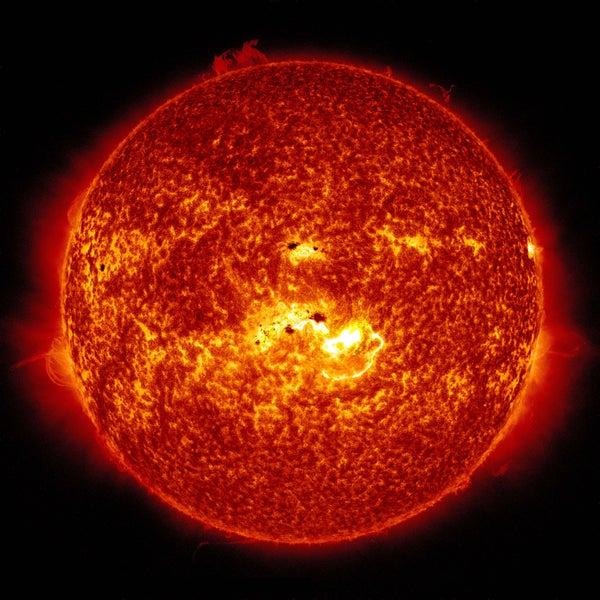


In the summer of 1975, Jørgen Christensen-Dalsgaard became obsessed with the idea of seeing inside the sun. He was at a conference where an astronomer presented data that suggested our home star was alternately expanding and contracting. “I immediately thought that the waves that produce these oscillations must go all the way through the center of the sun,” he says.
If so, he realized, astrophysicists would have a powerful new tool to monitor reactions in the solar core, where nuclear fusion converts solar mass into radiant energy.
Although the 1975 data turned out to be an artifact, later observations of the sun showed that Christensen-Dalsgaard’s instincts were spot on. Astrophysicists have studied internal sound waves to study the structure, evolution and dynamics of the sun’s interior—and that of thousands of distant stars as well.
Astronomers had first spotted the solar surface oscillating in the 1960s. Not long after, Roger Ulrich, now a professor emeritus of astrophysics at the University of California, Los Angeles, laid out the equations that explained why the sun shimmers as it shines. “I solved them the way you would calculate the tone of an organ pipe,” he recalls.
Ulrich’s theoretical work validated the idea that hot gases within the sun bubble toward the solar surface and sink as they cool, generating waves that resonate inside the sun, much as air made to vibrate in an organ pipe generates waves that resonate to produce specific tones. Since the behavior of sound waves varies with the properties of the medium they’re traveling through, Ulrich realized that studying a star’s sound waves could reveal the makeup and dynamics of the star’s interior.
Ulrich and Christensen-Dalsgaard, an asteroseismologist now at Aarhus University in Denmark, then worked for years to promote the establishment of ground-based telescope networks and, later, space-based telescopes precise enough to detect visible signs of sound waves inside the sun and distant stars. That data allowed asteroseismologists a powerful tool to measure the mass, gravity, chemical makeup, rotation and age of thousands of stars, revealing insights into the evolution of the Milky Way itself.
“Those data are something we will continue to work on for a very long time,” says Christensen-Dalsgaard, who shares the 2022 Kavli prize in astrophysics with Ulrich and asteroseismologist Conny Aerts of KU Leuven, Belgium, for their pioneering work in helio- and asteroseismology.
Here, Christensen-Dalsgaard pokes holes in our current understanding of stellar interiors—including that of our own sun—and ponders Earth’s fate, our galaxy’s history and the possibility of extraterrestrial life.
What happens inside a sun-like star when it burns up its hydrogen and evolves into a red giant?

2022 Kavli Prize laureates Jørgen Christensen-Dalsgaard (left) and Roger Ulrich.
As a star becomes a red giant, its outer layer expands and cools, while its helium core contracts. You would expect the rotation of this contracting core to speed up—just as a figure skater spins faster when she pulls in her arms. But in these red giant stars, the core does not rotate as rapidly as our models would predict. Something is slowing it down, perhaps magnetic fields. But how these fields arise, how they interact with the matter in stars, and how they evolve over the lifetime of a star—these are all open questions. The answers could affect our understanding of the evolution of the massive stars that will become supernovae and create a lot of the elements in the universe.
Will the Earth ultimately be swallowed by the sun?
We don’t yet know. In the very late stages of solar evolution, the sun will expand greatly in size. At the same time, it will be losing mass. This means that Earth will drift farther away from the sun. How rapidly the sun loses mass compared with how rapidly it expands will determine whether Earth ends up swallowed or whether it manages to hang on out there. Either way, in 5 billion years the sun is going to be very much brighter than it is now, so Earth is not going to be a very nice place to live.

Illustration by Falconieri Visuals
How did the Milky Way evolve—and what’s next for our galaxy?
Going back maybe seven billion years, there is evidence that a fairly large galaxy merged with the Milky Way. We can see streams of stars that joined after the bulk of the galaxy was formed. One way we see this is by looking at what the stars are made of: their composition holds the secrets of the environment where the stars were formed. We can also see how they move in the sky and determine how old they are.
Mergers are still going on in the present universe. Two Magellanic Clouds are probably going to merge with the Milky Way in a billion years or so, and the Andromeda galaxy is also going to merge with the Milky Way, maybe a few billion years down the line. In these merger events, you see regions of very rapid star formation where the two galaxies overlap. Although it happens on a timescale of a few hundred million years, it’s quite dramatic.
Could there be life elsewhere in the universe?
Thanks to the Kepler mission, we’ve found Earthlike planets in the “Goldilocks zone”—not too warm, not too cold. We haven’t found very many, and some are around stars that are very different from the sun. We want to look for more Earth-like planets in the right place around a star that’s not too different from the sun. Then we want to look at the atmosphere of those exoplanets to look for molecules that indicate the presence of life. Oxygen, for instance. Knowing that life has evolved elsewhere in universe would be huge. One might then imagine that at least somewhere in the universe there’s intelligent life.
To learn more about brilliant work of Kavli Prize laureates, visit kavliprize.org. To explore more of the biggest questions in science, click here.
