


The practice of genetic modification is as old as humanity. For thousands of years, humans have bred crops, livestock and even pets that possess desirable traits. This selective process, which alters an offspring’s genome, began long before anyone knew of genes or DNA, and it has shaped the course of human civilization.
The same might one day be said for the gene-editing technology known as CRISPR (clustered regularly interspaced short palindromic repeats). In a decade, scientists have transformed CRISPR from a natural system used by bacteria to block viral attacks into a molecular scalpel for genetic engineering. CRISPR permits researchers to make precise deletions or substitutions in a specific genetic sequence. Its applications have proliferated, and already many have begun to transform approaches to agriculture and disease research and treatment.
As a chief architect of formative CRISPR research, Emmanuelle Charpentier shared the 2018 Kavli Prize in Nanoscience with Jennifer Doudna and Virginijus Šikšnys—followed by a 2020 Nobel prize with Doudna. Charpentier talked with Scientific American Custom Media about how to harness the full power of CRISPR to fortify crops against the impacts of climate change; how to accelerate the treatment of infectious and genetic diseases; and what lies ahead for science itself.
Will we be able to use CRISPR as a drug to treat human disease?

There is great interest in this. Right now, CRISPR is being developed to treat certain blood disorders like sickle-cell disease. In that case, hematopoietic stem cells are harvested from the patient, and the disease-related gene is edited with CRISPR outside the body, before the cells are given back to the patient. These cell-based therapies are awaiting approval from the FDA and European regulators, and the first patients are expected to receive treatment with the commercial version in the coming year.
For disorders caused by single genetic mutations, like Huntington’s disease and certain forms of Alzheimer’s disease, the delivery of CRISPR-Cas9 to tissues inside the body is a bottleneck. A delivery system has to be safe, with no secondary effects. It also needs to be precise enough to target a specific tissue and provide the correct amount of CRISPR-Cas9 to cells. People are working to develop delivery systems, such as lipid nanoparticles and lentiviral vectors, but it remains a key challenge.
Could CRISPR be used to combat infectious disease?
Some biotech companies are developing strategies that use CRISPR to target the DNA of certain bacterial species. The idea is that DNA repair mechanisms in bacteria are relatively weak, so DNA cleaved by CRISPR-Cas9 would not be repaired or fully replicated, and the bacteria would not survive. This approach looks nice on paper, but there are a few hurdles to treating bacterial infections, including how to bring CRISPR to the right bacterial species in the body. I do think CRISPR could be a promising way to treat viruses like HIV. Researchers could modify the CCR5 receptor that HIV uses to enter immune cells. This approach would not prevent infection, but it would block viral propagation.
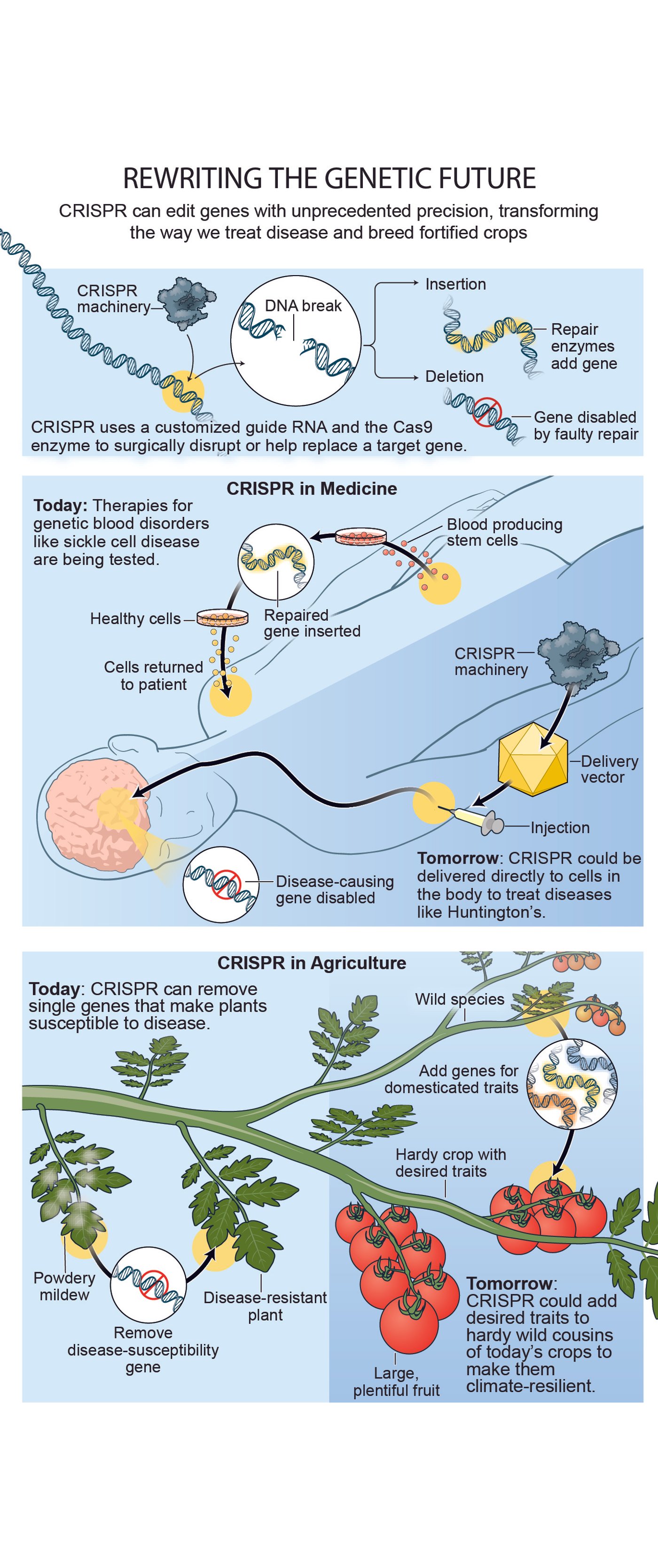
Illustration by Falconieri Visuals
How can CRISPR be used to improve agriculture?
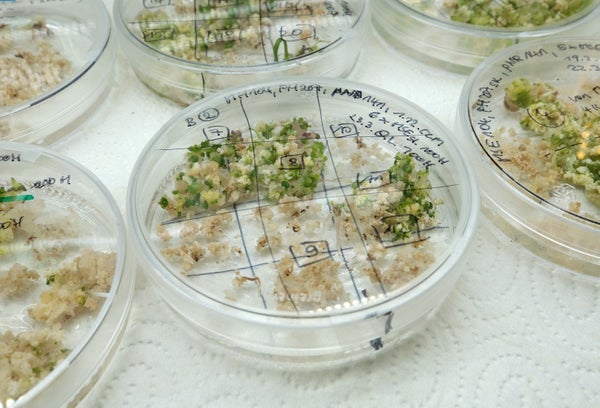
CRISPR offers the possibility of engineering plant crops that will help us face the challenges of climate change. One approach is to challenge plants with the types of stresses we think will be encountered in the future, such as rising temperatures and drought. Researchers then sequence the genomes of the plants that can resist those stresses and identify the mutations that confer resistance. They can then use CRISPR to reproduce the mutation that allows a plant crop to resist such challenges. CRISPR could also be used to custom-design plants optimized for a farmer’s soil type—a kind of personalized agriculture. The challenges of climate change are coming faster than we can react to them. If we don’t apply these technologies, there will be a part of the world without enough food.
How can we ensure that the scientific enterprise remains vibrant in the future?
Since the pandemic, a lot of PhD students have skipped a postdoc to go directly into startups and biotechs. Biotechs can be innovative, but we have to make sure that basic research is sustained. In the past, at least in Europe, labs were given core funding to do research without the need to constantly write grants. This model could provide some balance. Also, I think a lot of young researchers don’t want the pressure of being a group leader, so they go to a company where they can be part of a team. Maybe public institutions should evolve to be more like companies, with smaller groups that work together in an environment where everyone is supported, and success is evaluated at the level of the institute and its projects, not the individual.
Could microbes harbor other mechanisms that we could exploit technologically?
Bacteria are in a constant war with viruses. To survive, they have evolved novel defense systems. CRISPR-Cas9 is one of those, but we continue to discover others on a regular basis. The technologies we use in molecular biology and genetics have primarily come from basic research performed on microorganisms, and often on bacterial defense systems. Nature has a lot to offer and much of it is likely better than anything we could imagine.
To learn more about the work of Kavli Prize Laureates, visit kavliprize.org. To explore more of the biggest questions in science, click here.