


About a billion years ago, a pair of black holes 30 times the mass of our sun whirled around one another, drawing closer and closer. When they ultimately crashed together, the force of their collision sent shock waves skittering across the very fabric of space.
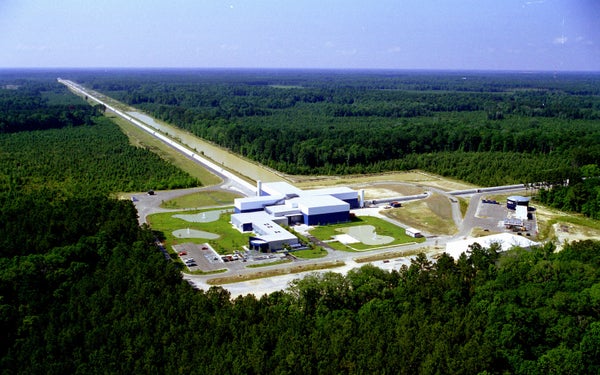
On September 14, 2015, an instrument called LIGO picked up the remnants of those ripples. The discovery of these gravitational waves provided solid proof of Einstein’s theory of general relativity, which predicted their existence more than a century ago. And it heralded the dawn of a new era of astronomy.
The gravitational waves that LIGO detected distorted the geometry of space-time by just 10—18 meter—a thousandth the width of the nucleus of an atom—and it registered here on Earth as a brief and gentle chirp. But detecting this previously unseen class of signals provides a new way of observing the cosmos, allowing us to tune in to collapsing stars, battling black holes and the universe itself.
Sensing such tiny stirrings in space-time required experimental breakthroughs, unflagging effort and four decades of high-tech troubleshooting, and it earned Rainer Weiss, Kip Thorne, and Ronald Drever the 2016 Kavli Prize in Astrophysics, followed by a Nobel Prize for Weiss and Thorne. It also gave them a front-row seat to the most epic astronomical pas de deux the world has ever witnessed.
Scientific American Custom Media sat down with Weiss to hear about the secrets and surprises he thinks gravitational astronomy is bound to reveal, including the nature of dark matter, the origin of the first black holes, and the events that transpired when the universe winked into existence.
Where do we go from LIGO?

To boost the sensitivity of our instruments by a factor of 10, we want to build the Cosmic Explorer, which has 40-kilometer arms—10 times longer than LIGO’s. Europeans will be building the Einstein telescope, which will be a triangle with 10-kilometer sides and three detectors, each with interferometers that can be tuned to different [gravitational-wave] frequencies. These longer antennae should be able to tune in to all the binary black holes in the universe that have come from the collapse of stars, as well as all the colliding neutron stars. The European Space Agency is also developing LISA—a space-based triangle of interferometers with arms about 1.5 million kilometers long that will hopefully launch in the 2030s. It will allow us to see—or hear—the collision of gigantic black holes that are a million solar masses, like the one at the center of our galaxy, and watch as they eat a smaller black hole, or even a star. It will be fascinating.
How do black holes form?
The most likely way is in a supernova, the end result of the collapse of a star. But we expect that nature can also make black holes by distorting space. This should make gravitational waves. It should distort and excite geometry, like a hammer to a xylophone, and make space-time ring. People have imagined these things over the years, but with Cosmic Explorer or LISA, we want to see them for real.
What exactly is dark matter?
I happen to think that dark matter is made of black holes—really small black holes, a tiny fraction of a solar mass, that don’t interact much with light so you can’t see them. The distribution of hot spots and cold spots we see in the cosmic microwave background radiation could not have existed unless there was dark matter holding those places together somehow. So dark matter’s been around since the beginning of time. And I think that black holes that form from distortions in the geometry of space are as good a candidate as anybody has right now.
What can neutron stars teach us about physics and chemistry?
People always wondered where in the universe you could create heavy elements like gold or platinum. Turns out it’s through neutron star collisions. Neutron stars pack the weight of the sun into the size of a city, and they’re made primarily of neutrons. When they crash into each other, they produce an afterglow called a kilonova, which is a plasma made of the most fundamental particles you can think of: gluons and quarks, things we see in atomic nuclei.
After LIGO detected the first neutron binary merger in 2017, people studied its kilonova. They identified broad [spectral] signatures for elements like gold and platinum. Looking at more of these collisions, we’re going to learn a lot about the fundamental interactions between particles. We don’t have an accelerator powerful enough to produce this kind of plasma on Earth, so that’s going to be a big deal.

Illustration by Falconieri Visuals
How did the universe come to be?
According to [cosmic inflation theory], the universe was created by a fluctuation in the vacuum. That kind of fluctuation will have instabilities and explode asymmetrically—which will generate gravitational waves. Those primordial gravitational waves, produced at the instant of creation, are still with us, still there to be measured. They’re too weak to be seen directly by any instrument being considered for the near future. But we might be able to measure them indirectly, based on how they polarize the cosmic microwave background radiation. Those experiments are ongoing. Detecting the primordial gravitational waves from the instant of creation—that would tell us about the origin of everything. And what could be more important than that?
What surprises might the universe still have in store for us?
When we start looking with new and more sensitive instruments, better instruments, we turn up all sorts of surprises. That’s happened over and over again in astronomy. Now, gravitational waves are showing us things we’ve never seen. The thing I’m really counting on is that we’ll find things we never even imagined in signals that come from the universe itself. That’s what’s driving me.
To learn more about brilliant work of Kavli Prize Laureates, visit kavliprize.org. To explore more of the biggest questions in science, click here.