
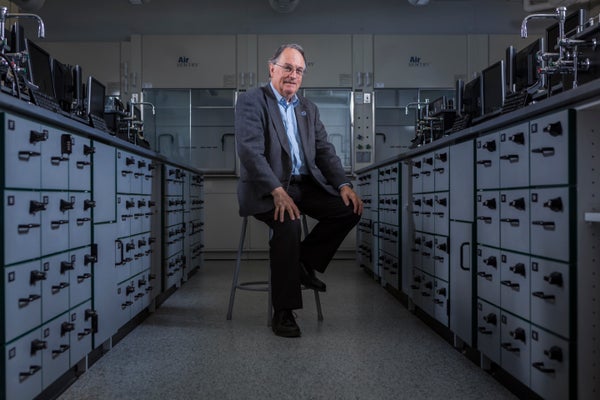



M. Stanley Whittingham shared the 2019 Nobel Prize in Chemistry for developing the chemistry used in rechargeable lithium-ion batteries, key components of today’s mobile electronics, electric vehicles and electrical grid storage, and he has spent his career working to improve their capacity and useful life. Today he helps lead New Energy New York (NENY), a Binghamton University–led coalition of upstate New York universities and companies that aims to develop longer lasting, more environmentally friendly batteries—and train local workers to manufacture batteries at a large enough scale to boost the regional economy.
What applications need better batteries?
We believe the largest applications in the next 10 years will come in places like New York City, London and Paris, where they're going to ban internal combustion engines. Suddenly, businesses like Amazon, as well as buses, delivery trucks, postal fleets—all those are probably going to have to go all-electric. Another is grid storage. The utilities want their grid storage to last for 25 years or, ideally, forever.
How do you define a better battery?
The higher we can get the energy density, the more the cost of the materials goes down. Right now we're using 60% of the material. We should be using 100% of it. The other 40% is the lithium that stays in the electrodes, so we have to charge them harder to get the rest out, and that causes some degradation.
What improvements do you hope to make in batteries?
The energy density of batteries has gone up by a factor of 50 percent in the last five or six years, and prices dropped by a factor of four or five. On a large scale you can buy a lithium-ion battery for about $100 a kilowatt hour. Ten to 15 years ago, that was $3,000. The Department of Energy wants it to get down to about $60 or $70. We should be able to do it. We also want to make them in the most sustainable way possible and get the bad chemicals out of the process. There’s N-methyl-2-pyrrolidone, which is used to make the paste you make the electrodes with. If we can get that out of there, we’d save at least a third of the energy and get the toxicity out of the manufacturing plant.
Why do you want to make the supply chain for batteries more U.S.-based?
During COVID, you couldn't get masks, you couldn't get semiconductors, because 70 or 80 percent of the product goes through one country. We got too globalized, so things can go wrong very fast. We have lithium, iron and phosphorus in North America, so we have all the components of batteries, and
we don't have to worry about anybody else's supply chain. If you find all your products within, say, 1,000 or 2,000 miles, you’ll need less transportation and it will make life much easier.
Click here to explore New Energy New York’s efforts to boost battery development and manufacturing.