
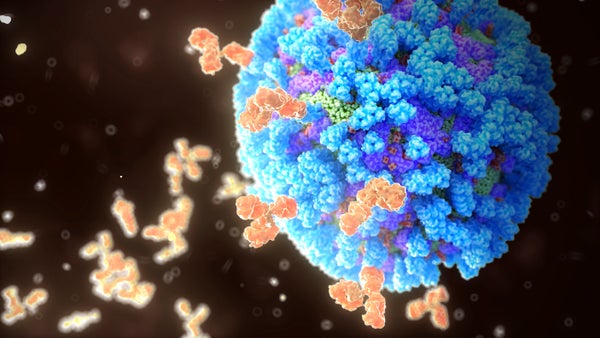

Here are a couple of things we know about seasonal flu: It’s caused primarily by A and B strains of the influenza virus, and it circulates during the fall and winter in the Northern Hemisphere.1 And here’s what is decidedly not true about it: that flu is “just the common cold.”
For some, the infection may be mild, with symptoms like a runny nose, a cough and a sore throat.2 But for many others—especially young children, pregnant people and older adults—the flu can result in severe illness.3 In the 2019-2020 flu season, for example, an estimated 390,000 Americans were hospitalized because of the flu and an estimated 25,000 died.4
Some who only get moderately ill from the infection are still sick enough that they’re unable to go to work for days, compounding the burden of the flu and adding to the virus’ economic toll.5 For example, in the U.S. in 2015, the burden—including direct medical costs and lost productivity—was estimated at $11.2 billion.6
“Children lose time from school when they get sick, and their parents and guardians lose work time if they have to stay home with the kids,” says Archana Chatterjee, an infectious diseases expert and Dean of Chicago Medical School. “The actual footprint of this virus in terms of its impact on the human population is significant.”
PROTECTION AGAINST INFLUENZA
Influenza vaccination remains a critical tool in influenza protection, according to the Centers for Disease Control and Prevention (CDC). Specifically, during the 2021-2022 season, flu vaccines helped avert approximately one million medical visits, 22,000 hospitalizations and nearly 1,000 deaths.7
To create an effective influenza vaccine, each year scientists tap global surveillance data on influenza strains so that the World Health Organization (WHO) can predict which are most likely to spread and cause illness during the upcoming season.8
“Experts at the WHO do a very good job in predicting predominant circulating influenza strains,” says Gregg Sylvester, chief health officer of CSL Seqirus. “But it’s a hard job given the changing nature of the virus.”
TRADITIONAL INFLUENZA VACCINES AND THE POTENTIAL FOR MISMATCH
Looking back to when the first influenza vaccine was developed in the early 1940s, scientists produced it by growing the inactivated influenza A virus in fertilized chicken eggs.9 The reliance on chicken eggs in manufacturing traditional flu vaccines has endured and is still used today, with tens of millions of chicken eggs used every year to manufacture influenza vaccines, accounting for approximately 80 percent of the flu shots that people receive.10
Flu vaccine effectiveness can be impacted by multiple factors, such as the vaccine recipient’s age and health, as well as how well the viruses in the vaccine match the influenza viruses in circulation.11 When these strains do not match those circulating, this is known as strain mismatch, which can be caused by antigenic drift or egg adaptation.12
Antigenic drift refers to small genetic changes that occur in the influenza virus over time, resulting in the virus mutating and becoming slightly different from the original strains used to create the vaccine.12 Egg adaption refers to the influenza virus undergoing changes, specifically during the egg-based manufacturing process, and occurs in order for human influenza viruses to better grow in the egg medium.13
A challenge with egg-based manufacturing, Chatterjee says, is that as the viruses grow inside the eggs, they can mutate and adapt, so “what comes out of the egg may no longer be an exact match to what we put into it.”13
In contrast to antigenic drift, egg adaption is more readily addressable due to innovation in influenza vaccine manufacturing. In particular, the use of cell-based influenza vaccines is designed to produce an exact antigenic match to the WHO-selected influenza strains.13
AN ALTERNATIVE TO EGG BASED MANUFACTURING
To make vaccines more effective, vaccine makers have developed flu shots that do not rely on eggs for vaccine production, one of which is a cell-based influenza vaccine, which was first approved by the U.S. Food and Drug Administration (FDA) in 2012.13,14
As an alternative option to traditional egg-based influenza vaccines, cell-based influenza vaccines represent further innovation in influenza vaccine manufacturing. Specifically, cell-based vaccines are produced in mammalian cells, eliminating the reliance on chicken eggs and avoiding egg-adaptation.13 Candidate vaccine viruses are introduced to these cells to replicate and produce large quantities of vaccine antigens that are then harvested and purified.14 This renders the virus inactive while retaining the ability to help protect against influenza.
Cell-based vaccine manufacturing offers several potential benefits, including that the virus doesn’t undergo the changes that could occur when growing inside an egg,13 “which may allow for a better match to the circulating virus,” Sylvester says.
THE FUTURE OF INFLUENZA PROTECTION
We’ve come a long way in improving influenza vaccines and the technology to manufacture them. This includes advancements like cell-based manufacturing and vaccines containing adjuvants—an ingredient that can boost immune response—which are included among the CDC’s list of preferential flu vaccines for people 65 and older.15 And looking ahead, there is even more potential for innovation.
“A promising strategy may consist of vaccines that work like some of the vaccines developed to fight COVID: They use messenger RNA to produce viral antigens,”16 says Stanley Plotkin, a global expert in vaccines and best known for developing vaccines, including those against rubella.
mRNA vaccines help protect against infectious diseases by giving instructions to cells in the body to make a protein, stimulating the immune response and leaving a blueprint to recognize and fight future infection.17 Through the use of this technology, additional vaccine innovation is advancing in the form of self-amplifying mRNA, also known as sa-mRNA or the next generation of mRNA, which instructs the body to replicate mRNA and amplify the amount of protein made.18
Overarchingly, the future of influenza protection relies on continuous innovation in vaccine manufacturing. The advancements made, and those still to come, are essential steps in reducing the risk of severe flu-related illness and protecting public health by moving us closer to comprehensive influenza protection for all.
Learn more about influenza at this dedicated site from CSL Seqirus.