
Scientific American

April 15, 2024

2 min read

Google Logo Add Us On GoogleAdd SciAm

Eye Tests Could Help Preserve Brain Health

The optic nerve is a link to the brain—and potentially to Alzheimer’s diagnosis

Adam Piore

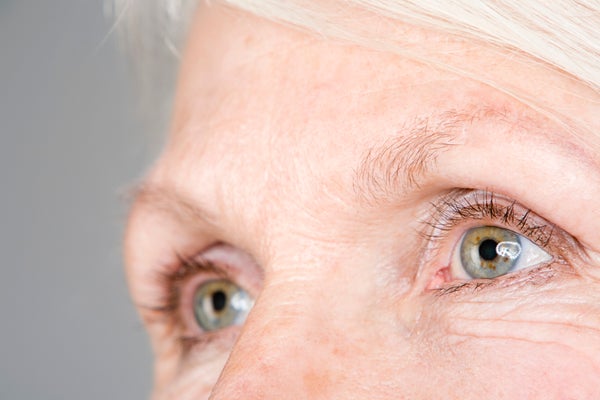
Close up of a woman with hazel and blue eyes and white hair

Image Source/Getty Images

Scientific American Custom Media LogoDavos Alzheimer’s Collaborative logo

This article was produced in partnership with the Davos Alzheimer’s Collaborative by Scientific American Custom Media, a division separate from the magazine’s board of editors.

Join Our Community of Science Lovers!

The big goal for firms that are devising tests for Alzheimer’s is to find a simple, inexpensive one that is reliable enough to provide definitive diagnoses—something that could replace entirely the need for expensive PET scans and cerebrospinal fluid biopsies. Scientists at Toronto-based RetiSpec believe that retinal scans might eventually meet this bill.

The eye is linked to the brain by way of the optic nerve, so changes in the brain—including the buildup of amyloid plaque from Alzheimer’s—are reflected in the retina. RetiSpec has developed a device that beams light on to the retina and measures the light reflected back. It then analyzes the output using AI algorithms trained on other retinal scans collected from thousands of Alzheimer’s patients who had tested positive on PET and cerebral spinal fluid tests.

The device is an attachment that can be screwed on to a device, called a fundus camera, that most eye and neurology specialists, and some primary care physicians, already have. Although the company has not yet set a price for the device, officials say that the cost per test will be very affordable to ensure broad accessibility. Whereas normal fundus cameras capture three wavelengths of color, red, green and blue, the attachment consists of a hyperspectral sensor that can capture a wider band of frequencies, most of which are not visible to the naked eye.

Hyperspectral sensors have detected Alzheimer’s disease in lab mice. CEO Eliav Shaked says that a multicenter, blinded validation study showed the company’s AI-based retinal test can predict amyloid-beta brain pathology in a diverse population of adults with preclinical, mild cognitive impairment, and probably Alzheimer’s disease, and that the study, led by the Global Alzheimer's Platform Foundation, is under review at a scientific journal. 

RetiSpec hopes eventually to win FDA approval for use as a diagnostic tool, rather than just for purposes of screening. Retinal scans, he says, are more convenient than blood tests because they can provide a diagnosis immediately and don’t require the use of sensitive diagnostic equipment currently needed to analyze blood samples. The company is testing the device at 20 clinics and doctor’s offices. It is slated to begin feasibility testing with the FDA in early 2024. Shaked expects the technology will be available in early 2025.

Graphic illustration of the anatomy of an eye, explaining its direction connection to the brain

Katie Peek

This article is part of The New Age of Alzheimer’s, a special report on the advances fueling hope for ending this devastating disease.

Learn more here about the innovation ecosystem that Davos Alzheimer’s Collaborative is building to speed breakthroughs and end Alzheimer’s disease. Explore the transforming landscape of Alzheimer’s in this special report.

Adam Piore is a freelance journalist based in New York.

It’s Time to Stand Up for Science

If you enjoyed this article, I’d like to ask for your support. Scientific American has served as an advocate for science and industry for 180 years, and right now may be the most critical moment in that two-century history.

I’ve been a Scientific American subscriber since I was 12 years old, and it helped shape the way I look at the world. SciAm always educates and delights me, and inspires a sense of awe for our vast, beautiful universe. I hope it does that for you, too.

If you subscribe to Scientific American, you help ensure that our coverage is centered on meaningful research and discovery; that we have the resources to report on the decisions that threaten labs across the U.S.; and that we support both budding and working scientists at a time when the value of science itself too often goes unrecognized.

In return, you get essential news, captivating podcasts, brilliant infographics, can't-miss newsletters, must-watch videos, challenging games, and the science world's best writing and reporting. You can even gift someone a subscription.

There has never been a more important time for us to stand up and show why science matters. I hope you’ll support us in that mission.

Thank you,

David M. Ewalt, Editor in Chief, Scientific American

Subscribe

Subscribe to Scientific American to learn and share the most exciting discoveries, innovations and ideas shaping our world today.

Subscription PlansGive a Gift Subscription
  • Explore SciAm
  • Latest Issue
  • News
  • Opinion
  • Newsletters
  • Podcasts
  • Games
  • Travel
  • Company
  • About
  • Press Room
  • FAQs
  • Contact Us
  • Standards & Ethics
  • International Editions
  • Advertise
  • More
  • Accessibility
  • Terms of Use
  • Privacy Policy
  • US State Privacy Rights
  • Use of cookies/Do not sell my data
  • Return & Refund Policy

Scientific American is part of Springer Nature, which owns or has commercial relations with thousands of scientific publications (many of them can be found at www.springernature.com/us). Scientific American maintains a strict policy of editorial independence in reporting developments in science to our readers.

© 2026 SCIENTIFIC AMERICAN, A DIVISION OF SPRINGER NATURE AMERICA, INC.
ALL RIGHTS RESERVED.