Dementia is poised to take off as the world ages, and the burden will be heavier in unexpected places
Katie Peek
Katie Peek
This article was produced in partnership with the Davos Alzheimer’s Collaborative by Scientific American Custom Media, a division separate from the magazine’s board of editors.
Join Our Community of Science Lovers!
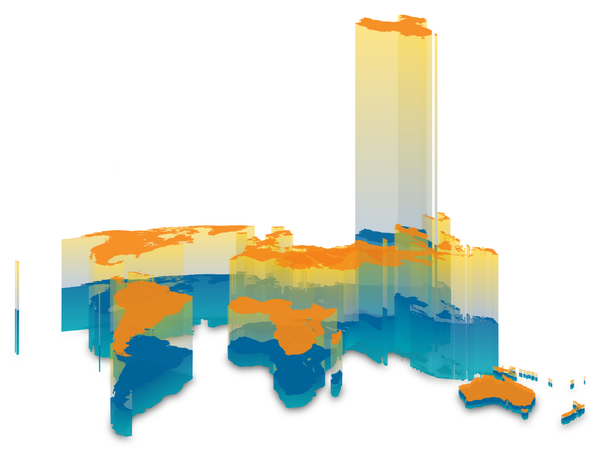
By 2050 more than 150 million people worldwide will suffer from some kind of dementia. (Today that number is more like 50 million.) The increase has two major drivers—in some regions, such as sub-Saharan Africa, the wave comes from population growth. In others, such as China and East Asia, dementia is expected to increase as the population ages. But everywhere, researchers write, “growth in the number of individuals living with dementia underscores the need for public-health planning efforts and policy.”
The data here track general dementia instead of Alzheimer’s specifically, in part because dementia is more consistently diagnosed worldwide. For the most part, Alzheimer’s increases wherever dementia does. Typically, Alzheimer’s accounts for more than half of all dementia cases.
Source: Alzheimer’s Disease and Other Dementias, Mayo Clinic, 2020
Here (below) is where researchers expect the most cases of dementia to emerge worldwide by 2050. The vertical height of each region represents the number of cases in that region—the higher they move, the more people there are living with dementia there.
Source: E. Nichols et al., The Lancet Public Health, 7, e105–E125 (2022)
This article is part of The New Age of Alzheimer’s, a special report on the advances fueling hope for ending this devastating disease.
Learn more here about the innovation ecosystem that Davos Alzheimer’s Collaborative is building to speed breakthroughs and end Alzheimer’s disease. Explore the transforming landscape of Alzheimer’s in this special report.
Subscribe to Support Independent Journalism
Great science journalism requires human expertise, time, effort and creativity. And it costs money. That’s why I and the journalists here at Scientific American hope you’ll join our community.
When you subscribe, you are supporting staff and freelance journalists who are passionate about telling science stories that are true, important and compelling. Our editors and reporters are often experts in their fields, which means they understand the nuances of big discoveries and can untangle the breakthroughs from the hype. With a subscription, you are also supporting rigorous fact-checking to ensure the words we publish are precise and accurate. And you’re supporting original illustrations, graphics and photos that bring you closer to an advanced laboratory, an ice sheet in Antarctica or a space mission in orbit. You’re helping us craft other types of high-quality journalism as well: Our newsletters are carefully written, edited and curated by staffers you have or will come to know and love. Our Science Quickly podcast is based on original reporting, collaboration with editors and scientists and exacting production.
Subscriptions keep this engine running so we can continue to deliver thoughtful, rigorous and independent science journalism to you. In an era of viral misinformation, this work is crucial. If you value what we do, I hope you’ll consider joining us as a subscriber
Thank you,
Jeanna Bryner, Editor in Chief, Scientific American