The Conditions that Keep Us from a Healthy Old Age
For people in the U.S., a handful of major conditions erode their healthy years
Katie Peek
Graphic by Katie Peek; Illustrations by Greg Betza
This series was created for Google, the Buck Institute, Optispan and Phenome Health by Scientific American Custom Media, a division separate from the magazine’s board of editors.
Join Our Community of Science Lovers!
To understand why healthspan has not kept up with increases in lifespan, longevity researchers need to know what exactly is making people chronically ill or disabled. The Institute for Health Metrics and Evaluation, a research organization at the University of Washington, has compiled data on people living with diseases and conditions that affect their health—a metric researchers call “years lived with disability.” As a population ages, these conditions pose a heavier burden.
These are the top contributors to years lived with disability in the U.S.:
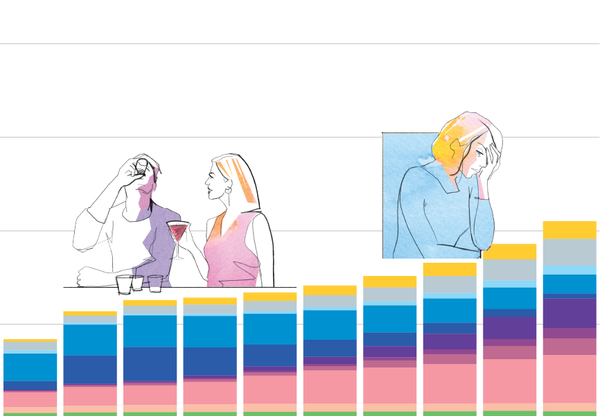
These diseases contribute differently to disability at different life stages:
The bars show years lost to disability in the U.S., grouped into 5-year bins. To allow easier comparisons between those age bins, the data are displayed as disease occurrence per 100,000 people.
Graphic by Katie Peek; Illustrations by Greg Betza; Source: The Institute for Health Metrics and Evaluation; data as of 2021
Graphic by Katie Peek; Source: The World Health Organization; data as of 2021
Explore the emerging science of healthspan in other stories in this special report.
Subscribe to Support Independent Journalism
Great science journalism requires human expertise, time, effort and creativity. And it costs money. That’s why I and the journalists here at Scientific American hope you’ll join our community.
When you subscribe, you are supporting staff and freelance journalists who are passionate about telling science stories that are true, important and compelling. Our editors and reporters are often experts in their fields, which means they understand the nuances of big discoveries and can untangle the breakthroughs from the hype. With a subscription, you are also supporting rigorous fact-checking to ensure the words we publish are precise and accurate. And you’re supporting original illustrations, graphics and photos that bring you closer to an advanced laboratory, an ice sheet in Antarctica or a space mission in orbit. You’re helping us craft other types of high-quality journalism as well: Our newsletters are carefully written, edited and curated by staffers you have or will come to know and love. Our Science Quickly podcast is based on original reporting, collaboration with editors and scientists and exacting production.
Subscriptions keep this engine running so we can continue to deliver thoughtful, rigorous and independent science journalism to you. In an era of viral misinformation, this work is crucial. If you value what we do, I hope you’ll consider joining us as a subscriber
Thank you,
Jeanna Bryner, Editor in Chief, Scientific American