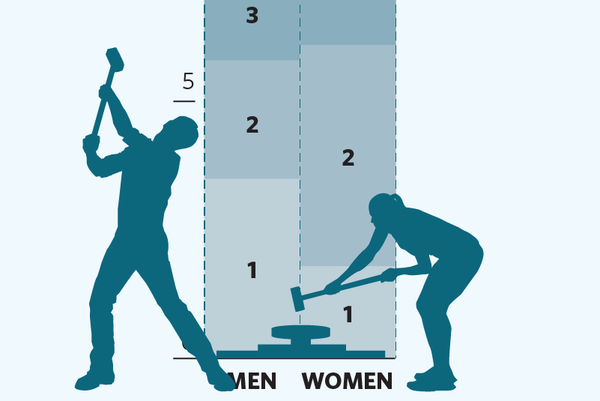
How much do healthy habits now create healthy years later?
Katie Peek
Graphic by Katie Peek; Illustration by Joelle Bolt
This series was created for Google, the Buck Institute, Optispan and Phenome Health by Scientific American Custom Media, a division separate from the magazine’s board of editors.
Join Our Community of Science Lovers!
Want to increase your own healthspan? The genetic die may be cast, but it’s still possible to add healthful years with lifestyle changes. Two recently published studies, one on U.S. veterans and one on U.K. civilians, help quantify by how much. Each study monitored nearly 300,000 people over a decade, tracking their lifestyles and looking for payoffs to healthy habits. The takeaway: small changes can have big effects, and big changes can have huge ones.
Graphic by Katie Peek; Illustrations by Joelle Bolt; Sources: Nguyen et al., “Impact of 8 lifestyle factors on mortality and life expectancy among United States veterans: The Million Veteran Program,” American Journal of Clinical Nutrition, December 2023; Liang et al., “Polygenic risk for termination of the ‘healthspan’ and its interactions with lifestyle factors: A prospective cohort study based on 288,359 participants,” Maturitas, June 2023.
Explore the emerging science of healthspan in other stories in this special report.
Subscribe to Support Independent Journalism
Great science journalism requires human expertise, time, effort and creativity. And it costs money. That’s why I and the journalists here at Scientific American hope you’ll join our community.
When you subscribe, you are supporting staff and freelance journalists who are passionate about telling science stories that are true, important and compelling. Our editors and reporters are often experts in their fields, which means they understand the nuances of big discoveries and can untangle the breakthroughs from the hype. With a subscription, you are also supporting rigorous fact-checking to ensure the words we publish are precise and accurate. And you’re supporting original illustrations, graphics and photos that bring you closer to an advanced laboratory, an ice sheet in Antarctica or a space mission in orbit. You’re helping us craft other types of high-quality journalism as well: Our newsletters are carefully written, edited and curated by staffers you have or will come to know and love. Our Science Quickly podcast is based on original reporting, collaboration with editors and scientists and exacting production.
Subscriptions keep this engine running so we can continue to deliver thoughtful, rigorous and independent science journalism to you. In an era of viral misinformation, this work is crucial. If you value what we do, I hope you’ll consider joining us as a subscriber
Thank you,
Jeanna Bryner, Editor in Chief, Scientific American