
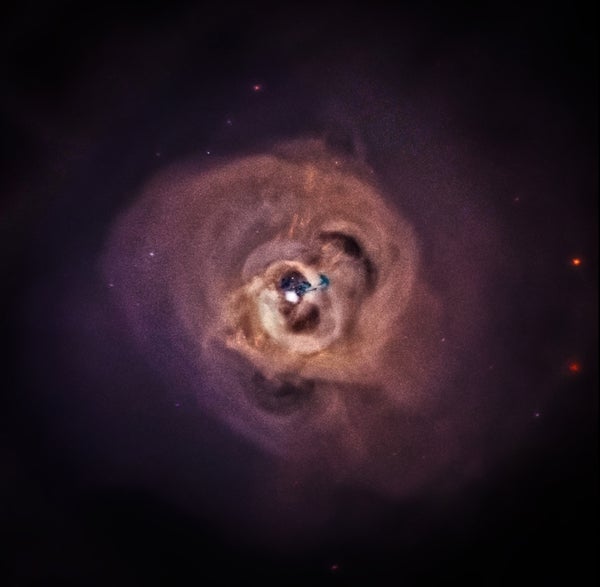


Andrew Fabian knows what’s hot. By examining the energetic X-rays produced by heated gases and celestial objects, the astronomer from the University of Cambridge has probed the hottest corners of the universe, including the blazing hot gas in vast galaxy clusters.
“When you have maybe 100,000 galaxies clustered together, the gas that lies between them gets squeezed by their large gravitational pull and becomes very hot, about 10 million degrees. That makes the gas emit lots of X-rays, which is how we can see it,” says Fabian.
Emitting this radiation should ultimately cause this intergalactic gas to cool. “The gas has cooled some, but it hasn’t cooled all the way—which was puzzling,” says Fabian. “Something had to be stopping it.” Fabian’s quest to find what that something was led to a dramatic discovery. It turned out that the heating is caused by the supermassive black hole that sits at the center of the brightest galaxy in the cluster.
Through decades of observations—particularly of the Perseus cluster, the brightest X-ray emitting galaxy cluster in the sky—Fabian has unraveled how this heating mechanism works. As a black hole spins and matter circles and tumbles into it, particles that make up that matter collide, shooting out energetic jets of radiation and other particles. Those jets generate cosmos-shaking sound waves that ripple outward like bass notes from a loudspeaker, delivering enough energy to keep gas hot throughout the galaxy cluster. Further, by tracking the distortions in the X-rays bouncing off the material that swirls around a black hole’s edge, Fabian has come up with a method for measuring the black hole’s spin, which helps power its galaxy-changing jets.
Although Fabian insists that “we’re only just beginning to sort out how all these processes work,” he was awarded the 2020 Kavli Prize in Astrophysics for advancing our understanding of the role that black holes play in shaping the evolution of galaxies and galactic clusters.
In this interview, Fabian contemplates what lurks inside supermassive black holes, outlines the next steps in our investigation of galactic evolution, and explains how quasars could shed light on the mysteries of dark matter.
What happens when matter falls into a black hole?

‘Don’t know’ is the answer. Matter, as it's falling in, passes through what we call the event horizon. We on the outside can't see within the event horizon because of the way that spacetime itself is warped around the black hole. If you were to fall to the center of the black hole, you would reach what we call the singularity. This is just a polite word for the bit we don’t understand because it has all the mass of the black hole in an infinitely small size. At such extreme densities, you run into quantum mechanics, and because we don’t have a solution for quantum gravity, we don’t know what’s going on. There’s talk about how, if you have a spinning black hole, then the singularity is not a point but a ring, which could act as a wormhole if connected to a similar ring in another universe. These are interesting questions, but I’m very much grounded in observation, and I can see no way at the moment to observe any of this. But somebody may crack the problem of quantum gravity at some point. I know people are working on it.
How did black holes end up at the center of galaxies?
All massive galaxies have black holes at the center, as far as we can tell. We don’t know when, in the process of galaxy formation, they arose. In the early universe, galaxy formation began with dark matter. Because dark matter doesn’t collide with ordinary matter, it was able to form clumps, and then cold gas fell into these clumps, forming the galaxies. But we don’t know how the first black holes formed or where they formed. That’s something that will probably be sorted out in the next couple of decades by telescopes which can actually start to see the first stars and also the first black holes. After they formed, these black holes would then have a profound effect on the evolution of the surrounding galaxies. They can stop the formation of new stars by pushing gas away, or they can provoke the formation of new stars by compressing gases within their outflow. These cycles in which star formation starts and stops may happen many times during the evolution of a galaxy. To see how these galaxy clusters grow and at what point these cycles get set up, we’ll have to look out at very, very distant clusters [to observe events that took place] when the clusters were very young. We will have to use much larger X-ray telescopes, like the Athena satellite we’ve been designing with the European Space Agency, which should be launched in the early 2030s.
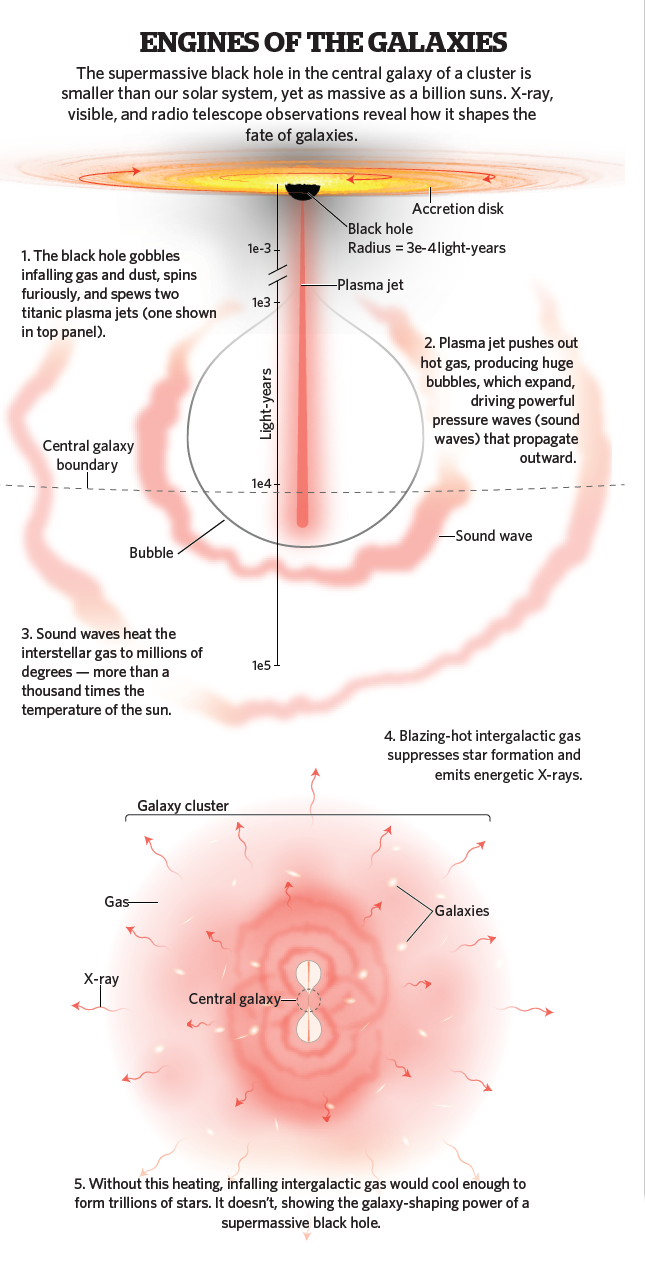
Illustration by Falconieri Visuals
What exactly is dark matter?
There’s much more dark matter around in the universe than there is ordinary matter, of which we’re composed. I am on the side of people who think it’s some kind of particle, but it’s not a particle that we know of. I’ve been working with a colleague, Chris Reynolds, who has been looking at the center of the Perseus cluster to see if he can see signs of axions. An axion is a hypothetical particle that's got a very weak interaction with ordinary matter. It was introduced decades ago to solve a problem in physics, and at the time, there was a detergent called Axion. So, this particle was called an axion because it cleaned away a problem in physics. Axions may or may not exist, but [if they do], they have a property similar to photons—they are both bosons. In the presence of a strong magnetic field, photons can turn into axions, and vice versa. What we’re doing is using the quasar at the center of the galaxy NGC 1275 as a backlight to see any signs of this interchange as its light goes through the magnetic fields in the Perseus cluster. So far, we have not seen any effects that we can attribute to axions. It’s nice that there are fundamental things out there that we know exist, yet we don’t understand them. I find that exciting.
To learn more about brilliant work of Kavli Prize Laureates, visit The Kavli Prize. To explore more of the biggest questions in science, click here.