



For some, getting their hair styled is a routine task—book an appointment, show up, clean up and go. For Janet Wangari Olivero, it’s an expedition.
There was the initial hunt to find a stylist with training and experience cutting and styling curly hair like hers. There’s the one-hour trip from her home in rural, overwhelmingly white Hunterdon County, New Jersey, to Maplewood, a diverse inner-ring suburb of Newark, where she had finally found a good one. Then there’s the prep before the appointment, including prewash and detangling, which many stylists require their curliest customers to do before arriving.
“It becomes a half-day experience,” Wangari Olivero says. “You cannot rush to take care of curly hair.”
Hair care is different for people with curliest hair, including Black women like Wangari Olivero, a former cancer researcher who is now assistant vice president of research and innovation at L’Oréal.
Curly hair itself is different, too. The structure, function and development of human hair have been closely studied. By 2030, 40 percent of the world’s population is expected to have curly hair. But most studies have focused on straight or wavy hair, and understanding the nature of curly fibers was long treated as an afterthought. As a result, research on curly locks lags far behind.

Janet Wangari Olivero.
Classifying curls
Hair, a protein-rich filament that grows from hair follicles in the skin, is one of the defining characteristics of mammals, and in humans it ranges from pin-straight to tightly coiled. For most of the 20th century, however, there was no scientific method for categorizing hair by its curliness. Instead, it was classified by its geographic or ethnic origins as European, Asian or African. But there are Polynesians and Europeans with curly hair and Africans with straight hair, as well as variations in hair’s twist and texture, and more. “There is so much diversity of hair,” Wangari Olivero says.
In the 1990s, celebrity hairstylist Andre Walker developed a typing system that became popular among stylists. But the system, which categorized hair into straight, wavy, curly and kinky morphologies, has been criticized as an oversimplified and unscientific marketing tool.
To bring science to bear on curly hair, in 2007 researchers at L’Oréal developed an objective method to classify curliness independent of ethnicity.
They collected hair from nearly 2,500 people from 22 countries and from three different parts of each person’s head—the top, temple and nape of the neck. They washed and dried each hair sample and laid it on a glass plate to retain its natural shape, then measured the tightness of the hair’s curl, and the number of waves and twists. From these measurements, they classified human hair into eight types, ranging from pin-straight to tightly curled.
As the natural hair movement gained momentum, fueled by the rise of social media, it inspired people with curly, kinky or wavy hair to accept their hair the way it was, and they began skipping the often-damaging hair relaxers and straightening tools that earlier generations had used. The beauty industry began to shift and develop more products for customers with natural and curly hair.
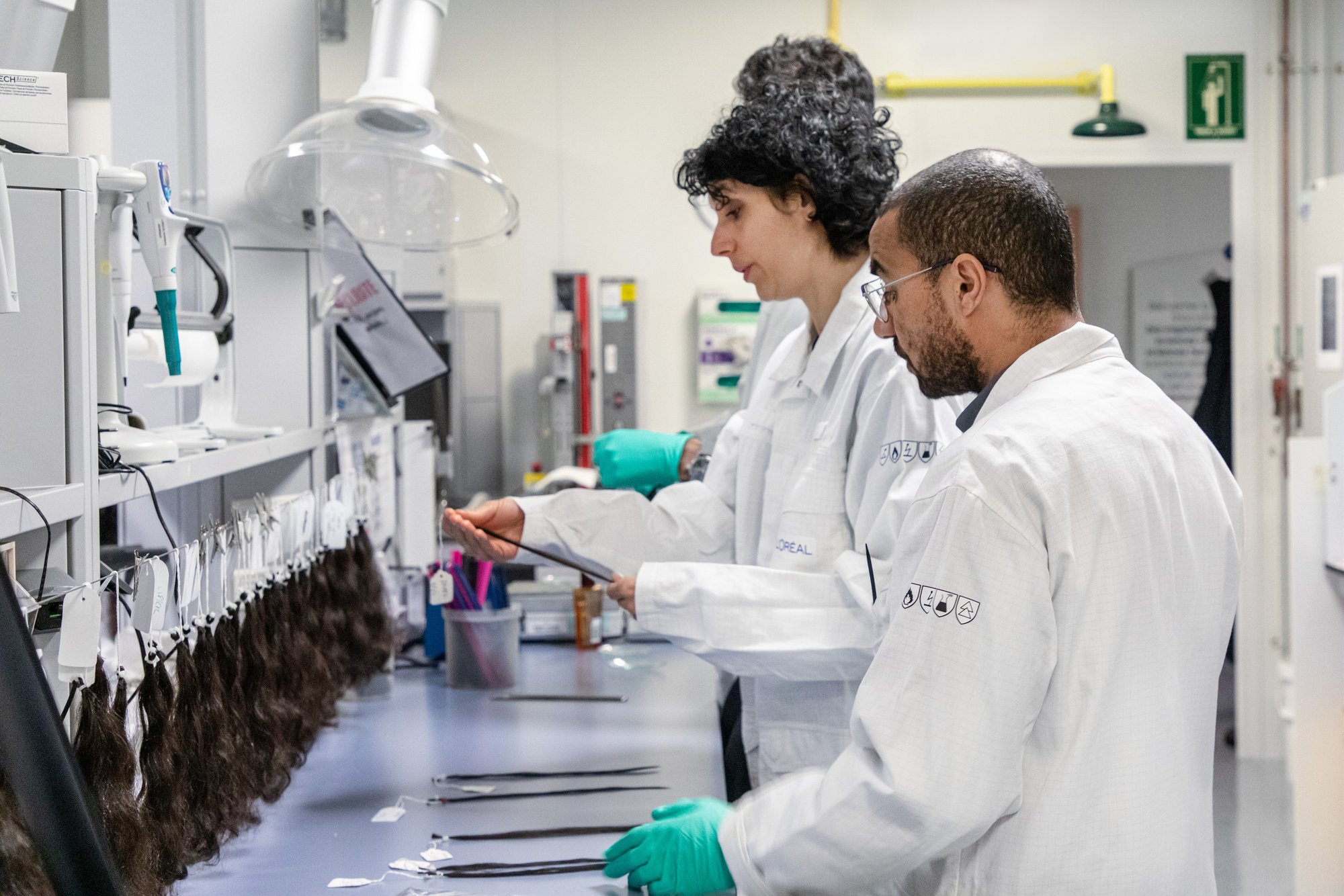
L’Oréal’s researchers have characterized the biophysical properties of all varieties of human hair.
Image courtesy of L’Oréal Groupe
A complex fiber
Despite its variety, all human hair has a similar composition. It grows from specialized epidermal cells beneath the surface of the skin, and forms three layers—medulla, cortex and cuticle. The innermost or core layer, or medulla, is limited mostly to thick, coarse hair. The outermost layer, or cuticle, offers protection and is a critical indicator of hair health.
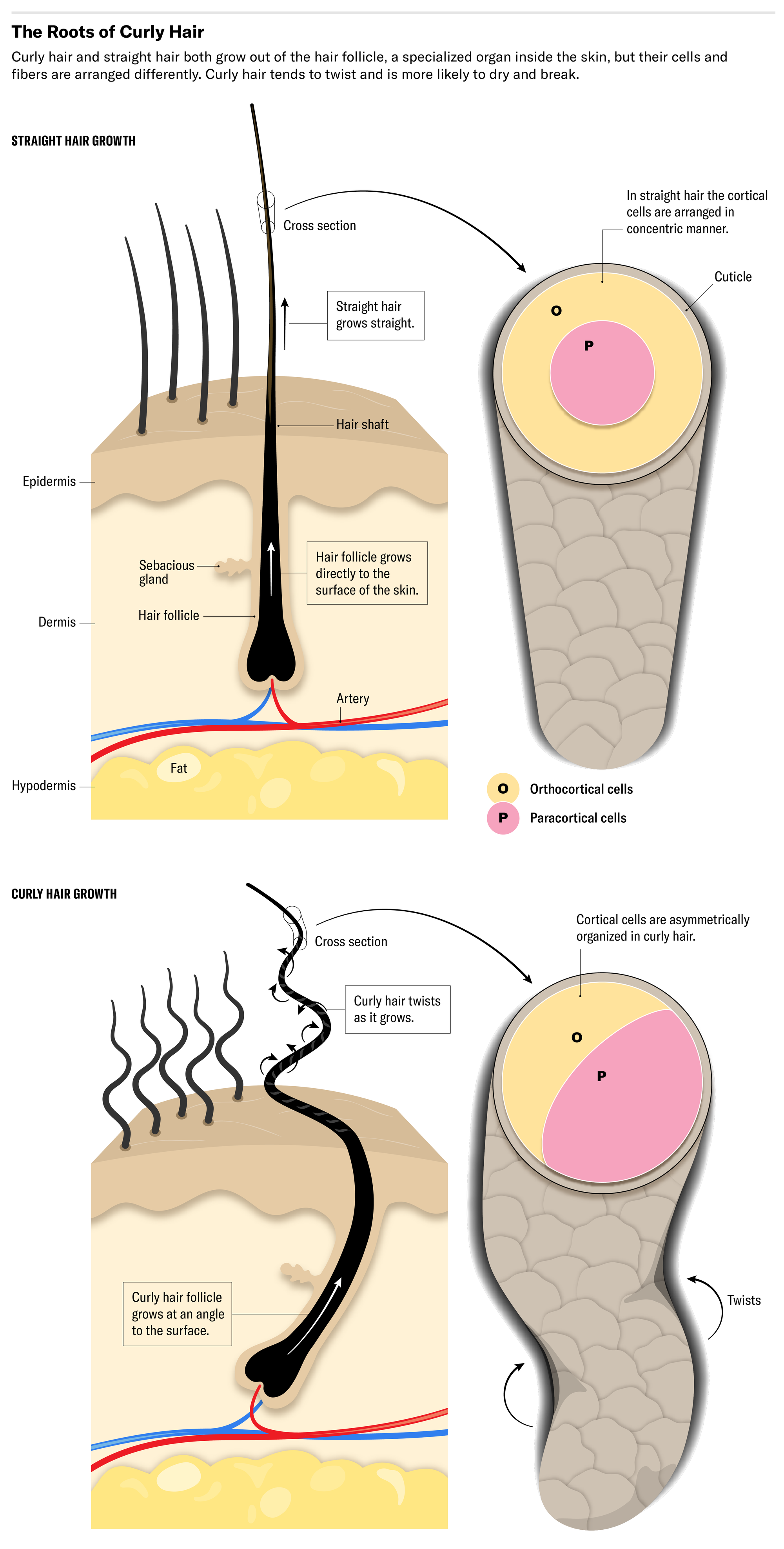
The middle layer, or cortex, creates curls. Made from spring-shaped protein molecules called keratin, which imparts strength, and melanin granules, which determine hair color, the cortex contains two types of cells. In straight hair, they're arranged concentrically, while in curly hair, they’re arranged asymmetrically, which helps generate twists.
Stylists have long observed that curlier hair is more prone to breakage than straight hair. Using an instrument that tugs on a hair until it snaps, L’Oréal researchers found that with its spring-like structure, curlier hair indeed snaps at low extension. Further study pinned that down to the twists, which are fragile points that break more readily than untwisted hair.
Since tangles are a nemesis to the curly, effective detangling products are in high demand. To create them, L’Oréal scientists first traveled to the European Synchrotron Radiation Facility in Grenoble, France, to blast x-rays into a tangle of curly hair. By using data analytics and AI to virtually slice and reassemble the resulting images, they created the first 3-D rendering of such a tangle, revealing how the hairs within crisscross, interact and change shape.
“Structural insights like these could lead to better detangling products, which can also prevent breakage,” says Dakota Piorkowski, a senior scientist on L’Oréal’s research and innovation team, who presented the results at the World Congress for Hair Research in Dallas in April 2024. “The idea we’re driving is that each curl pattern requires customized solutions,” he says.
Threads of discovery
Researchers need to find and test new formulations to develop customized products for curly hair. To better predict which are likely to work, L’Oréal is collaborating with Karl Koehler, a regenerative medicine expert and assistant professor at Harvard Medical School.
In a 2020 Nature paper, Koehler and his colleagues solved a 50-year-old challenge by coaxing two types of stem cells to grow into an organoid—a floating ball of lab-grown skin tissue—that sprouted human hair.
Koehler can now grow skin that matches the pigmentation of the donor and sprouts hair that replicates the donor’s hair type. Eventually, lab-grown, hair-producing skin organoids could serve as a testbed for medicines to treat burn scars or male pattern baldness for people with hair of all types, Koehler says.
Back in the labs at L’Oréal, skin organoids could also be used to help test new hair product ingredients to develop custom formulations. And as scientific understanding of hair develops, so too does understanding of the people it adorns. “Hair that grows out of your head is normal, beautiful, not unruly or anything to be ashamed of,” Wangari Olivero says. “It’s a symbol of beauty, and we want to get people to accept it that way.”
Alisdair Macdonald
Explore more emerging insights into curly hair and the development of personalized hair care in this video and this podcast. Learn more about L’Oréal's science-based innovation at this dedicated resource.