
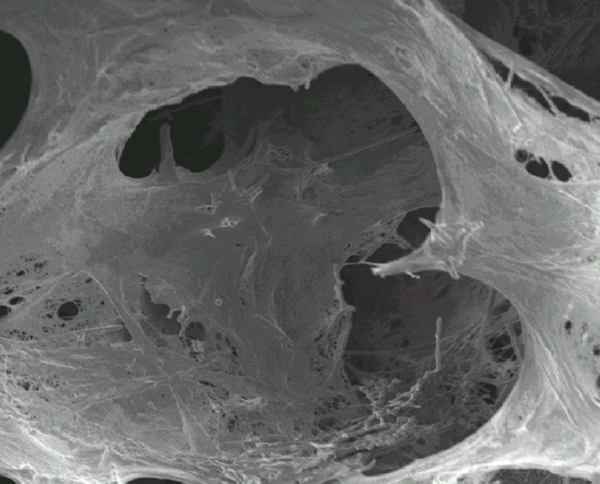


With a nudge from some engineered proteins, immune cells can be activated to identify and attack tumor cells. This is the basis for an emerging approach in cancer therapy, which involves harvesting immune cells from patients, activating them in the lab, and returning them to the body. Though promising, the prohibitive cost of producing the proteins has prevented this kind of therapy from becoming widely available.
But Mamoru Aizawa — a professor at Meiji University’s School of Science and Technology and an applied chemist at Meiji University International Institute for Materials with Life Functions (MUIIMLF) in Tokyo, Japan — is finding evidence that simply placing immune cells on to tiny ceramic dishes could activate them in a similar manner.
In experiments on mice, he found that metaboronic acid groups in the ceramics interact with structures on the cell surfaces, triggering signals that command them to recognize and kill tumors. After a spending a day on a two-centimeter ceramic dish, the activated cells helped shrink tumors when reinjected into mice1. Aizawa named these materials ‘immunoceramics’ and sees them as a potential alternative to costly proteins.
Immunoceramics are just one example of the broader work of Aizawa’s team on “materials with life function” — ceramics that are intended to engage with cells to activate biological processes. This not only includes the immune response, but also materials that could affect bone formation and tissue regeneration. With these ceramics, the researchers hope to push the boundaries of how the body can heal itself.
Creation of artificial bones for minimally invasive treatment
Ceramics are non-metallic, inorganic materials such as clay and minerals mixed with water, molded into desired forms and fired at high temperatures to harden. Besides pottery, they are used in industrial contexts such as in semiconductors for their heat resistance and also for electrical insulation.
But, it was the medical applications that piqued Aizawa’s interest as a student. At the time, it had just emerged that apatite, the mineral form of the compound calcium phosphate, bonds directly to living bone. “Apatite ceramics were beginning to be used as artificial bone in clinical settings. I found it intriguing that these materials could act as substitutes for real bone,” says Aizawa.
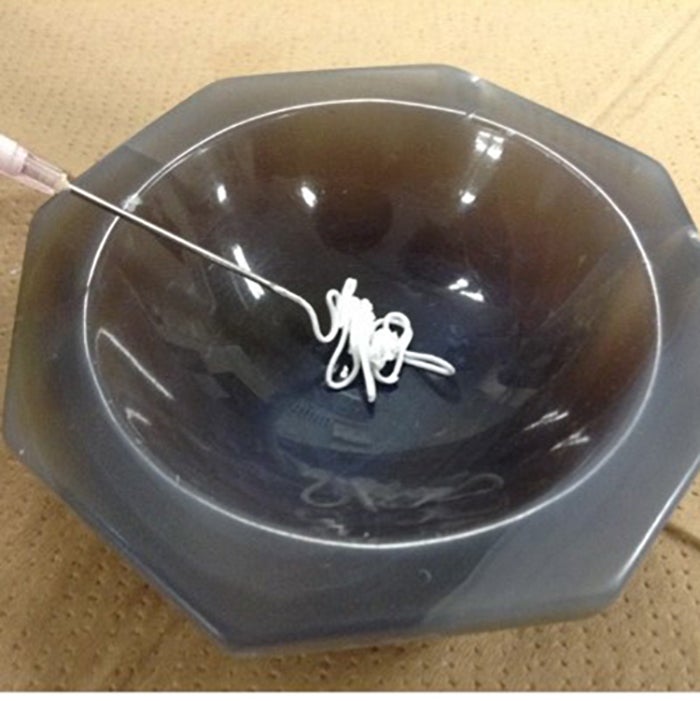
A paste-like artificial bone ceramic material produced by Mamoru Aizawa's laboratory at Meiji University.
Meiji University
That fascination eventually led to Aizawa’s work on biodegradable ceramic cement, a paste-like material that can be injected into damaged bone through a syringe. Aizawa’s cement is made from calcium phosphate ceramics that are biodegradable. The cement is mixed with spherical biodegradable polymers2.
Through experiments in pigs, Aizawa’s team showed that after the cement hardens, the spheres dissolved, leaving small pores in the ceramic. They found that the pores helped bone-forming cells migrate deeper into the material and generate new bone tissue as well as grow blood vessels. The ceramics were gradually replaced by bone as they are broken down and absorbed.
Using cement to treat bone damage, however, is not new. While surgeons around the world already use cement for minimally invasive treatment, they typically use apatite materials that bind directly with bone, but are not absorbed by the body.
“The artificial material is stuck in the body forever, and doctors feel uneasy with that,” says Aizawa, as artificial materials in the body can be a breeding ground for bacteria and lead to infections. He believes that biodegradable ceramic cement may be a solution to this problem, and also has other benefits.
For example, in older people with low bone density, their vertebrae can sometimes collapse from too much compression.
A common treatment is ‘kyphoplasty’, where surgeons create space in the vertebrae with a balloon and inject cement to restore the structure. But the cement is commonly made of polymethylmethacrylate, the same acrylic material used in aquarium tanks. Aizawa says that the structural strength of the material can be counterproductive in older people, as their fragile bones can be damaged by the pressure of the material, above and below the injection site.
As certain pore sizes better facilitate bone formation, Aizawa’s team has continued to investigate the optimal sizes for these pores. They were also hampered by the time the cement takes to harden — nearly half an hour during surgery in mice. The researchers found that adding calcium sulfate, the same material that makes casts for broken bones harden quickly, made the cement harden in just 15 minutes, increasing the practicality of its use for surgery3.
Construction of ‘cell houses’
Aizawa is also working on an alternative way to regenerate soft tissues, using apatite fibers to create porous scaffolds that drive cell growth. Unlike the cement, the scaffold requires cells to be cultured inside pores and later implanted into the body.
“Theoretically, the scaffold is applicable to many other organs. You just need to change the cell you culture,” says Aizawa. In addition to bone4,5, his team is currently investigating the potential for regenerating soft tissue including the liver, nerves and blood vessels with apatite fiber scaffolds.
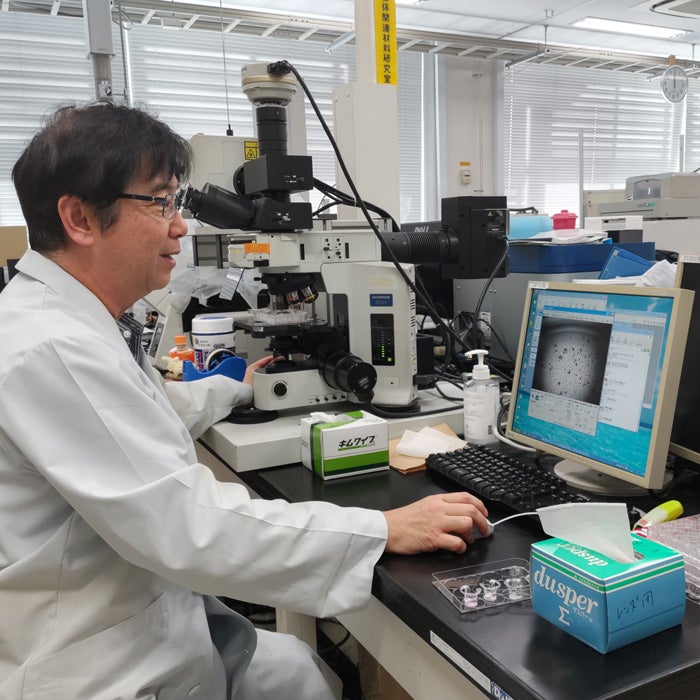
Mamoru Aizawa in his laboratory at Meiji University in Tokyo, Japan.
Meiji University
This holds promise for situations in which entire chunks of tissue are removed, for example after a bone tumor removal. The current gold standard for filling those chunks of bone involves grafting bone harvested from the patient’s hip bone. However, that comes with the risk of secondary infections, especially in older patients.
“The aim is to develop an artificial material that achieves the same regenerative outcome as bone grafting, without the need to graft,” explains Aizawa.
The development of these ceramic materials is getting a major boost from AI. Currently focused on bone regeneration, Aizawa and collaborator, Hiromasa Kaneko, a materials and process informaticist at Meiji University, built a predictive model using Aizawa’s 25 years of data on ceramics implanted into animals6.
The model predicts bone growth based on factors such as porosity, the ceramic’s resistance to compression and the dissolution rate of calcium ions. It also showed that porosity and the ceramic’s resistance to compression are most influential, an important discovery as it helps prioritize properties to optimize. In addition to speeding up ceramic design, the machine learning method could cut down on animal testing involved in finding the right mix of material properties.
Aizawa’s hope is for materials with life function to extend healthy life expectancy. “As people live longer, they become more prone to musculoskeletal disorders — in the worst cases, people end up bedridden from broken bones that don’t recover,” says Aizawa. “But bioceramics could be one solution to address these issues and help people live to their fullest for a longer time.”
Learn about Mamoru Aizawa's research into biomaterials for artificial bones at Meiji University in Tokyo, Japan.