
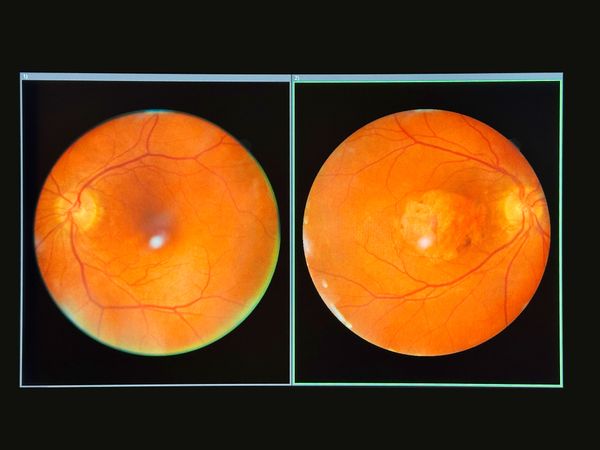


Megan Hall: If you’re over 60 and experiencing vision loss, it’s likely you have age-related macular degeneration, or AMD. AMD blurs your central vision and makes it difficult to see details straight in front of you. It’s also the leading cause of blindness in people over the age of 65.
Here, we’ll talk about wet AMD, which affects 10 to 15 percent of patients with AMD. It also accounts for more severe AMD-related vision loss compared to dry AMD.
Scientific American Custom Media recently sat down with Dr. Pravin Dugel, Ocular Therapeutix’s CEO, to explore what has changed in how we understand wet AMD, where unmet needs remain and what kind of experimental treatments are on the horizon.
Welcome, Dr. Pravin Dugel. It’s so great to have you on the podcast.
Pravin Dugel: Megan, thank you for the opportunity. It’s lovely to be here.
Megan Hall: So, we’re here to talk about your treatment in development, which is known as OTX-TKI. But before we talk about that, let’s make sure all of our listeners are on the same page. Will you first just explain how age-related macular degeneration affects our vision? What’s happening in the eye when people are experiencing this vision problem?
Pravin Dugel: The retina is kind of shaped like a cup, if you will, and in the center of that cup is an area that we call the macula. The macula is where we see fine detailed vision from, and that is the area that has the specialized photoreceptor cells that we call the cone cells, and these cells allow us to see detail. And they work really hard, and as we get older—for a variety of reasons, some people more susceptible than others—end up having degeneration of those cone cells, and that’s really what we call macular degeneration. So, the way that it manifests is that, as we get older, we start seeing maybe straight lines not be quite as straight, maybe seeing some spots, and maybe some areas getting blurry. And that happens gradually, and that’s what we call dry macular degeneration. In some cases, for certain reasons, it becomes wet, and what we mean by that is that blood vessels grow and start to bleed. And there, the change is much more accelerated. It can be quite sped up, where suddenly there’s a black spot or suddenly there’s a tremendous loss of vision. So, that’s the difference between dry macular degeneration and wet macular degeneration.
Megan Hall: I understand that the way it works is it sort of all starts as dry AMD, and then it can develop into wet AMD, but it doesn’t necessarily develop into wet AMD. Is that correct?
Pravin Dugel: That is absolutely correct. A lot of people end up having dry macular degeneration, and it stays dry for the rest of their life. But in a certain percentage of people—perhaps by genetic vulnerability and perhaps by environments such as smoking, such as hypertension—one is more likely to convert to wet macular degeneration, which can be much more accelerated and sometimes result in catastrophic loss of vision.
Megan Hall: How do people catch this early on? What should they be doing to make sure that it doesn’t evolve into the worser stages?
Pravin Dugel: That’s a great question. What you don’t want to do is to wait until there’s a catastrophic loss of vision. And oftentimes, even in conversion to wet macular degeneration, one can start seeing changes in vision. Probably the most sensitive change is something that we call metamorphopsia, which is a fancy word just to say that things aren’t looking straight. So, if you look at a door, for instance, if the door pane is, appears to have a little bump or a little crookedness, that’s usually the first sign that there’s something going on. It doesn’t mean that it’s wet macular degeneration. There could be a bunch of other things that cause that, but that would be a reason to go ahead and see your eye-care professional to make sure that everything is okay. But that probably would be the earliest and most sensitive sign.
Megan Hall: How has our understanding of wet AMD evolved over time?
Pravin Dugel: At some point there’s going to be a book written about this. I’m not sure if there’s a documentary, but the great thing, from my point of view, is that I’m old enough to have lived through the entire process. When I was in training and certainly when I first got out in practice, there was simply nothing to do. What we did was when patients came in with wet macular degeneration, the goal was to really—and this sounds horrible—to predict when somebody was going to actually lose vision and go blind and let them know when to get their affairs in order because there was really nothing we could do. In some cases, there was laser, but the laser was probably available to less than 5 percent, and in almost all of them it was absolutely ineffective anyway. So, that’s what we would do. We would simply basically be there and say, “Look, you’ve got two months or you’ve got six months,” or whatever it is, that’s what we’d try to do. That was only about 35 years ago or so, and that’s not a long time. And then came these drugs, and some of them absolutely miraculous, and what it involved is an anti-VEGF.
Megan Hall: Let’s talk about what this anti-VEGF is. I understand that it was actually a cancer treatment at first. How did people figure out that this was a good way to address wet AMD?
Pravin Dugel: A lot of what we learn, quite honestly, comes from the oncology world, and we use a lot of their knowledge for us. And the growth of blood vessels occurs for a number of reasons. If you have areas in the heart that require blood vessels to grow because of small injuries, that’s a good thing. All right? So not all of blood vessel growth is bad. We also realized that with tumors, as the tumors grow, this is where oncology comes in, to support their growth, they need nourishment. So, tumors get blood vessels to grow to feed them. That’s bad blood vessels that come in.
Megan Hall: And the idea is this wet AMD is caused by these blood vessels that are abnormal and growing out of control just the way a tumor might grow out of control. And so, you made the connection that if we can target the protein that’s responsible for these blood vessels growing, then we can help with people’s eyesight. Is that right?
Pravin Dugel: That is correct. So, look, people may wonder, why is it that blood vessels need to come in in macular degeneration, right? And that’s a good question. As I mentioned earlier on, these photoreceptor cells die over time, as we get older, and the general consensus is that there must be a healing process that has not quite gone the way it should have gone, and thus the influx of abnormal control of these blood vessels causing wet macular degeneration.
Megan Hall: And VEGF is what is making those blood vessels grow, thus anti-VEGF is getting them to stop growing?
Pravin Dugel: That is correct. Look, we do know that there are other things that are involved. I want to make that clear. We’ve learned from oncology and from our other colleagues who are way advanced than us that there are clearly other factors that are involved. But either way, this VEGF has been known for a while, and what we did was we basically learned from these other disciplines and said, “Hey, why don’t we use it in retina.” The question was, how do we get it there? What was done was to say: look, we’ll put a needle in the eye, and that’s how we’ll get it there. I remember the first time that I saw that vision was actually improving, I mean, it was like watching a miracle in front of your eyes. Now, there are a couple of things at that time—having been part of a lot of these investigations and steering committees and so forth in my previous life—that we knew. We knew we couldn’t put a needle in the eye on a regular basis. We knew something bad was going to happen, and here it involved putting a needle in the eye every month, right? We knew something bad was going to happen. We can’t keep on doing this forever, and this is going to be fairly temporary. And the other part that we knew for sure was that this whole process of blood vessels growing it was a terribly complicated process. And yes, we discovered a really cool receptor in VEGF, but there are hundreds of receptors, and we knew that any time, we would discover other receptors that would actually make the situation even better. Well, you know, fast-forward now 35, 40 years, we’re dead wrong on both. And for us trying as hard as we can, guess what? We haven’t found another receptor that has truly been proven to be important other than VEGF still, and that’s where we stand. You may be asking: Look, what’s the problem here? Fine, you’ve got a great receptor. You’ve got a way to put it in there. What problem are you solving for? The problem is this. What we’ve come to realize is two things. You know, one is that despite having these incredible treatments, which at that time was Lucentis, and then Eylea came, and now we have the second version of both of those drugs, but they still block that one receptor. Despite having these phenomenal, incredibly safe drugs and a way to administer them, which has been proven to be effective and safe with time in this country—and this is the US, the richest country in the world—40 percent of patients actually drop out in the first year. 40 percent. That’s almost half the patients.
Megan Hall: So, you found this really miracle drug that if you continue to inject it into the eye, in most cases it stalls this degeneration. Explain to me what it’s like for a patient to receive this treatment and why they might stop coming to the doctor.
Pravin Dugel: Yeah, it’s a great question. Well, listen, if you ask my colleagues, if you ask the doctors, and this is what I used to say as well, to say, “Hey, listen, is it hard to give these injections?” You know, we would offhandedly say, as I would too, “Oh, it’s really easy. It takes me...” I said, “How long does it take you?” “It takes me a second.” Well, that’s from the doctor’s point of view, and it really does, right? From a patient’s point of view, it’s a whole day’s experience, First of all, they’ve got to come into my office. They’ve got to find a parking spot. They often are older, so there’s got to be a caretaker there as well, right? The caretaker maybe having to take a day off for work. You know, you go to the front of the office. You need insurance verification. These drugs are expensive. People change insurances. That always happens. That’s another 20, 30 minutes. You sit there. You’ve got to have your eye test. You got to have all these things, and then after that, you know, you see a tech. You see a doctor. You may get an injection. You recover. You wait. You go through the whole thing again. It’s a whole day’s experience. And typically what happens is this kind of a conversation, and I used to have these, and I practiced for 30 years before I did this, and this happened all the time. Ms. Jones would come in with the family, and I’d say, “Ms. Jones, I’ve got great news for you. You know, if we had met X years ago, there’s nothing I could do for you. Now, there’s a really good chance that I can save your vision, if not make it better. That’s the really good news. But I need to tell you that you need to come to see me either every month or every other month, and that’s not gonna be easy.” And immediately the family would say, “Oh, no, no, no, no, we’re gonna bring Granny. You know, Jenny’s gonna take time from her, from her work. If not, Tom is gonna do this, and Joe is gonna do this. No problem at all. We’ll do it.” And sure enough, they do, you know, three, four, five times. And then what will happen is that maybe after the third or fourth time, Ms. Jones will take me aside and say, “Doctor, you know, Jenny’s about to lose her job at the post office. Is it okay if I miss an appointment, the next one? Or can we space this out a little bit?” Pretty soon, Ms. Jones just doesn’t show up. And that happens all the time, unfortunately. And that’s one problem we’re trying to solve. The other part, which is not realized quite as much, is on the back end, even if, say, Mrs. Smith came religiously. After two to five years, inevitably, Mrs. Smith would start getting worse than baseline, and it’s not because of rebleeding. It’s interesting how this happens. The back of the eye, the retina, is full of nerve cells, right? So, when we inject, say, every month or every other month, there’s fluid that goes with the blood vessels growing. So, the back of the eye gets thicker and thinner and thicker and thinner in a pulsatile way. Well, that thickening and thinning is just like getting multiple concussions in sports. It’s really no different. So, you can imagine having multiple concussions in the back of the eye, and what happens in the brain in sports? You get scarring. Exactly the same thing happens in the back of the eye.
Megan Hall: So that’s the problem with using the eye as a pin cushion.
Pravin Dugel: Yes, in a frequent way. Now, if you’re able to go ahead and suppress VEGF constantly, right, as opposed to episodically, there’s very good evidence that you will have better long-term outcomes because you’ll have less scarring and less of this concussion-like effect.
Megan Hall: Right. So, let’s talk about that. What would an ideal treatment look like for people suffering from wet AMD?
Pravin Dugel: Yeah. So, look, it all starts with safety, right? I don’t know how many drugs there are in medicine where, after almost 40 years, the drug that came in first is still at the top, period, and nothing has come close. Now, I know, I realize there’s a second version of these drugs, but still, it’s the same drug, and the reason that they’re at the top is because they’re that good, and they’re incredibly effective, and they’re incredibly safe. So, you’ve got to have the same amount of safety that you have with the anti-VEGFs. You can’t have unpredictable inflammation. You can’t have anything other than the safety profile that these anti-VEGFs have. That’s the first thing. The second thing is how often do you need to be seen, right? Doctors and patients, for that matter, feel very comfortable being seen in a chronic disease like this that still can go south, right, every six months. I think that’s the ideal amount of time. So, to have a drug that you can give every six months, that drug really has to last comfortably for nine to 10 months, and the reason for that is because these are elderly patients, and patients may get sick. They may not be able to come in their six-month visit, or the doctor may be out or whatever it may be. You need to have some kind of a safety net. So, the profile of the drug would be a drug that comfortably lasts for nine to 10 months that you can give every six months. The other profile also is the drug has to suppress VEGF, rather than doing it in a pulsatile way, in a constant way.
Megan Hall: So, instead of just injecting it one month, injecting it one month, having a constant supply of this anti-VEGF, is that what you mean?
Pravin Dugel: Yeah, injecting every six months, right? So instead of every one month, injecting every six months, but that six-month period is not going to give you any kind of a pulsatile response because you’ll still have some leftover drug from before. So basically what you’re doing is after the first injection, if you keep on giving this every six months, for instance, you’ll have a constant level of suppression, which, studies have shown that if you have that, you’ll have less of a chance of scarring, less of a chance of atrophy and better long-term outcomes, let alone sustainability. It’s much more acceptable for patients to come in every six months than it is every month or every other month.
Megan Hall: Let’s talk about this experimental product that’s on the horizon, OTX-TKI. Explain to me how it works and how it’s different from the injections that people are getting now.
Pravin Dugel: Well, the great news is that, look, the actual experience is going to be no different for the doctor or the patient or the doctor’s office. We’re not reinventing the wheel. What we’re providing, we believe, is a better version of the anti-VEGF. We’re still inhibiting a known target, which is VEGF. We’re doing so with a drug that is wrapped in a hydrogel, which is tunable, and it’s tuned to release in nine to 10 months. And we will be submitting for FDA approval in the fourth quarter of this year. So hopefully, this will go to market very soon and be available to doctors and most importantly to patients as soon as possible. That’s our goal.
Megan Hall: Let’s talk a little bit more about that hydrogel. What makes it so special?
Pravin Dugel: So, it’s a proprietary hydrogel, and what it does, in essence, is trap this TKI or tyrosine kinase inhibitor, and as the hydrogel gradually dissolves in a tunable fashion, that drug is eluted. What’s really, good about this is that both of these entities, the drug consists, OTX-TKI consists of these two entities.
Megan Hall: So, it sounds like you’ve got a lot of things that are similar. The injection is the same, the drugs are known, but the hydrogel is what’s different. Is that right?
Pravin Dugel: It’s actually the combination of putting a known TKI into the hydrogel. That’s the secret sauce. And the fact that everything else is the same is actually a huge advantage, because the adoptability will be seamless. There’s nothing the doctor has to do. There’s no new piece of equipment to buy. There’s not a single cent more in overhead. The workflow is the same. The experience is the same.
Megan Hall: And to our eyes, you wouldn’t be able to tell a difference. I mean, I’m imagining this hydrogel is teeny tiny.
Pravin Dugel: It is teeny tiny, and it goes to way in the bottom of the eye. It’s smaller than a grain of rice and, it’s never seen. It just sits there and just elutes the drug in a constant fashion so that that suppression is continuous. It’s not pulsatile.
Megan Hall: So as someone who has watched the treatment of wet AMD evolve from there’s nothing we can do to this, how does it feel to be at this stage?
Pravin Dugel: That question is actually more profound than I think you even anticipate because macular degeneration is actually in my family. My father, before he passed away, was blind in one eye because of wet macular degeneration and was on Lucentis, for almost 25 years. I remember that was his only eye. And when he was bedridden in the last couple of years of his life, you know, it took us four hours to transport him to get a Lucentis injection. Obviously, we did that because we didn’t want him to be blind in his last few days. And that meant the world to him. And now my mother is also getting injections with Vabysmo in her eye because of wet macular degeneration. So, this is not just professionally important to me; it’s deeply personal to me. At the end of the day, again, I look at the impact that it potentially will have. I was driven to this company because of that. And now with the data that we have, with the success of what we call the SOL-1 study, which is our phase-3 study, I am even more excited, even more confident, even more passionate than ever that this needs to and should be available to patients.
Megan Hall: Seeing that this runs in your family, do you ever feel like you’re potentially developing these products for yourself?
Pravin Dugel: In many ways, yes.
Megan Hall: What do you think your father would say if he knew what you were doing right now?
Pravin Dugel: I hope he’d be happy.
Megan Hall: Well, Dr. Pravin Dugel, it’s been a pleasure talking to you. Thank you so much for joining me today.
Pravin Dugel: Thank you for the opportunity.
Megan Hall: Dr. Pravin Dugel is the CEO of Ocular Therapeutix.
This podcast was produced by Scientific American Custom Media and sponsored by Ocular Therapeutix.
The preceding information discusses OTX-TKI—an investigational product candidate that has not been approved by the FDA or any other regulatory body. Safety and effectiveness have not been established.