
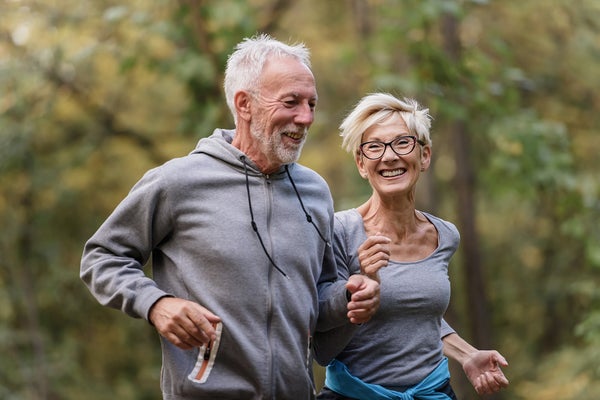

“Heart and muscle condition, coordination, balance and flexibility are the five pillars of physical ability,” explains Pauline Maillot, associate professor at Université Paris Cité and deputy director of research at the Sports Science Department (STAPS). “And over the last ten years or so, we've come to realize the extent to which muscle capital is as fundamental as the heart.” But it declines from the age of 30 onwards, and in very different ways from one individual to the next. “We have recently discovered that this age-related muscle loss has a major impact on life expectancy as well as on our ability to recovery from illness and the way in which we respond to medical treatment,” adds Elena Paillaud, professor at Université Paris Cité and geriatrician at Georges Pompidou European Hospital.
“We now know, however, that regular physical activity slows down muscle loss. The benefits are irrefutable when it comes to maintaining or even improving physical capacity, particularly by combining endurance and stamina activities. And this is true regardless of the age at which you start,” she says. (It is best to get a medical check-up before you start.) Regular physical activity also delays the onset and progression of cognitive diseases such as Parkinson's or Alzheimer's, as well as reducing the risk of falls. Pauline Maillot points out that “there is a close link between physical activity and cognitive activity: the former helps better oxygenate and revascularize the brain, while the latter promotes the formation of new neuronal networks.”
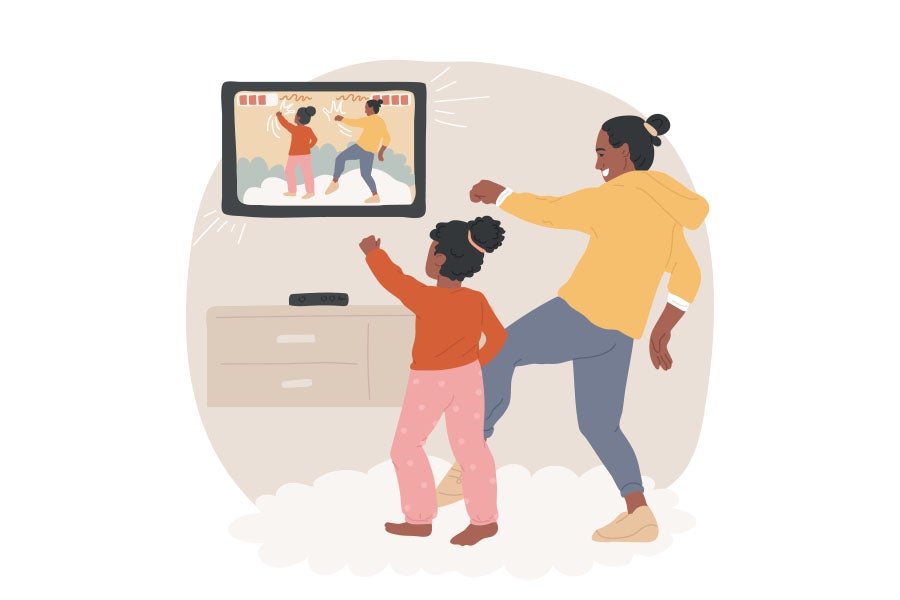
The benefits of "exergaming" for seniors. Exergaming (from “exercise” + “gaming”) has its origins in the United States and was developed to compensate for our increasingly sedentary lifestyles and obesity. It refers to a video game in which the body becomes the “joystick.” Fun, appealing and interactive, it is especially good for older people because it combines cognitive stimulation and physical activity. “We were the first to test this tool in our studies in 2009,” explains Pauline Maillot. “We are developing our programs on commercial consoles with unrivaled gaming qualities, which allow players to start playing the game without even realizing that they have.” And it works! Rehabilitation and indeed some care homes are already equipped with bicycles, treadmills, virtual reality headsets and interactive walls.
RAStudio/VectorStock
Boosting learning and interest
In fact, any physical or cognitive activity that stimulates interest and learning has positive effects, especially when combined with other activities such as interactive video games (see sidebar, “The benefits of ‘exergaming’” for seniors.) Maillot also stresses the importance of social interaction, such as chatting while walking. In fact, it's often social interaction that ensures that you continue with your sporting activities. Games are also a great way of encouraging physical activity. “Use it or lose it,” the researcher reminds us: keeping both the body and the brain fit contributes to good health, slows down aging and allows us to better recover from an illness or a fall.
Is it possible to model these changes in performance with age? American researcher Dan H. Moore laid the foundations in 1975 with the publication in Nature of a study of athletics records linking age to performance,” reports Geoffroy Berthelot, researcher at the National Institute of Sport, Expertise, and Performance (INSEP) at Université Paris Cité. A graph from his work is still the benchmark today: an inverted U shape, with an increasing exponential slope at the start of life, reaching its peak between the ages of 20 and 30 and then decreasing until the end. “This model, which has no biological basis, is perfectly suited to sportspeople and the general population alike,” continues Berthelot, “and even to racehorses, greyhounds and a large fraction of living organisms, as well as to cognitive performance. Indeed, we have tested it on chess players.”
When talent takes time. Quentin de Larochelambert, an INSEP researcher, has shown that the performance of 15,000 skiers between 10 and 25 varies greatly from one athlete to the next over a period of almost twenty years. It is therefore difficult to predict who will perform best during the so-called “maturing” phase—a period of biological development that continues until peak maturity. His colleague Audrey Difernand has put forward two tools for correcting selection bias. One is based on relative age rather than rankings by year of birth. “The performance gap is very wide among the youngest athletes,” she points out in her analysis of 120,000 athletes (swimming and athletics) since 2010. The second, more precise tool she has designed is based on maturity level, estimated using physiological measurements (weight, age, sitting and standing height) on swimmers aged 12 to 14. The French Swimming Federation has used these results to integrate 30 more swimmers into its training centers this year, out of the 100 selected—not necessarily the best, but those with the most potential. The young researcher is now extending her analysis to basketball and football.
Volodymyr Melnyk/Alamy Stock Photo
In search of a predictive model for sporting longevity
In view of these results, the body deteriorates faster than the brain, with cognitive decline occurring around the age of 50 or 60. This finding could be incorporated into public health programs, taking into account the benefits of physical and cognitive training or the detrimental effects of chronic illness or injury. But sports science is lagging behind for when it comes to modelling. Berthelot’s work currently focuses on two areas: linking Moore's model to physiological parameters such as the number of cells and, more surprisingly, looking for invariants in the properties of transport networks, particularly those linked to their collapse, which is comparable to aging. “We think that a network of blood vessels or pulmonary airways behaves in a similar way to an electric, air or communication transport network,” he says. “The main parameter characterizing their collapse is the connectivity rate between the nodes in the network.” Will these models one day reveal how we can effectively slow decline in physical condition? In the meantime, we all know the rules: work your muscles, use your brain, develop your social network … and avoid excess in all things.
This article has been reprinted from a special issue in Pour La Science. Read the magazine in French or English here.