


When Jennifer Doudna was finishing her doctoral research in biochemistry and molecular pharmacology at Harvard, academia and industry were considered unbridgeable worlds, and to those in academia, basic research was the higher calling. But Doudna was exploring career paths and decided to visit a nearby biotech company anyway, just in case the industry might inspire her. She snuck out of the lab and missed a team meeting, and when she returned from the visit, she sheepishly explained the absence to her advisor. “He was shocked and horrified,” she recalled.
Today Doudna, who shared the 2020 Nobel Prize in Chemistry for inventing CRISPR genome-editing technology, still works in academia at the University of California, Berkeley, where she is a professor of chemistry and molecular and cell biology. And, in January, she co-founded her seventh startup.
Early in his career, Omar Yaghi also used to reject applied research as not being real science. “But things change when you invent something,” he said. Yaghi, a U.C. Berkeley chemist who shared the 2025 Nobel Prize for pioneering a subfield of chemistry based on arranging and assembling organic and inorganic molecules into new, useful configurations not found in nature, sees it differently today. “If the science points toward applications that could benefit society, it’s your responsibility—your moral responsibility—to pursue that.”
Doudna and Yaghi shared these reflections at a February 2026 event in New York with an audience of funders, entrepreneurs, foundation staffers and researchers from both industry and academia. They joined U.C. Berkeley roboticist Ken Goldberg and the university’s chancellor, Rich Lyons, for a discussion hosted by Scientific American Custom Media, in partnership with U.C. Berkeley. In keeping with the spirit of innovation that infused the evening, the event, entitled “Breakthroughs to the Future: The Science Reshaping Our World,” took place in the midtown Manhattan building that was the site, in 1973, of the very first cell phone call.
Lyons, an economist who served as the university’s first chief innovation and entrepreneurship officer and dean of the Haas School of Business, has led the campus’s reinvention as a university whose work spans from discovery to delivery. U.C. Berkeley now encourages entrepreneurship as part of a college education. Its values include “quintessentially American” ones like individualism, resourcefulness and freedom of thought, Lyons said, and its undergraduates now found more startups with venture funding than students at any other university.

An AI laundry robot developed in Ken Goldberg’s lab at U.C. Berkeley can fold 30-40 disheveled garments per hour.
Adam Lau/Berkeley Engineering
Robots get a grip
In November 2022 the first commercial version of ChatGPT was released, transforming the digital world with large language models and deep learning algorithms. Goldberg thinks that the field of humanoid robotics will achieve its own ChatGPT moment, but not as soon as some AI industry leaders maintain.
At the New York event, audience members watched raptly as Goldberg showed videos of humanoid robots performing martial arts moves and backflips, and one of himself sparring playfully with a robot boxer. But then he revealed a secret: For all their dexterity, many of these robots lack any real intelligence. Instead, they rely on human controllers at computers, making them essentially “expensive puppets.”
To become truly autonomous and navigate a material world where we make, move and maintain our stuff, robots will require more than AI, Goldberg said. They’ll need “physical intelligence” that integrates AI into physical spaces populated by people, machines, motorized vehicles and other obstacles.
To that end, Goldberg and his students strive to make robots less clumsy by improving their grasping ability. Using advances in computer vision, a subfield of AI, combined with “good, old-fashioned engineering,” they have trained robotic arms to hold on to ordinary objects of every shape. In 2018 Goldberg and a few former students cofounded Ambi Robotics, which now has robots sorting and stacking packages for shipping across 14 states.
Advancing the abilities of robots gives Goldberg “more appreciation for human abilities, human dexterity, human ingenuity.” He foresees a near future where robots help an aging population at home while also filling roles in factories. “These machines are not going to replace us,” he said. They’re going to enhance us.”

CRISPR technology, which uses the Cas9 protein (green) to cut double-stranded DNA, is being commercialized as a treatment for rare genetic disorders.
Innovative Genomics Institute
CRISPR enters the clinic
In 2019, after reading in a magazine about CRISPR technology, which acts as molecular scissors that help make targeted changes in DNA, Victoria Gray became the first person to enroll in a clinical trial that tested CRISPR as a gene therapy. Gray suffers from sickle cell disease, a painfully chronic condition that affects 100,000 Americans and an estimated eight million people globally.
“I can’t imagine the bravery of being willing to say, ‘I’ll be the first to sign up for this completely experimental therapy,’ but she did,” Doudna said at the event.
Gray’s symptoms improved after receiving the treatment, and in a milestone 2023 ruling, the U.S. Food and Drug Administration (FDA) approved that therapy for clinical use. Today, six years after her treatment, Gray remains free of symptoms. “It’s extraordinary,” said Doudna. “It changed her entire life.”
A second milestone for CRISPR occurred a year ago, when an infant boy named KJ Muldoon became the first person to receive a personalized CRISPR therapy to correct a rare genetic disorder. KJ’s condition prevents the liver from converting ammonia to urea, which usually leads to liver and neurologic damage. Scientists at the Innovative Genomics Institute, which Doudna founded in 2015, helped develop and test KJ’s treatment for safety in just six months.
At the event, Doudna flagged another milestone for the field that’s in her sights: the ability to develop CRISPR therapies swiftly and safely that can treat patients with a variety of rare genetic diseases. That’s the goal of her latest startup, Aurora Therapeutics, which is developing platform technology to produce CRISPR gene-editing tools for multiple diseases.The FDA just eased the way in February by issuing new guidelines that relax the requirement for a separate clinical trial for each rare-disease gene-editing therapy, Doudna said. “That puts CRISPR on a path to have real impact in the future in many more diseases and, we think, for many more individuals.”

U.C. Berkeley researchers Ken Goldberg and Jennifer Doudna listen intently as Omar Yaghi fields a question at “Breakthroughs to the Future: The Science Reshaping Our World,” a recent panel discussion in New York.
Scientific American Custom Media
World-changing materials
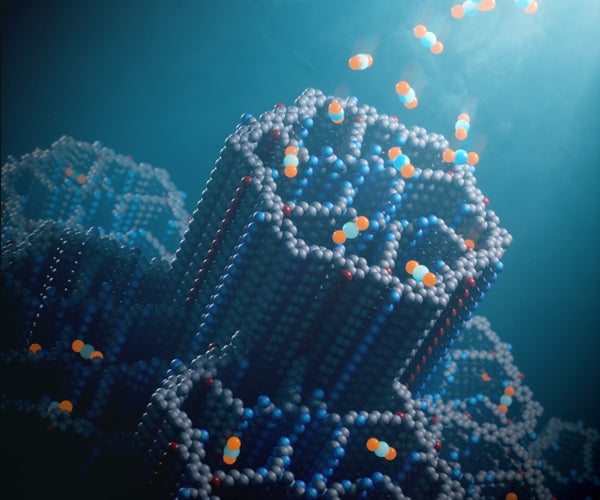
Three decades ago, Yaghi started constructing stable, porous materials he called metal-organic frameworks (MOFs) and covalent organic frameworks (COFs) by combining and rearranging atoms of elements from aluminum to zinc. “The result is that a vast number of materials are possible,” he said.
A mere gram of such material conceals a surface area equal to a football field onto which molecules can adsorb. Individual MOFs and COFs can be optimized to capture carbon dioxide to counter climate change or store and release hydrogen as a source of clean energy. In the past, making them demanded much trial and error. “It took me 35 years to discover a material that takes up CO2 from air and to discover a material that takes up water from air,” Yaghi recalled. “We want to change that.”
Today Yaghi collaborates with colleague Jennifer Chayes, dean of the College of Computing, Data Science, and Society, to speed the process through aimatry, an interdisciplinary approach named for its combination of AI, materials and chemistry. Aimatry leverages AI to design and help synthesize novel chemical structures for humans to analyze for promising properties.
“It has revolutionized what I do in my lab,” Yaghi said, doubling the rate of materials discovery and expediting other steps. One MOF’s water-collecting capacity increased by half, thanks to input from ChatGPT. An AI-devised COF called COF-999 removed nearly all the carbon dioxide from air samples collected on campus. Yaghi has co-founded one company, H2MOF, to develop and commercialize hydrogen storage and another, Atoco, to harvest water from air and directly capture carbon dioxide and waste heat at data centers.
Physically intelligent dexterous robots. CRISPR cures for a host of genetic diseases. Water-harvesting and carbon-catching MOFs. It was an enlightening evening, and a glimpse into the practical and profound impact scientific and technological discovery can have on our daily lives.
To explore the range of entrepreneurial research at the University of California, Berkeley, visit this dedicated resource.