
On supporting science journalism
If you're enjoying this article, consider supporting our award-winning journalism by subscribing. By purchasing a subscription you are helping to ensure the future of impactful stories about the discoveries and ideas shaping our world today.
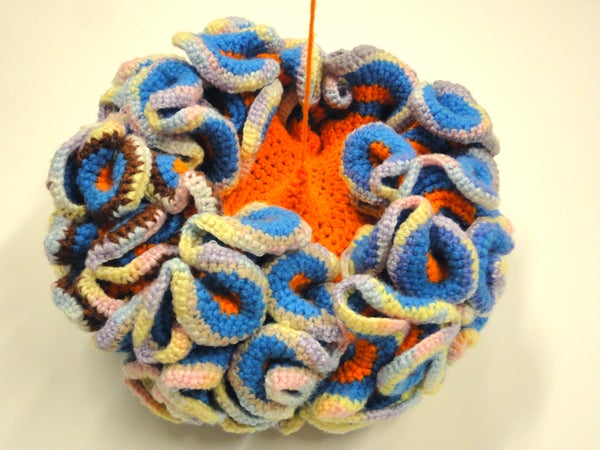
This is a hyperbolic pseudosphere—made with nothing more than yarn and a crochet hook.
Hyperbolic geometry describes surfaces that are negatively curved. Negative curvature appears in coral reefs, kale leaves and Pringles potato chips. A surface with negative curvature is at every point like a saddle—your legs rest on a surface that curves down whereas the front and back of the saddle curve up.
In the past decade or so many mathematicians have embraced crochet both as a way to visualize difficult concepts in hyperbolic geometry and as an outreach activity: With a little instruction and practice, even high school students can create their own hyperbolic models.
Pictured here, the pseudosphere is a hyperbolic surface that has constant negative curvature. It is named in analogy to the sphere, which has constant positive curvature (every point is just as curvy as every other point). Some would call this a half-pseudosphere; it is analogous to one hemisphere of a globe, with the point sticking up in the middle (held up by orange yarn in this picture) the "north pole."
Daina Taimina is the mathematician who first used crochet to create models of the hyperbolic plane. She noticed that paper models were quite fragile and wanted something sturdier that allowed freer manipulation and exploration of hyperbolic space. She turned to yarn. Creating negative curvature using crochet is relatively simple: in each row, you add stitches at a constant rate. The more frequently stitches are added, the curlier (and more negatively curved) the surface gets.
Sean Lawton, an assistant professor of mathematics at the University of Texas–Pan American, is one of the many mathematicians who has followed in Taimina's footsteps. He uses hyperbolic crochet as an outreach and teaching tool. He has worked with students from middle school to college as well as given public lectures, demonstrations and even crochet instructional sessions at libraries and museums.
The pseudosphere shown here was created by Claudia Carranza, an undergraduate student who worked with Lawton before she became a public school teacher. For this project, she added a stitch every three stitches. As you can see, the border gets very curly. She made this piece over the course of a year but says, "If I had sat down and worked nonstop, I figure it might have taken me about a week."
–Evelyn Lamb