
On supporting science journalism
If you're enjoying this article, consider supporting our award-winning journalism by subscribing. By purchasing a subscription you are helping to ensure the future of impactful stories about the discoveries and ideas shaping our world today.
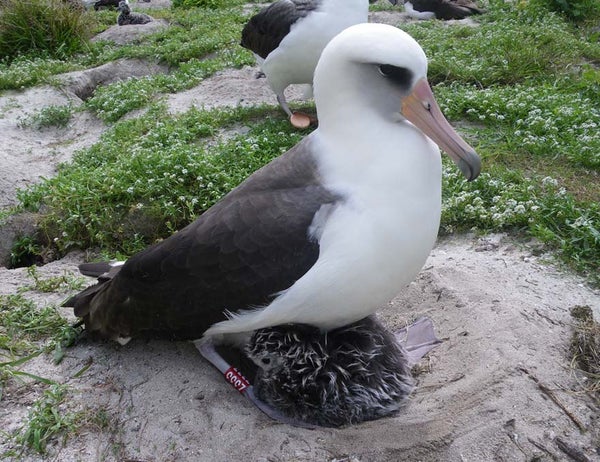
This old bird is a new mother. Spotted a few weeks ago at the Midway Atoll National Wildlife Refuge, which is part of the Hawaiian archipelago. Wisdom the Laysan albatross is at least 60 years old, making her the oldest wild bird documented in North America.
Pictured here with her newest chick, Wisdom appears unruffled by, what scientists estimate, is probably her 35th turn at motherhood. Laysan albatross (Phoebastria immutabilis) mate for life, lay one egg per year, and invest many months into raising each chick. They, however, occasionally take a year off between successful breeding cycles. Advanced age has not slowed Wisdom down: she was seen nesting in five of the past six years.
Laysan albatross spend their first three to five years over seas—that is, gliding above the Pacific Ocean, even sleeping aloft, feeding on squid and fish without setting a webbed foot on terra firma. Adults resemble overgrown seagulls, with wingspans exceeding two meters. They do not start breeding until age eight or nine; scientists estimate Wisdom to be in her early 60s because she was already incubating an egg when she was first banded by researchers in 1956. Her species's typical life span is about 40 years.
"To know that she can still successfully raise young at age 60-plus, that is beyond words," said Bruce Peterjohn of the U.S. Geological Survey's Patuxent Wildlife Research Center in Laurel, Md., in a prepared statement. "While the process of banding a bird has not changed greatly during the past century, the information provided by birds marked with a simple numbered metal band has transformed our knowledge of birds." Wisdom has worn out five tracking bands over the years.
"This is an animal that is perhaps genetically predisposed to live longer, and she's probably been very lucky," says Mary Ann Ottinger, a professor of physiology and reproduction at the University of Maryland, College Park. Albatross, like many other seabirds, are a long-lived species, meaning they do not show rapid age-related reproductive decline, although the extent of their reproductive age is unknown. Other examples include hummingbirds, parrots, tortoises, lobsters, elephants and humans. Just as improving living conditions have pushed human life span, favorable environmental factors are particularly pertinent to long-term survival in the wild. Ottinger says it is an unusual but "a hopeful sign" to discover birds like Wisdom.
Approximately 64.5 million birds have been banded and 4.5 million bands recovered in the 90-year history of the North American Bird Banding Program, a collaboration between Patuxent and the Canadian Wildlife Service. The program has provided essential data on avian survival, migration patterns, toxicology, disease and behavior.
—Nina Bai