New Issue: Orbital Catastrophe Ahead? Read Now

A rose is a...galaxy collision: Hubble sends the people of Earth a flower on its 21st anniversary

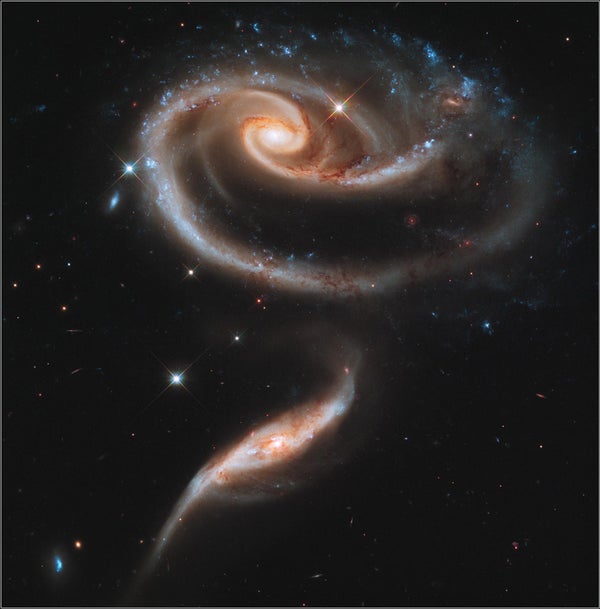
This image of two interacting galaxies, called Arp 273, has been released by the organization that operates the Hubble Space Telescope in celebration of the 21st anniversary of its launch into space.

NASA, ESA, and the Hubble Heritage Team (STScI/AURA)

Join Our Community of Science Lovers!


On supporting science journalism

If you're enjoying this article, consider supporting our award-winning journalism by subscribing. By purchasing a subscription you are helping to ensure the future of impactful stories about the discoveries and ideas shaping our world today.


This image of two interacting galaxies, called Arp 273, has been released by the organization that operates the Hubble Space Telescope in celebration of the 21st anniversary of its launch into space. Gravitational forces have pulled the objects into the shape of a rose on a stem as seen from Earth's vantage point.

The blossom part of the rose is a large spiral galaxy named UGC 1810. The ring shape of the galaxy's outer arm suggests to scientists that the "stem" galaxy, UGC 1813, rapidly dived through UGC 1810 at one time, according to a press release by the Space Telescope Science Institute in Baltimore, which operates Hubble. UGC 1810's inner spiral arms are also unusually positioned, out of the plane of the rest of the galaxy. The bright blue points across the top of UGC 1810 are clusters of young, hot blue stars shining in ultraviolet light.

Interacting galaxies like Arp 273 are common in the universe. In fact, the nearby Andromeda Galaxy is approaching Earth's own Milky Way Galaxy. In a few billion years they will interact before finally merging into one galaxy, according to a 2008 post by NASA.

During Hubble's 21 years in orbit, researchers have used its data to detect and map dark matter, to observe the universe's accelerating expansion, to characterize black holes and more. In April 2010 NASA announced that scientists will continue to maintain Hubble's instruments and gather data through April 2013. After that the fate of the telescope, which lifted off on April 24, 1990, on board space shuttle Discovery, is uncertain. NASA plans to launch Hubble's successor, the James Webb Space Telescope, as early as 2014.

—Francie Diep

Subscribe to Support Independent Journalism

Great science journalism requires human expertise, time, effort and creativity. And it costs money. That’s why I and the journalists here at Scientific American hope you’ll join our community.

When you subscribe, you are supporting staff and freelance journalists who are passionate about telling science stories that are true, important and compelling. Our editors and reporters are often experts in their fields, which means they understand the nuances of big discoveries and can untangle the breakthroughs from the hype. With a subscription, you are also supporting rigorous fact-checking to ensure the words we publish are precise and accurate. And you’re supporting original illustrations, graphics and photos that bring you closer to an advanced laboratory, an ice sheet in Antarctica or a space mission in orbit. You’re helping us craft other types of high-quality journalism as well: Our newsletters are carefully written, edited and curated by staffers you have or will come to know and love. Our Science Quickly podcast is based on original reporting, collaboration with editors and scientists and exacting production.

Subscriptions keep this engine running so we can continue to deliver thoughtful, rigorous and independent science journalism to you. In an era of viral misinformation, this work is crucial. If you value what we do, I hope you’ll consider joining us as a subscriber

Thank you,

Jeanna Bryner, Editor in Chief, Scientific American

Subscribe