
On supporting science journalism
If you're enjoying this article, consider supporting our award-winning journalism by subscribing. By purchasing a subscription you are helping to ensure the future of impactful stories about the discoveries and ideas shaping our world today.
At 12:25 P.M. E.T. today, the spacecraft Juno, named after the queen of the Roman gods, began its journey to the planet named after Juno's husband Jupiter, the ruler of the pantheon. Juno is the first solar-powered probe to explore deep space, and its mission could reveal more details of our solar system's origins.
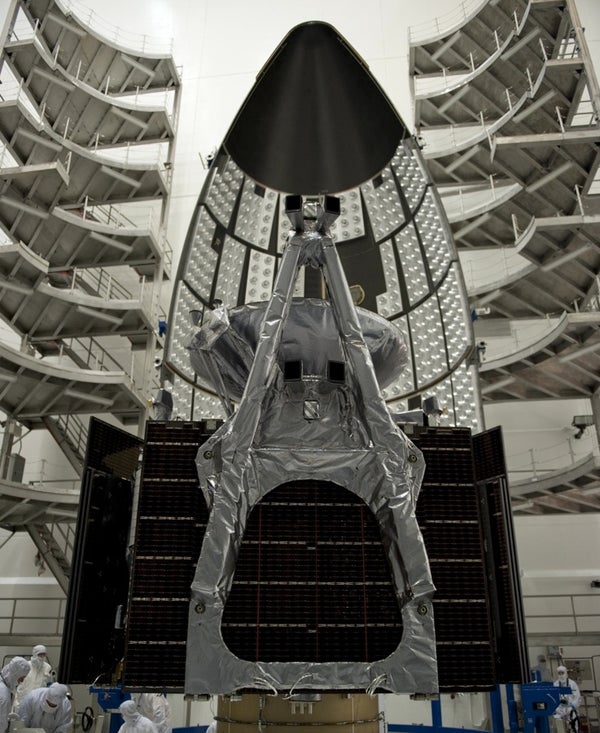
In this image, Juno sits in a clean room in front of the open casing of the payload fairing, the part of the rocket that carried the probe out of Earth's atmosphere. The Atlas 5 took off this afternoon from Cape Canaveral, Fla., and gradually jettisoned parts until only Juno, housed in this casing, and Atlas's upper stage, called the Centaur, remained. The Centaur pushed Juno a little further, and aimed the spacecraft in the right direction. Finally, about an hour after launch, Juno separated from the Centaur to begin its complex five-year journey toward its mythological spouse.
Juno is set to unite with Jupiter on July 4, 2016, when the spacecraft will enter orbit around the largest planet in our solar system. As the spacecraft circles Jupiter 33 times over the course of one year, passing over the planet's poles, Juno will gather information about its atmosphere, magnetic field and structure.
Of all the planets in the solar system, astronomers think that Jupiter formed first, and its strong, clingy gravitational field means that any scraps of primordial material it snatched up then may still be present today—and in 2016, when Juno arrives at the gas giant. By measuring Jupiter's chemical content, Juno could aid in scientists' understanding of what this solar system looked like when it first formed.
—Sophie Bushwick