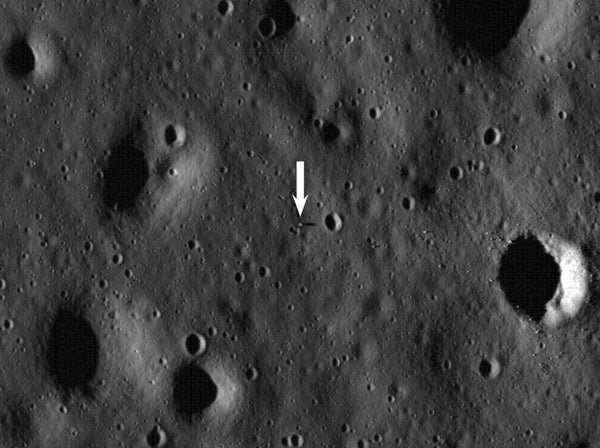
NASA's Lunar Reconnaissance Orbiter (LRO) , which reached orbit around the moon last month , passed over the Sea of Tranquility on Sunday and spied the Apollo 11 lunar module descent stage, still resting on the surface.
NASA/Goddard Space Flight Center/Arizona State University
Join Our Community of Science Lovers!
On supporting science journalism
If you're enjoying this article, consider supporting our award-winning journalism by subscribing. By purchasing a subscription you are helping to ensure the future of impactful stories about the discoveries and ideas shaping our world today.
NASA's Lunar Reconnaissance Orbiter (LRO), which reached orbit around the moon last month, passed over the Sea of Tranquility on Sunday and spied the Apollo 11 lunar module descent stage, still resting on the surface.
The lander set down on the moon by Buzz Aldrin and Neil Armstrong in 1969 is at the center of this image, a small white dot [arrow] with a long shadow stretching to the right. Each pixel in the photograph, which comes from the LRO's Narrow Angle Camera, is 1.14 meters across, so the Apollo 11 craft is just a few pixels wide.
If you enjoyed this article, I’d like to ask for your support. Scientific American has served as an advocate for science and industry for 180 years, and right now may be the most critical moment in that two-century history.
SciAm always educates and delights me, and inspires a sense of awe for our vast, beautiful universe. I hope it does that for you, too.
If you subscribe to Scientific American, you help ensure that our coverage is centered on meaningful research and discovery; that we have the resources to report on the decisions that threaten labs across the U.S.; and that we support both budding and working scientists at a time when the value of science itself too often goes unrecognized.