
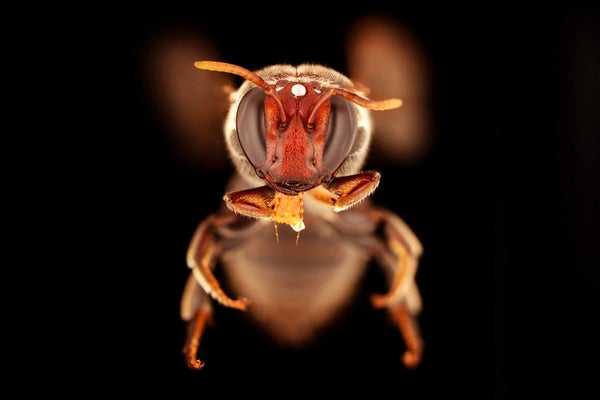
Locking eyes with a bee is an opportunity offered only by photography. And while this close-up is strangely humanizing (who knew tilted antennae could look like a raised eyebrow?), it has a purpose, too. Scientists can determine whether a bee sees well in the dark by examining the insect’s portrait.
Last year a team of Adelaide, Australia–based researchers identified the first known Australian bees that collect nectar and pollen at twilight. The scientists witnessed the species pictured here and three others foragingafter sunset. When this species and two of the same genus were seen, the light was so low, “the host plant could only be perceived as a silhouette,” they wrote in a paper about their finding.
When the team captured the bees and brought them back to the lab, it found that photography could identify eye characteristics that were crucial for night vision. For example, the researchers examined the insects’ eye-to-head size ratios and found they had more face space dedicated to sight, which seemed likely to make them see better in low-light conditions. Similar photo shoots with other Australian bees could identify more yet unknown nighttime gatherers—information that could be important for protecting ecosystems as they operate through the night.
On supporting science journalism
If you're enjoying this article, consider supporting our award-winning journalism by subscribing. By purchasing a subscription you are helping to ensure the future of impactful stories about the discoveries and ideas shaping our world today.