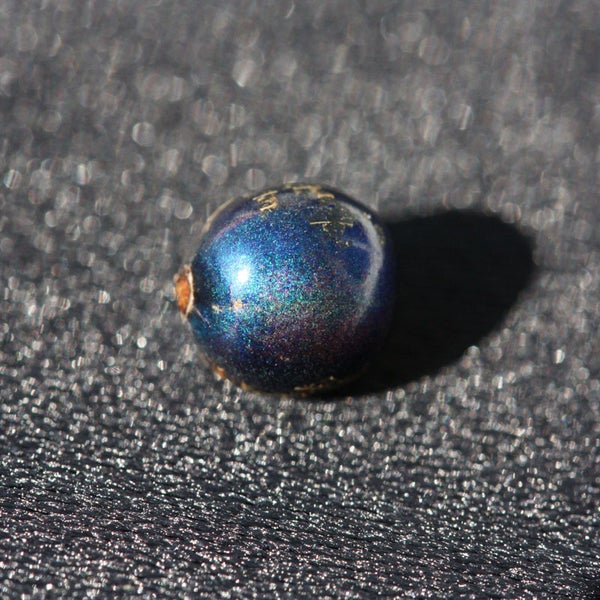
Although a vibrant blue, this African fruit contains no blue pigment, according to new research by Silvia Vignolini and her colleagues at the University of Cambridge.
"Pointillist structural color in Pollia condensata fruit," by Silvia Vignolini et al. in PNAS; September 10, 2012
Join Our Community of Science Lovers!
On supporting science journalism
If you're enjoying this article, consider supporting our award-winning journalism by subscribing. By purchasing a subscription you are helping to ensure the future of impactful stories about the discoveries and ideas shaping our world today.
Although a vibrant blue, this African fruit contains no blue pigment, according to new research by Silvia Vignolini and her colleagues at the University of Cambridge. The jewellike berry is from the plant Pollia condensata, which grows across Africa. Each plant produces up to 40 shiny bits of fruit. The blue and its beautiful iridescent shine are caused by a Bragg reflection—intense peaks of light generated at certain wavelengths and angles—created by spirally stacked cellulose fibers that form multiple layers in the fruit's skin. "The reflected color differs from [skin] cell to cell, as the layer thicknesses in the multilayer stack vary, giving the fruit a striking pixelated or pointillist appearance," Vignolini wrote in a paper published in the September 10 Proceedings of the National Academy of Sciences. The researchers note that the berry's coloration is more intense than any biological material studied to date.
—Ann Chin
Subscribe to Support Independent Journalism
Great science journalism requires human expertise, time, effort and creativity. And it costs money. That’s why I and the journalists here at Scientific American hope you’ll join our community.
When you subscribe, you are supporting staff and freelance journalists who are passionate about telling science stories that are true, important and compelling. Our editors and reporters are often experts in their fields, which means they understand the nuances of big discoveries and can untangle the breakthroughs from the hype. With a subscription, you are also supporting rigorous fact-checking to ensure the words we publish are precise and accurate. And you’re supporting original illustrations, graphics and photos that bring you closer to an advanced laboratory, an ice sheet in Antarctica or a space mission in orbit. You’re helping us craft other types of high-quality journalism as well: Our newsletters are carefully written, edited and curated by staffers you have or will come to know and love. Our Science Quickly podcast is based on original reporting, collaboration with editors and scientists and exacting production.
Subscriptions keep this engine running so we can continue to deliver thoughtful, rigorous and independent science journalism to you. In an era of viral misinformation, this work is crucial. If you value what we do, I hope you’ll consider joining us as a subscriber
Thank you,
Jeanna Bryner, Editor in Chief, Scientific American